For an OEM sourcing team, choosing a casting material is rarely as simple as comparing the price per kilogram.
A casting that looks cheaper at the quotation stage can become significantly more expensive once metal yield, machining time, tooling, heat treatment, inspection, rejection risk and logistics are added to the equation.
This becomes even more important when metal and energy costs are moving quickly. The source material notes that grey cast iron pricing increased by approximately 8.1% quarter-on-quarter in Q2 2026, illustrating how quickly initial cost assumptions can change.
For OEM programs, the more useful question is therefore not:
“Which casting material has the lowest ₹/kg or $/kg?”
It is:
“Which material and casting process gives us the lowest total cost while meeting the component’s mechanical and functional requirements?”
Grey iron, ductile iron and cast steel each answer that question differently.
Grey Iron, Ductile Iron and Cast Steel: Understanding the Difference
Grey Cast Iron
Grey cast iron, including grades such as EN-GJL-250 and EN-GJL-300 under EN 1561, contains graphite in flake form.
Its major advantages are vibration damping, dimensional stability and good machinability.
That combination makes grey iron particularly suitable for components such as:
- Machine bases
- Housings
- Engine and equipment brackets
- Pump components
- Gearbox structures
- Other rigid components where vibration control matters
Compared with ductile iron and cast steel, grey iron generally represents the lower-cost material route when its strength characteristics are sufficient for the application.
But its real economic advantage often comes after casting.
Better machinability can reduce machining cycle time, cutting-tool consumption and overall conversion cost.
Ductile Iron
Ductile iron, also known as nodular or spheroidal graphite iron, uses graphite in nodular form rather than flakes.
Common grades include:
EN-GJS-400-18
EN-GJS-500-7
EN-GJS-600-3
Compared with grey iron, ductile iron provides substantially higher tensile strength and elongation.
This makes it useful for components exposed to:
- Impact
- Cyclic loading
- Structural loads
- Higher mechanical stress
- Applications where thinner sections can reduce component weight
The ability to reduce wall thickness or consolidate fabricated parts can sometimes compensate for ductile iron’s higher material and processing cost.
This is where procurement teams need to look beyond raw-material pricing.
A lighter ductile iron casting that replaces a heavier grey iron component or a multi-part fabricated assembly may produce a better overall commercial result.
Carbon and Alloy Cast Steel
Cast steel is generally selected when the application requires higher toughness, weldability, temperature capability or demanding mechanical performance.
Typical standards include ASTM A27, ASTM A216 and IS 1030, depending on the application and specification.
Cast steel provides broader opportunities for heat treatment and is commonly considered for components exposed to severe shock loads, elevated temperatures or safety-critical operating conditions.
However, steel castings generally involve:
- Higher melting energy
- More demanding feeding and risering
- Lower casting yield in many geometries
- Greater machining effort
- Additional heat-treatment requirements in certain applications
These factors can push the final component cost significantly above the apparent raw-metal difference.
Material Properties That Directly Affect Casting Cost
Material selection influences far more than mechanical strength.
The supplied comparison highlights the following typical tendencies:
| Property | Grey Iron | Ductile Iron | Cast Steel |
|---|---|---|---|
| Typical tensile strength | 250–300 MPa | 400–600+ MPa | 450–485+ MPa |
| Elongation | Very low | Grade-dependent, considerably higher | High |
| Vibration damping | Excellent | Moderate | Lower baseline |
| Machinability | Excellent | Moderate | More demanding |
| Impact resistance | Low | Moderate to high | High |
| Relative casting cost tendency | Lower | Medium | Higher |
The important point is that there is no universally “best” material.
The correct material depends on what the casting must do.
For example, choosing cast steel simply because it offers higher mechanical strength may create unnecessary cost when a ductile iron grade already satisfies the engineering requirement.
Likewise, selecting ductile iron for a component primarily requiring stiffness and vibration damping may provide little commercial advantage over grey iron.
Material selection must therefore be connected directly to component performance.
Seven Cost Drivers OEM Buyers Should Evaluate
A professional casting quotation should go deeper than net casting weight multiplied by a metal rate.
1. Raw Material and Alloy Cost
Material cost is the most visible component of a casting quotation, but it is only the starting point.
Grey iron, ductile iron and cast steel have different:
- Charge-material requirements
- Alloy additions
- Treatment requirements
- Melting characteristics
- Chemistry-control requirements
Ductile iron, for example, involves additional treatment and tighter metallurgy control compared with conventional grey iron.
The sourcing team should therefore evaluate material cost together with the process required to achieve the specified grade.
2. Melt Loss and Metal Recovery
Not every kilogram of metal charged into the furnace becomes saleable casting weight.
Oxidation, slag, treatment losses and process returns influence overall metal efficiency.
The source provides a simple example:
A 2% melt loss on a 20 kg component represents approximately 0.4 kg of additional metal requirement per casting.
At low volume this may appear minor.
Across tens of thousands of components, it becomes commercially significant.
3. Tooling and Program Volume
Patterns, core boxes, fixtures and gauges represent upfront investment.
But tooling economics change dramatically according to production volume.
A high-volume automotive program may justify higher tooling investment because the cost is amortized across a large number of components.
A lower-volume industrial casting may require a different approach.
OEMs should therefore avoid evaluating tooling price independently.
Instead, calculate:
Tooling cost ÷ expected program quantity
and consider the resulting effective tooling cost per component.
4. Moulding Cycle and Labour
The moulding process directly influences:
- Production speed
- Labour content
- Repeatability
- Dimensional consistency
- Moulding cost per casting
Automated green-sand moulding generally becomes commercially attractive for suitable medium- and high-volume programs.
For larger or highly complex castings, no-bake moulding may provide greater flexibility even if the moulding cost per piece is higher.
5. Casting Yield
Casting yield is one of the most overlooked cost drivers.
The customer may purchase a 20 kg finished casting, but considerably more than 20 kg may need to be poured because of:
- Runners
- Gates
- Risers
- Feeders
- Process allowances
The source explains that if poured weight is 1.6 times net casting weight, the effective metal requirement increases substantially before machining even begins.
Foundry engineering therefore plays a direct role in cost reduction.
Improved gating and feeding design can reduce excess metal while maintaining soundness.
6. Machining Allowance
Casting cost should never be separated from machining cost when the component will undergo extensive machining.
Additional machining stock means:
- More metal must be melted.
- More metal must be poured.
- More material must be removed.
- Machining takes longer.
- Cutting tools experience additional wear.
Grey iron generally offers a major machinability advantage compared with cast steel, while improved moulding accuracy can further reduce machining allowance.
For heavily machined components, this can materially influence the total component cost.
7. Heat Treatment, Inspection and Finishing
Casting does not necessarily end at shakeout.
Depending on the specification, additional operations may include:
- Heat treatment
- Shot blasting
- Fettling
- Straightening
- Machining
- Surface coating
- Magnetic particle inspection
- Ultrasonic testing
- Dimensional inspection
Each operation adds both cost and lead time.
Critical steel applications are also more likely to require additional heat treatment and non-destructive testing.
Specifications should therefore be based on genuine functional requirements rather than unnecessarily conservative acceptance criteria.
Green Sand vs Shell Moulding vs No-Bake: Why Process Selection Matters
Changing the moulding process can sometimes create a larger cost difference than changing the material itself.
Green Sand Moulding
High-pressure green-sand moulding is designed for productivity and repeatability.
For suitable castings, automated systems such as DISA-type lines can provide:
- High production rates
- Consistent mould quality
- Lower moulding cost at volume
- Good repeatability
Typical applications include automotive components, brackets, housings and medium-sized industrial castings.
However, surface finish and dimensional requirements must still be considered because they can influence downstream machining allowance.
Shell Moulding
Shell moulding becomes attractive when the value of better dimensional control and surface finish outweighs the additional tooling and mould cost.
Its advantages can include:
- Better surface quality
- Improved dimensional consistency
- Reduced machining stock
- Lower machining time
- Reduced tool wear
For precision housings and pump or valve components, these downstream savings can materially affect overall program economics.
No-Bake Moulding
No-bake or resin-sand moulding is particularly useful for:
- Large castings
- Heavy castings
- Complex geometries
- Lower-volume industrial components
- Components requiring flexible pattern arrangements
It generally involves higher moulding-material and labour costs than automated green-sand production.
However, the flexibility to manufacture larger and more complex components can enable customers to replace fabricated assemblies with a single casting, potentially reducing welding, assembly and inspection requirements.
Material Selection by Application
The source provides the following broad selection guidance based on common ferrous casting families.
Automotive Brackets and Mounts
Where vibration and rigidity are important:
EN-GJL-250 / EN-GJL-300 grey iron
can provide an effective combination of damping, dimensional stability and machinability.
Pump and Valve Bodies
Depending on pressure, mechanical loading and temperature requirements:
EN-GJS-400-18
or
EN-GJS-500-7
may be considered.
Where steel is required by temperature, service condition or applicable specification, grades such as ASTM A216 WCB may become appropriate.
Off-Highway Structural Components
Where fatigue, strength and impact resistance are important:
EN-GJS-500-7
and
EN-GJS-600-3
can provide stronger mechanical properties than conventional grey iron.
Steel may be considered where extreme shock loading, welding requirements or application specifications demand it.
How Total Cost Can Change With Material and Process Selection
Consider three common engineering situations.
Example 1: NVH-Sensitive Automotive Bracket
Assume a component has adequate strength in more than one ferrous material, but noise and vibration are critical.
Grey iron’s natural damping characteristics may allow the designer to reduce secondary damping features while its machinability can reduce machining time.
In this situation, evaluating only tensile strength could point the design team toward a more expensive material than necessary.
The better decision comes from evaluating:
Structural requirement + vibration behaviour + machining cost + final component cost.
The source gives an illustrative comparison showing a 12% piece-cost reduction versus a steel baseline for an EN-GJL-300 solution.
Example 2: Ductile Iron vs Welded Fabrication
Large structural components are sometimes produced from multiple welded steel sections.
That creates additional:
- Welding labour
- Fixtures
- Distortion control
- Assembly operations
- Inspection requirements
A ductile iron casting can potentially consolidate several fabricated components into a single geometry.
The source presents an illustrative example where an EN-GJS-500-7 casting route produced an estimated 18% saving compared with a welded-steel configuration, alongside opportunities for geometry and weight optimisation.
Example 3: Reducing Machining Cost Through Better Moulding
Imagine a steel gearbox housing where the material itself cannot be changed because the duty cycle requires steel.
The next cost opportunity may therefore come from the moulding process.
If conventional sand casting requires excessive machining stock, moving to a process providing better surface and dimensional control can reduce the amount of material that must later be removed.
The supplied example reports a 22% reduction in machining cost after changing the moulding approach while maintaining the required steel material system.
The broader lesson is important:
Casting cost optimisation does not always require changing the material.
Sometimes the biggest opportunity is in the process.
What OEMs Should Ask a Foundry Before Sending the RFQ
A detailed RFQ helps the foundry engineer the right manufacturing route rather than simply quote a drawing.
Before requesting pricing, provide the foundry with:
Net casting weight
The component’s finished or expected casting weight.
Annual and lifetime volumes
This helps determine the most economical tooling and moulding strategy.
Material specification
Include required grade, applicable standard and any chemistry or mechanical-property requirements.
Machining requirements
Identify machined surfaces and target stock allowance wherever possible.
Critical dimensions
Clearly identify CTQ dimensions rather than applying excessively tight tolerances to every feature.
Inspection requirements
Define requirements for chemistry, dimensional inspection, ultrasonic testing or other NDT only where necessary.
Surface and finishing requirements
Specify blasting, coating, painting, machining or other secondary processing.
It is also useful to ask the foundry to discuss:
- Expected casting yield
- Approximate poured weight
- Recommended moulding process
- Tooling alternatives
- Opportunities for machining-stock reduction
- Inspection strategy
These inputs allow commercial discussions to move from “price per kilogram” toward “cost per functional component.”
Technocast Foundry: Multiple Ferrous Casting Routes Under One Roof
For OEMs sourcing multiple casting families, coordinating separate suppliers for different materials and processes can increase qualification work, communication and supply-chain complexity.
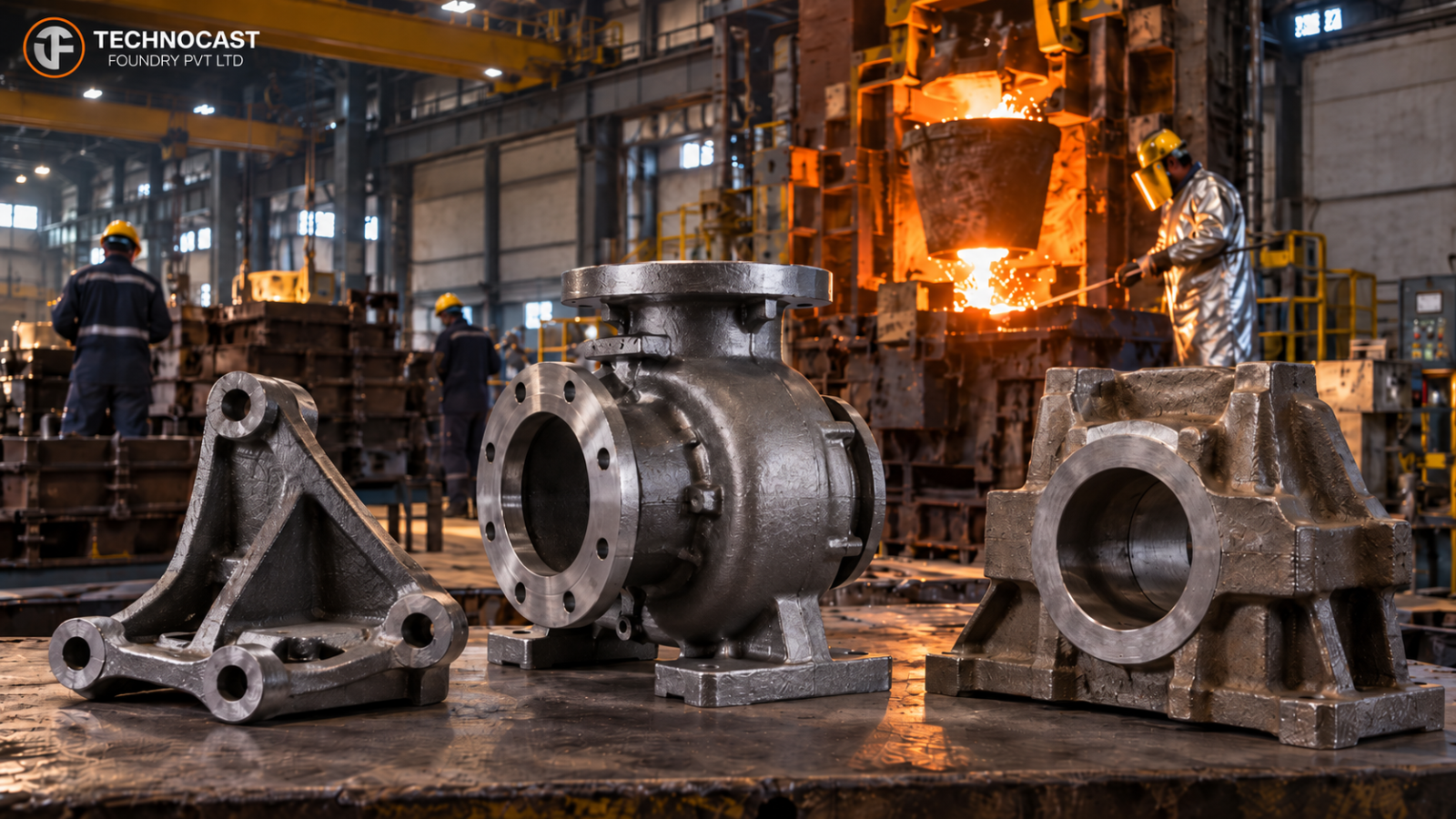
Technocast Foundry Pvt. Ltd. supports multiple ferrous casting families, including:
- Grey iron
- Ductile iron
- Carbon steel
- Alloy steel
Manufacturing capabilities described in the supplied company material include:
DISA HPML
ARPA 450/1300
Shell moulding
No-bake moulding
Quality infrastructure includes:
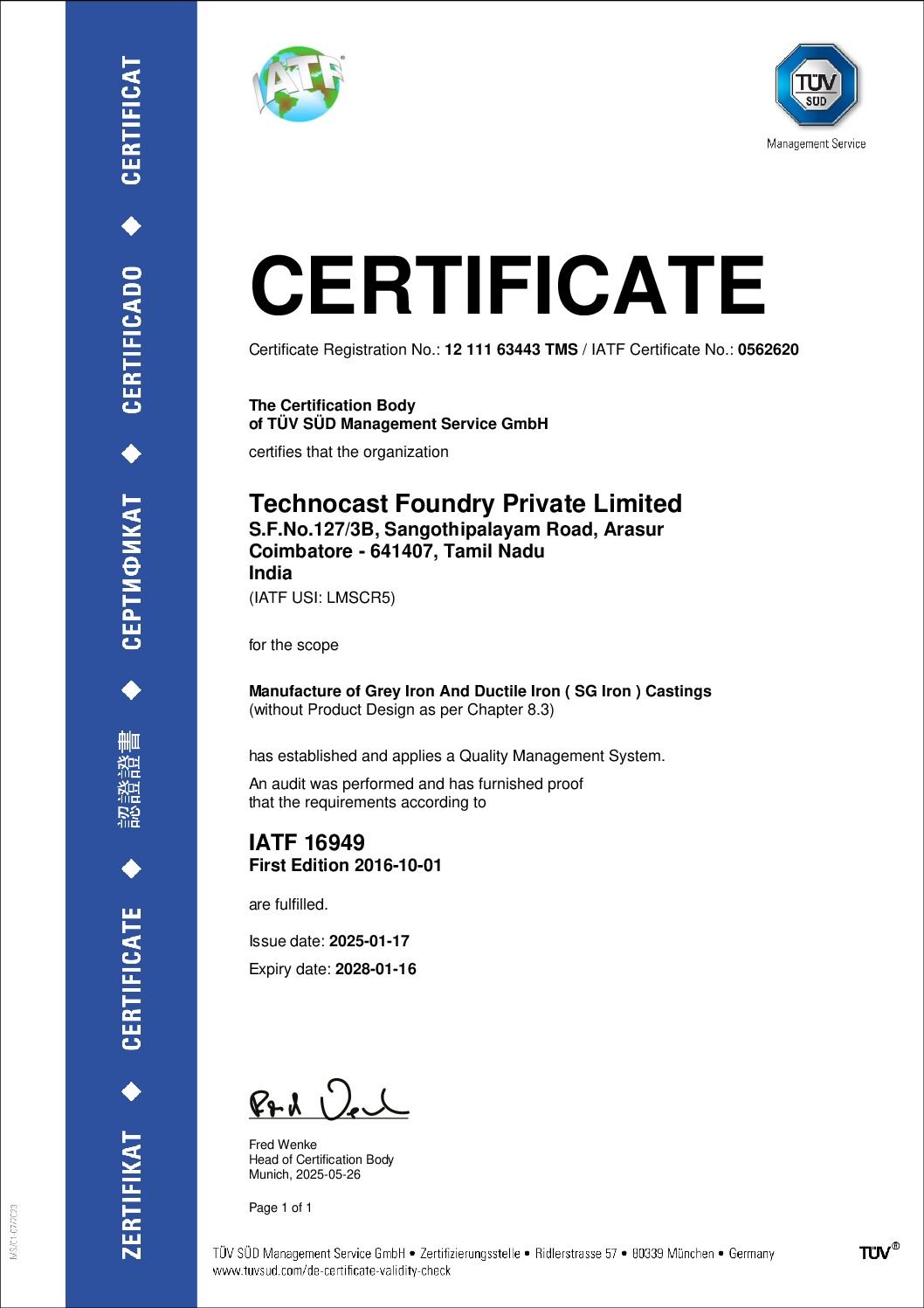
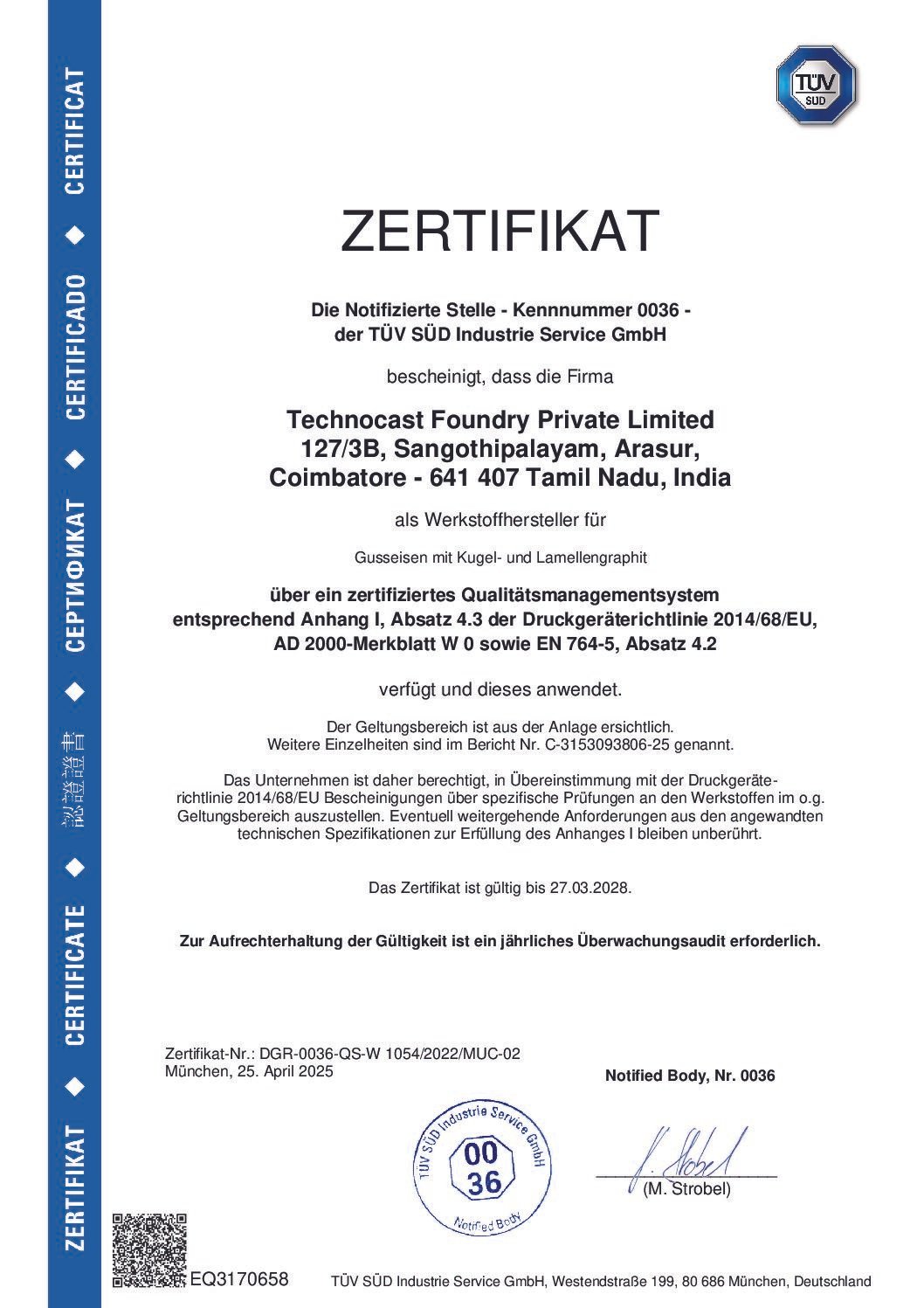
ISO 9001:2015 quality systems
In-house spectrometer
Coordinate Measuring Machines (CMM)
Ultrasonic testing capabilities
Technocast also has an established export track record.
This allows OEM customers to evaluate the casting based on the component requirement rather than forcing every component through a single material or manufacturing process.
The Cheapest Casting Is Not Always the Casting With the Lowest Metal Price
A sourcing decision based only on ₹/kg or $/kg can hide the largest cost drivers.
A more complete evaluation should consider:
Material + casting yield + moulding cost + tooling + machining + heat treatment + inspection + finishing + quality risk.
Grey iron can be highly economical where damping, rigidity and machinability are important.
Ductile iron can become more attractive where higher strength and elongation enable weight reduction or part consolidation.
Cast steel becomes important when toughness, elevated-temperature performance, weldability or applicable specifications demand it.
The objective should not be to select the cheapest metal.
It should be to engineer the lowest practical total cost for a casting that performs reliably throughout the OEM program.
For OEMs reviewing a new or existing casting program, involving the foundry early in material, moulding, gating, machining and inspection decisions can reveal cost-saving opportunities that are impossible to identify from the finished drawing alone.