Choosing a moulding route is the first real decision in a casting enquiry, and it sets the piece price, the tooling cost and the minimum sensible order quantity. At our plant in Arasur, Coimbatore we run five routes. This is how we decide which one a part goes on.
Start with two numbers: weight and annual quantity
Almost every routing decision comes down to how heavy a single piece is and how many of them you need in a year. A 4 kg bracket at 30,000 pieces a year and a 900 kg housing at 200 pieces a year are different manufacturing problems, even if both are ductile iron.
High volume, lighter parts: the DISA high pressure line
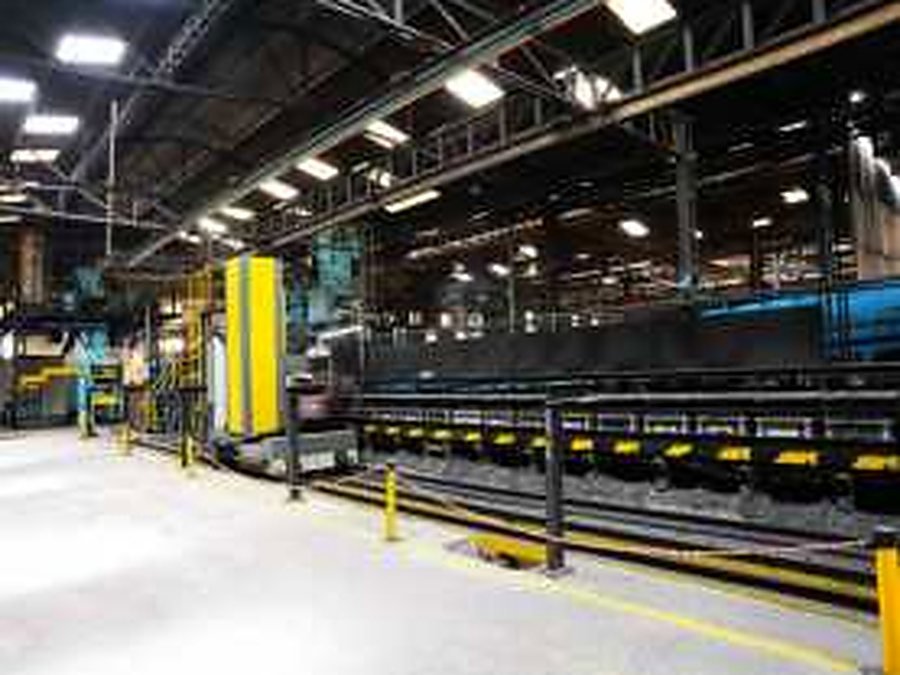
Our DISA MATCH 130 high pressure line runs 100 to 120 moulds an hour with a box of 510 x 610 x 400 mm and parts up to 50 kg. Tooling costs more, but the mould is identical every time, so the piece price falls away at volume. This is where most automotive castings end up.
Mid weights and mid volumes: ARPA 450 and ARPA 1300
ARPA 450 and ARPA 1300 cover the middle ground. ARPA 450 takes parts to 100 kg in a 650 x 700 x 400 mm box; ARPA 1300 goes to 550 kg in 1,200 x 1,000 x 700 mm. If your annual quantity does not justify high pressure tooling but the part is still repeat business, this is usually the answer.
Heavy or low volume: the Alpha-set No Bake line
The No Bake line handles the big work: 1,600 x 1,200 x 700 mm on the fast loop, 2,000 x 2,000 x 700 mm on the floor, and single pieces to 1,500 kg. The mould stays rigid while a thick section cools, which is why wind energy castings and heavy off-highway parts run here.
Where shell moulding fits
Shell moulding is used where surface finish and dimensional consistency matter on smaller parts, and shell cores make up about a fifth of our core output.
What to send us
Four things let us answer the routing question in one pass: the drawing, the material grade, the single-piece weight and the annual quantity. Send those to our enquiry form or to marketing@tcf.net.in and you will get back the route we would use, a lead time and a price.