Wind Energy Castings
in Coimbatore, Tamil Nadu

Technocast Foundry casts gearbox and generator housings, bearing supports, bedplates and torque arms for wind turbine builders. Ductile (SG) iron, grey iron and steel in single pieces up to 1,500 kg, moulded on a dedicated Alpha-set No Bake line at Arasur, Coimbatore, Tamil Nadu, India.

Wind Energy

Which Wind Turbine Parts
Do We Cast?

Large, thick-sectioned ductile iron castings, poured on a line built for exactly this.

Wind energy is about a tenth of what we pour, and it is the work our No Bake line was built for. Typical parts are gearbox and generator housings, bearing and shaft supports, machine frames and bedplates, torque arms, covers and end plates - mostly ductile (SG) iron, in single pieces up to 1,500 kg. A 450 kg wind energy casting is in current production.

Wind castings are large, thick-sectioned and expensive to get wrong. They are moulded on the Alpha-set No Bake line, where the mould stays rigid while a heavy section cools, fed by a 30 tonne per hour continuous mixer with two 100 tonne sand hoppers. The No Bake bay has its own melting: two 1.5 tonne dual-track induction furnaces, around 800 tonnes a month, so a large pour is not waiting behind the automotive line.

Tamil Nadu is one of India’s major wind energy states, and our plant is at Arasur, Coimbatore, inside that supply base. Nodularity is confirmed by ultrasonic velocity and microscope before the part is accepted, and machining runs to 1,750 mm cutting diameter on the vertical turn mill - so a hub or housing is cast, treated, machined and measured without leaving the site.

Why Wind Work Runs Here

What Does a Wind Casting
Actually Need?

Box size, dedicated melting, proven nodularity in thick sections, and machining reach. Four things, one site at Arasur.

A Line Sized for Big Parts

The Alpha-set No Bake line handles 1,600 x 1,200 x 700 mm on the fast loop and 2,000 x 2,000 x 700 mm on the floor, up to 1,500 kg in a single piece. Sand comes from a 30 tonne per hour continuous mixer with two 100 tonne hoppers.

1,600 x 1,200 x 700 mm 2,000 x 2,000 x 700 mm 30 t/hr mixer
Its Own Melting Capacity

The No Bake bay has two 1.5 tonne dual-track medium frequency induction furnaces of its own, around 800 tonnes a month. A large wind pour is not queued behind the high pressure line.

2 x 1.5 tonne 1,750 kW 800 t/month

Nodularity Confirmed, Not Assumed

Thick sections are where nodularity drifts. Every ductile heat is checked by ultrasonic velocity, then confirmed under a microscope with image analyser for graphite shape, size and count.

Nodularity check Microstructure Spectrometer

Machined and Measured Here

Vertical turn mill to 1,750 mm cutting diameter and 1,100 mm height, five vertical turret lathes to 1,000 mm swing, and a Brown and Sharpe CMM at 1,500 x 1,200 x 1,000 mm with a scanning probe.

VTM 1,750 mm CMM 1,500 mm Scanning probe

Specifications

What Are the Specs for
Wind Energy Castings?

Send a drawing and we will confirm against your part. The figures below are the working envelope at Arasur, Coimbatore.

Item What We Offer
MaterialsDuctile (SG) iron EN-GJS-400-18 to EN-GJS-900-2, grey cast iron EN-GJL-250 to EN-GJL-300, and cast steel to IS 1030 and ASTM A27 / A148 / A216
Typical part weightUp to 1,500 kg in a single piece. A 450 kg wind energy part is in current production
Moulding routesAlpha-set No Bake fast loop line at 1,600 x 1,200 x 700 mm and floor moulding at 2,000 x 2,000 x 700 mm. ARPA 1300 for smaller sections
Sand plant30 tonne per hour continuous mixer with two 100 tonne storage hoppers, dedicated to the No Bake line
Melting for large workTwo 1.5 tonne dual-track medium frequency induction furnaces, around 800 tonnes a month
Heat treatmentStress relieving, normalising, annealing, hardening and tempering, and induction hardening
MachiningVertical turn mill to 1,750 mm cutting diameter and 1,100 mm height, five VTL to 1,000 mm swing, plus VMC, HMC and turning centres
Non-destructive testingUltrasonic and magnetic particle inspection in house. Radiographic inspection through an accredited partner when specified
MeasurementBrown and Sharpe CMM at 1,500 x 1,200 x 1,000 mm with scanning probe, plus contour testing and ring gauge masters
Supply conditionRaw casting, machined, painted, or fabricated and assembled

Applications

Which Turbine Parts
Do These Castings Become?

Six part families we run for wind turbine and drivetrain builders.

Gearbox and Generator Housings

Large cored ductile iron housings where bore alignment has to survive heat treatment and machining. No Bake moulded, then bored on the vertical turn mill.

Bearing and Shaft Supports

Thick-sectioned supports carrying rotor and shaft loads. Nodularity is confirmed through the section, not just at the surface.

Machine Frames and Bedplates

Heavy grey and ductile iron frames up to 1,500 kg, floor moulded, stress relieved and machined flat so the drivetrain stays in line.

Torque Arms and Brackets

Ductile iron arms and brackets that carry reaction loads, ultrasonically checked before machining.

Covers and End Plates

Flat and shallow-cored parts, cast on the No Bake or ARPA lines depending on quantity, then faced and drilled.

Fabricated Sub-Assemblies

Castings welded with TIG, MIG or arc into larger assemblies, painted and supplied ready to install.

Quality Gates

How Are Wind Energy
Castings Checked?

Six checks between the furnace and the packing bay. On a thick-sectioned casting, the nodularity gate is the one that decides everything downstream.

Melt Chemistry

Every heat is read on an ARL spectrometer before pouring, and the result is recorded against the batch.

Nodularity Check

Checked by ultrasonic velocity, then confirmed under a microscope with image analyser. Thick sections are where nodularity drifts, so this gate matters most on wind parts.

Mechanical Testing

Tensile strength, elongation and hardness on samples poured from the same heat as your casting.

Dimensional Proving

Measured on the 1,500 x 1,200 x 1,000 mm Brown and Sharpe coordinate measuring machine with a scanning probe.

Soundness

Ultrasonic and magnetic particle inspection in house. Radiographic inspection through an accredited partner when the drawing calls for it.

Final Inspection and Packing

Paint, packing and the documentation pack, including heat traceability, for your incoming inspection.

Common Questions

Wind Energy Casting
Questions, Answered

Where is your wind energy casting foundry located?

At 127/3B, Sangothipalayam Road, Arasur, Coimbatore, Tamil Nadu 641407, India. Tamil Nadu is one of India’s major wind energy states, and the plant sits inside that supply base, with foundry, machine shop and inspection on one 523,200 sq ft site.

What wind turbine castings do you make?

Gearbox and generator housings, bearing and shaft supports, machine frames and bedplates, torque arms and brackets, covers and end plates, and fabricated sub-assemblies.

How large a wind casting can you pour?

Up to 1,500 kg in a single piece. Floor moulding runs to 2,000 x 2,000 x 700 mm and the No Bake fast loop line to 1,600 x 1,200 x 700 mm. A 450 kg wind energy part is in current production.

Which moulding process is used for wind castings?

The Alpha-set No Bake line. The mould stays rigid while a heavy section cools, which is what thick-walled wind castings need. ARPA 1300 is used for smaller sections.

Do you have dedicated melting for large castings?

Yes. The No Bake bay has its own melting: two 1.5 tonne dual-track medium frequency induction furnaces, around 800 tonnes a month, so a large pour does not queue behind the high pressure line.

How is nodularity proven in thick sections?

By ultrasonic velocity, then confirmed under a microscope with image analyser for graphite shape, size and count. Thick sections are where nodularity drifts, so it is checked before the part is accepted.

Can you machine large wind castings in house?

Yes. The vertical turn mill cuts to 1,750 mm diameter and 1,100 mm height, with five vertical turret lathes to 1,000 mm swing, and measurement on a 1,500 x 1,200 x 1,000 mm CMM with scanning probe.

Which materials do you use for wind energy castings?

Mostly ductile (SG) iron in EN-GJS-400-18 to EN-GJS-900-2, with grey cast iron in EN-GJL-250 to EN-GJL-300 and cast steel to IS 1030 and ASTM A27, A148 and A216 where the drawing calls for it.

Certifications

ISO 9001:2015
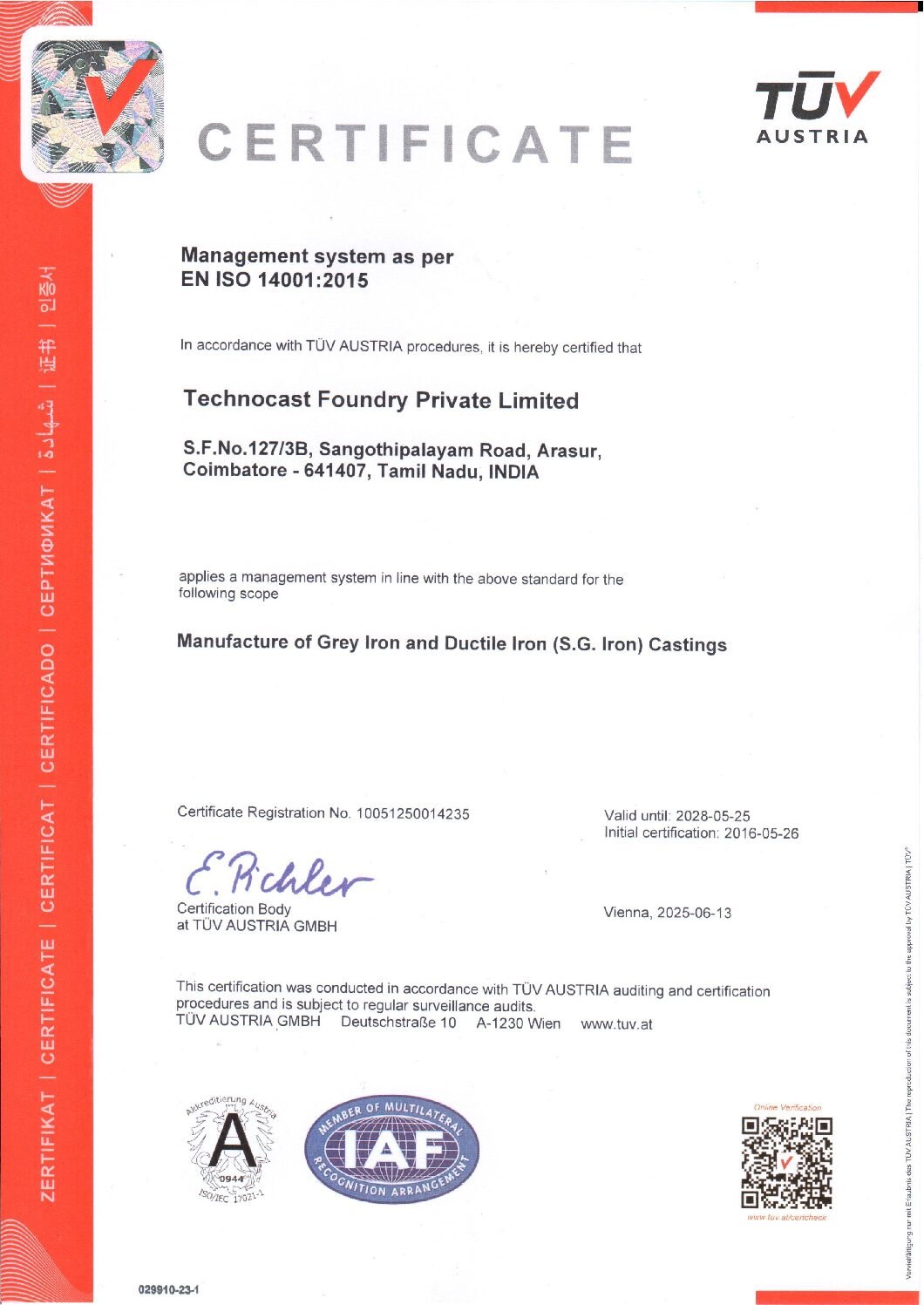
ISO 14001:2015
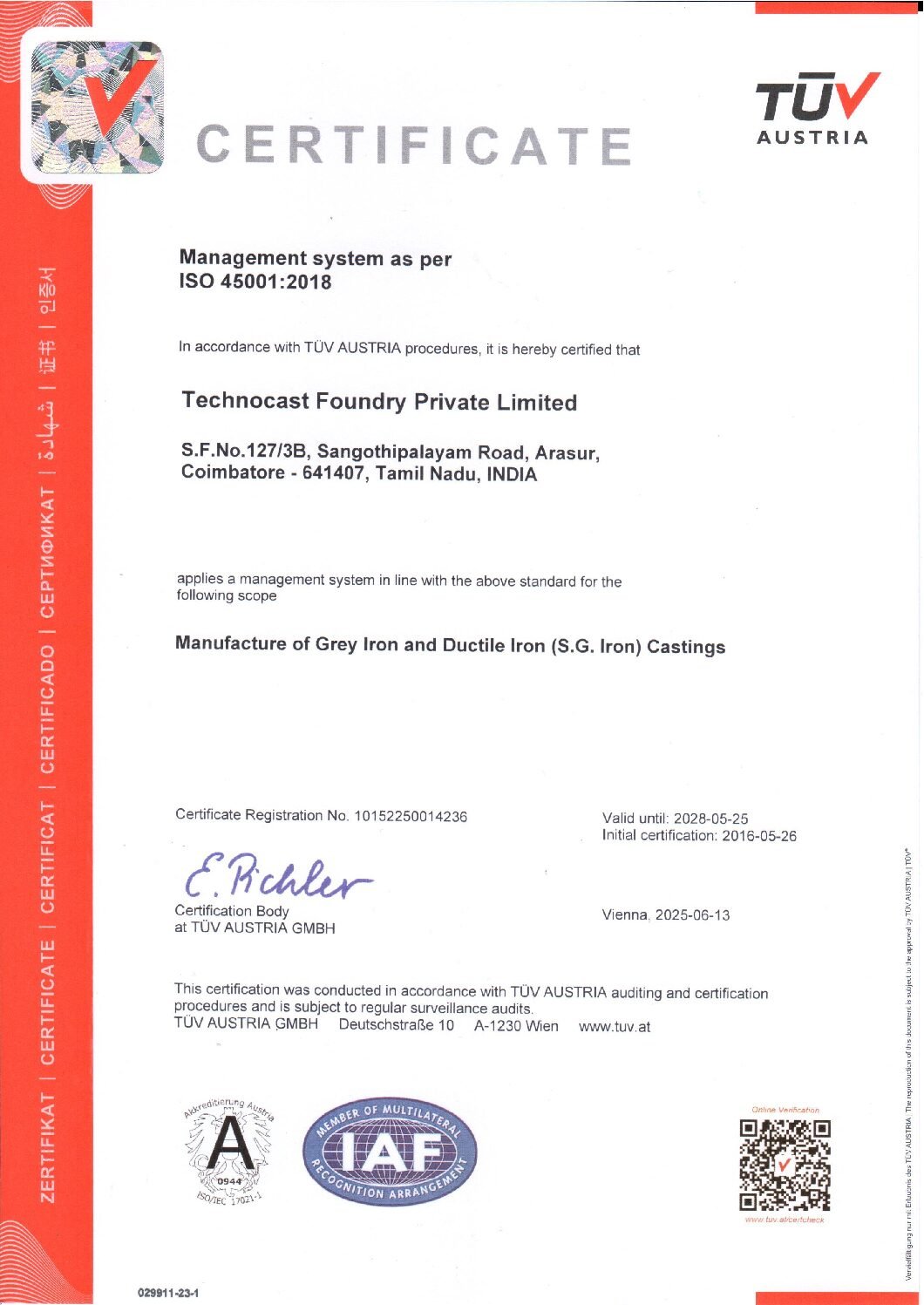
ISO 45001:2018
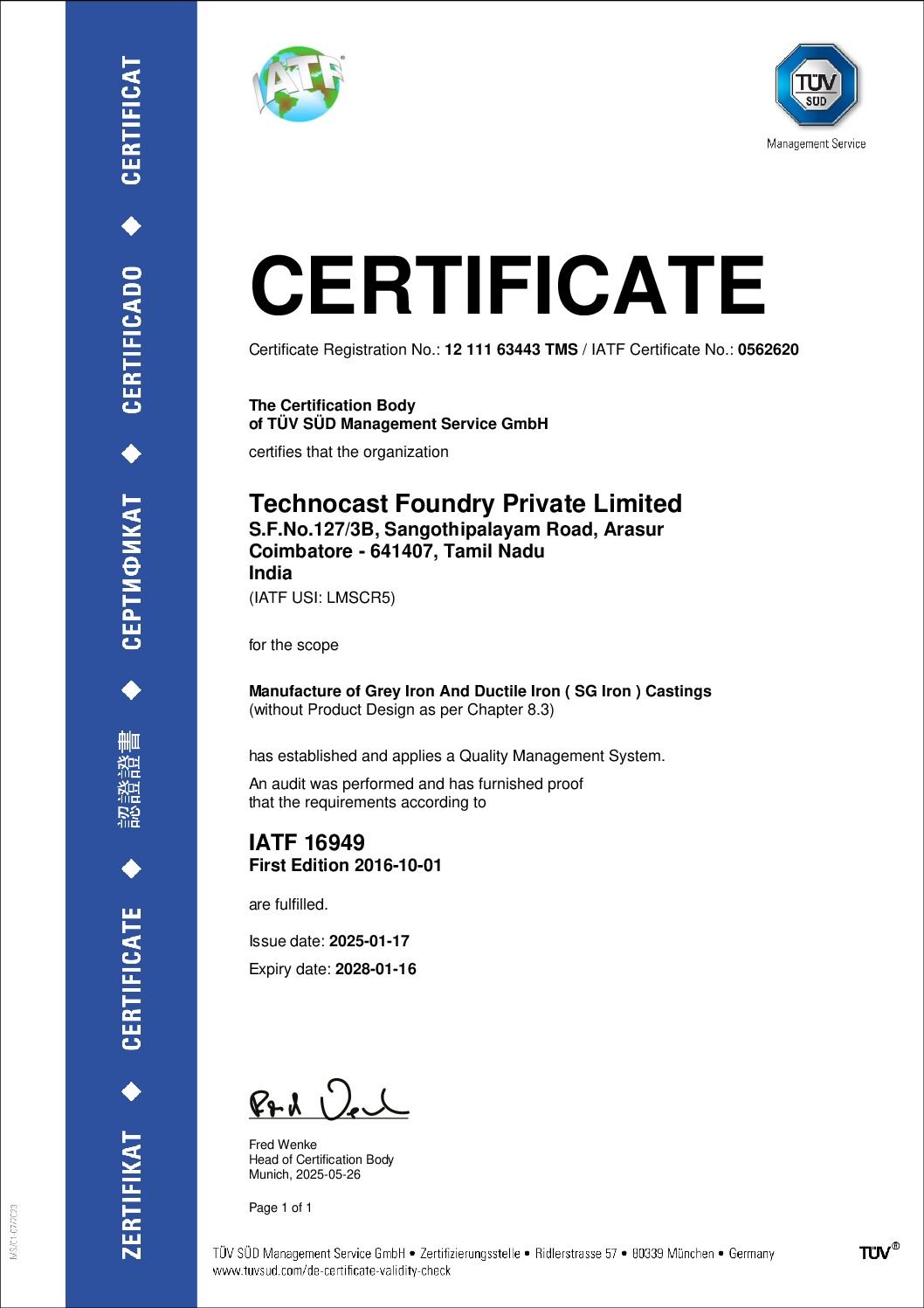
IATF 16949:2016
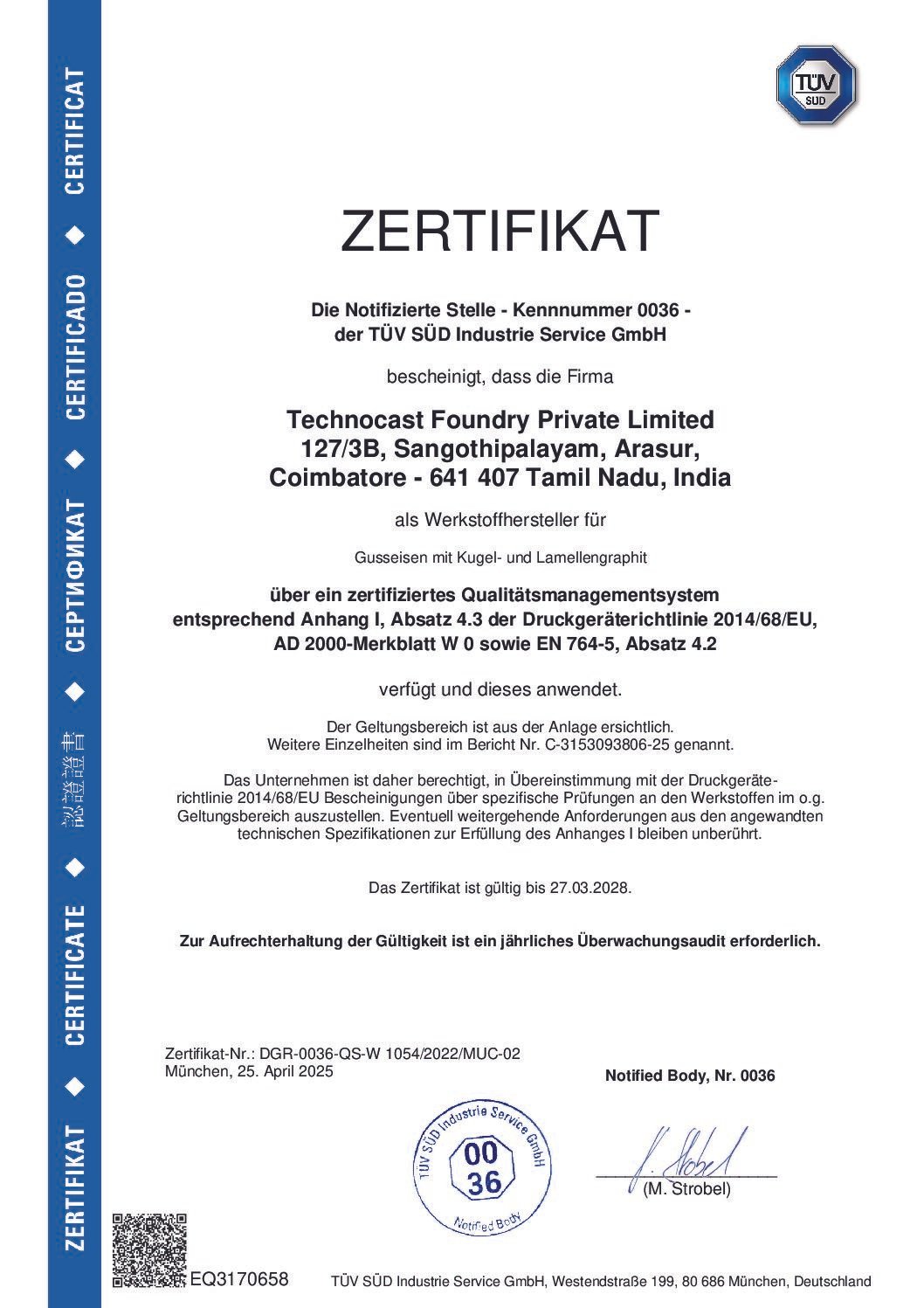
PED Certified

Send a Drawing

Sourcing Wind Castings
from Tamil Nadu?

Send the drawing with the material grade, the single-piece weight, the section thickness and the testing you need. You get back the moulding route, a lead time and a price.