Automotive Castings
in Ductile and Grey Iron

Technocast Foundry is an IATF 16949 certified supplier of automotive castings in ductile (SG) iron and grey cast iron, made at Arasur, Coimbatore, Tamil Nadu, India. Engine and gearbox mounts, suspension brackets, lever and pedal arms, clamps and small housings - cast, machined on site and CED coated before despatch.

Automotive

Which Automotive Parts
Do We Cast?

Medium-weight iron parts that hold a vehicle together, supplied raw or fully finished.

Automotive work is about one fifth of everything we pour. In practice that means engine and gearbox mounts, suspension and axle brackets, pedal and lever arms, clamps, caps, pulleys, covers and small housings - mostly ductile (SG) iron, with grey iron where damping matters more than strength.

Most automotive parts are small enough for the DISA high pressure moulding line, which runs 100 to 120 moulds an hour and gives the same mould every time. That keeps the piece price sensible at volume. Parts that need a bigger box move to ARPA 450 or ARPA 1300.

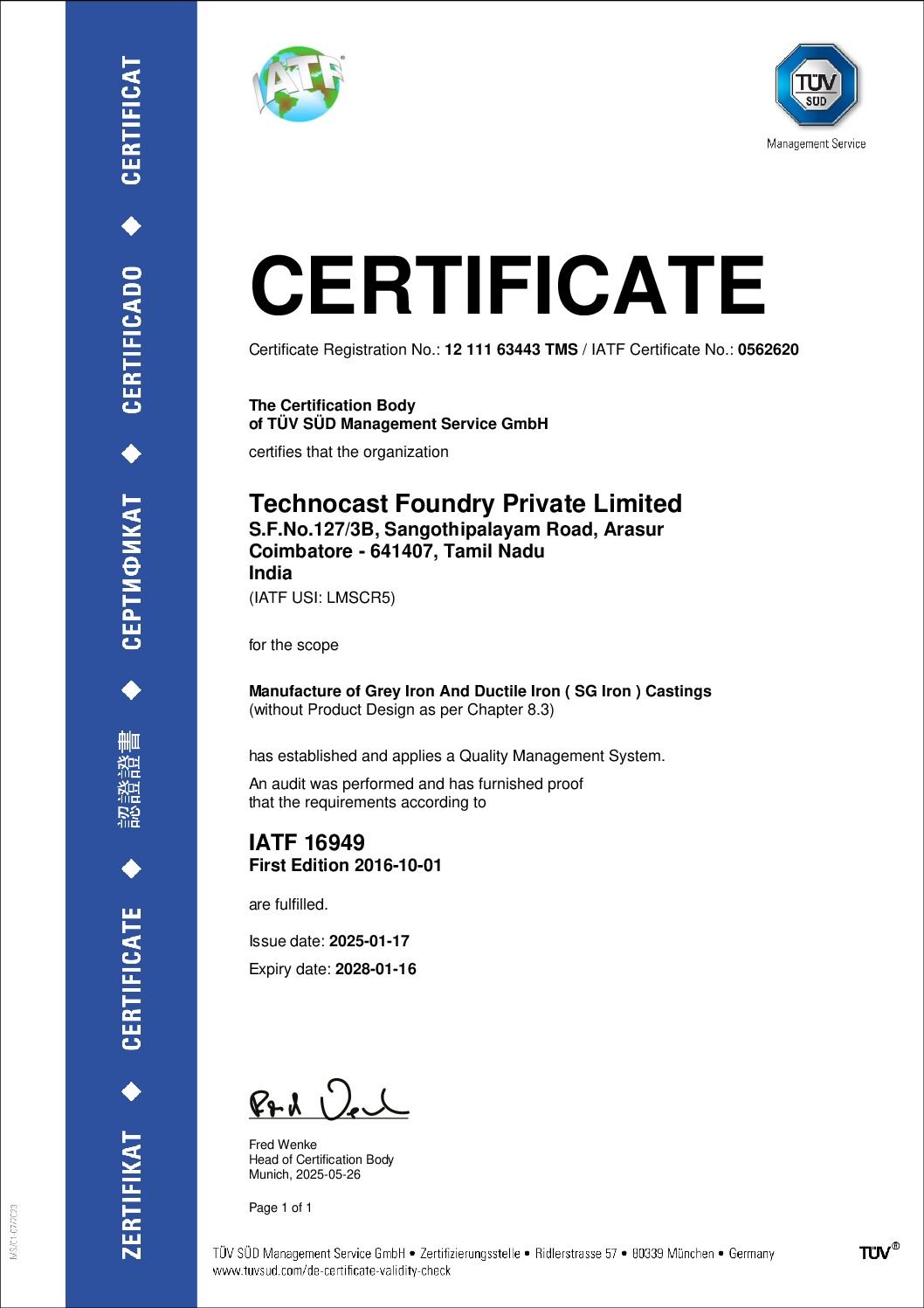
We hold IATF 16949:2016, so the documentation your quality team expects - control plans, traceable heat numbers, inspection records - comes with the order rather than after it. Automotive work covers OEM and Tier-1 programmes in India and overseas.

Why Buyers Place Automotive Work Here

What Makes This
Work for Automotive?

Four things decide whether a foundry can hold an automotive programme: mould repeatability, machining, finishing and paperwork. All four are handled here.

The Same Mould, Every Time

The DISA MATCH 130 line runs 100 to 120 moulds an hour with horizontal parting. A part cast in month one matches the part cast in month twelve, which is what keeps an assembly line running.

100-120 moulds/hr 510 x 610 x 400 mm box Up to 50 kg
Machined on the Same Site

Twenty vertical machining centres, four horizontals and thirteen turning centres sit a few metres from the foundry. Castings are machined to drawing before they are packed, so you buy a finished part, not a rough one.

20 VMC 4 HMC 13 turning centres

CED Coating Handled

Primer paint is applied in house. CED, powder, zinc, galvanised and manganese phosphate finishes are managed through approved partners, so one purchase order covers the whole part.

Primer in house CED Powder Zinc

IATF 16949 Discipline

Chemistry is read on an ARL spectrometer at every heat, nodularity is verified before pouring, and dimensions are proven on Brown and Sharpe coordinate measuring machines.

IATF 16949 Spectrometer CMM Traceable heats

Specifications

What Are the Specs for
Automotive Castings?

Send a drawing and we will confirm against your part. The figures below are the working envelope.

Item What We Offer
MaterialsDuctile (SG) iron in EN-GJS-400-18 to EN-GJS-900-2, and grey cast iron in EN-GJL-250 to EN-GJL-300
Typical part weight1 kg to 50 kg on the high pressure line. Heavier parts move to ARPA 450 (to 100 kg) and ARPA 1300 (to 550 kg)
Moulding routesDISA MATCH 130 high pressure, ARPA 450, ARPA 1300 and shell moulding
Core makingCold box, shell and CO2 cores. Shooters from 5 kg to 30 kg, plus a four-table CO2 facility
Heat treatmentStress relieving, normalising, annealing, hardening and tempering, and induction hardening
MachiningVMC, HMC, turning centres and VTL. Every VMC has a 4th axis and a through-coolant spindle
Surface finishPrimer paint in house. CED, powder, zinc, galvanised and manganese phosphate through partners
Supply conditionRaw casting, machined, coated, or fabricated and assembled

Applications

Which Vehicle Parts
Do These Castings Become?

Six part families we run regularly. If yours is not here, it does not mean we cannot make it - send the drawing.

Engine and Gearbox Mounts

Ductile iron mounts and brackets that carry the powertrain and damp vibration into the frame. Usually machined on the mating faces and CED coated.

Suspension Brackets

Spring hangers, shackle brackets and axle brackets, where strength and hole-to-hole repeatability decide whether the part fits on the line.

Lever and Pedal Arms

Clutch, brake and gear-shift arms. Small ductile iron parts, high volume, usually finished on the high pressure line.

Clamps and Caps

Bearing caps, clamp halves and retainers. Machined in pairs so the bore is round when the two halves are bolted together.

Pulleys and Covers

Grey iron pulleys, timing covers and end covers, where damping and easy machining matter more than tensile strength.

Small Housings

Gearbox and auxiliary housings up to around 50 kg, cast, machined and pressure tested where the drawing calls for it.

Quality Gates

How Are Automotive
Castings Checked?

Six checks between the furnace and the packing bay. A part that fails one does not move to the next.

Melt Chemistry

Every heat is analysed on an ARL spectrometer before pouring, and the reading is recorded against the batch.

Nodularity Check

Ductile iron is checked by ultrasonic velocity, then confirmed under a microscope with image analyser.

Mechanical Testing

Tensile strength, elongation and hardness are tested on samples poured from the same heat as your parts.

Dimensional Proving

First-off and in-process parts are measured on Brown and Sharpe coordinate measuring machines against the drawing.

Soundness

Ultrasonic and magnetic particle inspection in house. Radiographic inspection through an accredited partner when specified.

Final Inspection and Packing

Visual and gauge checks, then primer paint or coating, packing and the documentation pack for your incoming inspection.

Common Questions

Automotive Casting
Questions, Answered

Is Technocast Foundry an IATF 16949 certified automotive casting supplier?

Yes. Technocast holds IATF 16949:2016 alongside ISO 9001:2015, and supplies automotive OEMs and Tier-1 suppliers in India and overseas on that basis.

What automotive parts do you cast?

Engine and gearbox mounts, suspension and axle brackets, lever and pedal arms, bearing caps and clamps, pulleys and covers, and small housings up to around 50 kg.

Which materials are used for automotive castings?

Mostly ductile (SG) iron in EN-GJS-400-18 to EN-GJS-900-2, with grey cast iron in EN-GJL-250 to EN-GJL-300 where vibration damping matters more than tensile strength.

Can you supply automotive castings CED coated?

Yes. Primer painting is done in house, and CED, powder, zinc, galvanised and manganese phosphate finishes are arranged through approved coating partners, so one order covers the finished part.

Are automotive castings supplied machined?

Yes. The CNC shop is on the same site, with 20 vertical machining centres, 4 horizontals and 13 turning centres, so parts can ship machined to drawing and ready to fit.

What volumes can you handle?

The DISA high pressure line runs 100 to 120 moulds an hour for higher volumes. Lower and mid volumes run on ARPA 450 and ARPA 1300, so one part number can be quoted at a few hundred pieces or many thousands.

What is the heaviest automotive casting you can make?

Automotive parts usually sit between 1 kg and 50 kg on the high pressure line. ARPA 450 takes parts to 100 kg and ARPA 1300 to 550 kg if the part is larger.

Where are your automotive castings made?

At Technocast Foundry, 127/3B, Sangothipalayam Road, Arasur, Coimbatore, Tamil Nadu 641407, India. Around 75 per cent of total output is exported, mainly to the United States, Europe and the rest of Asia.

Certifications

ISO 9001:2015
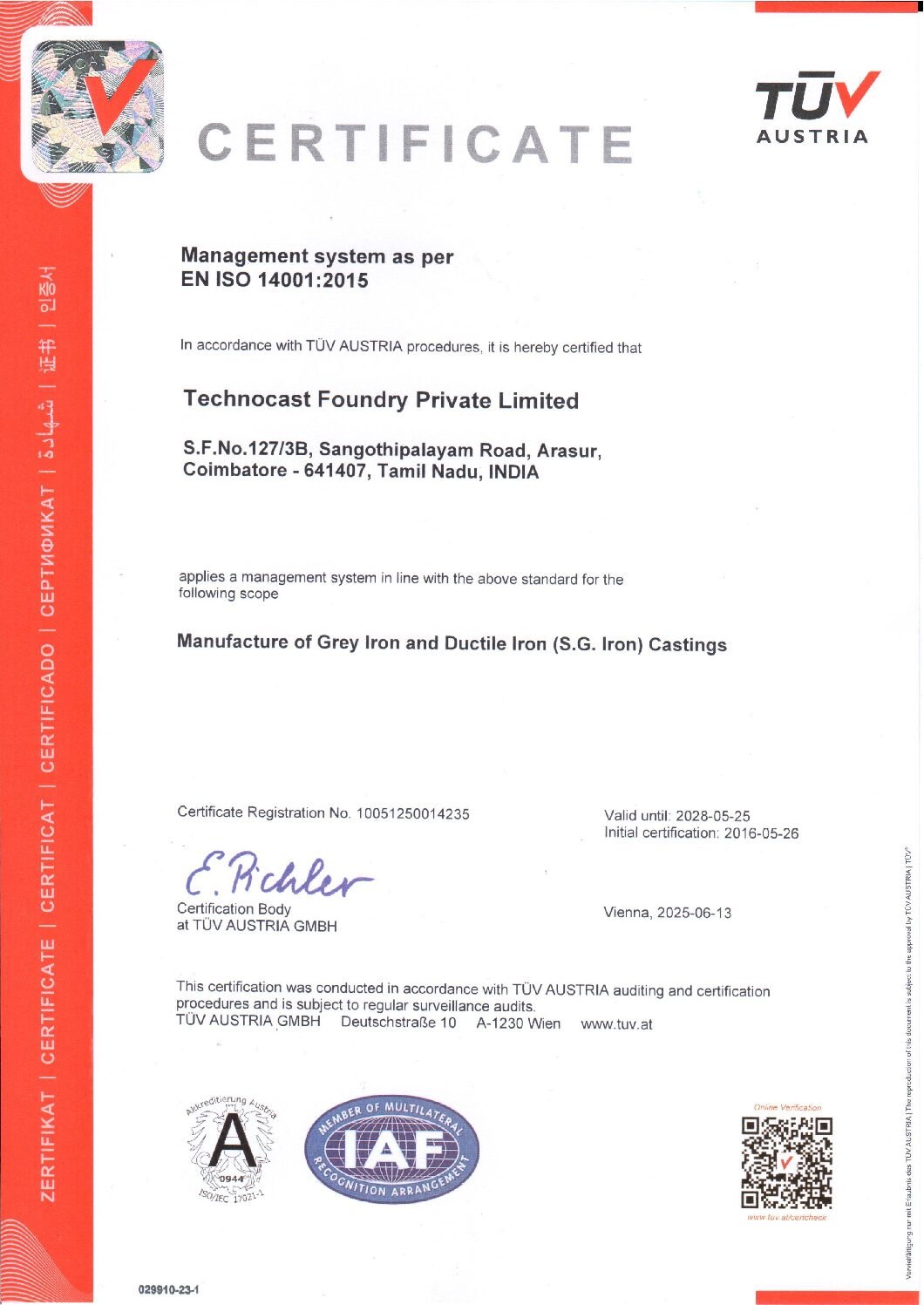
ISO 14001:2015
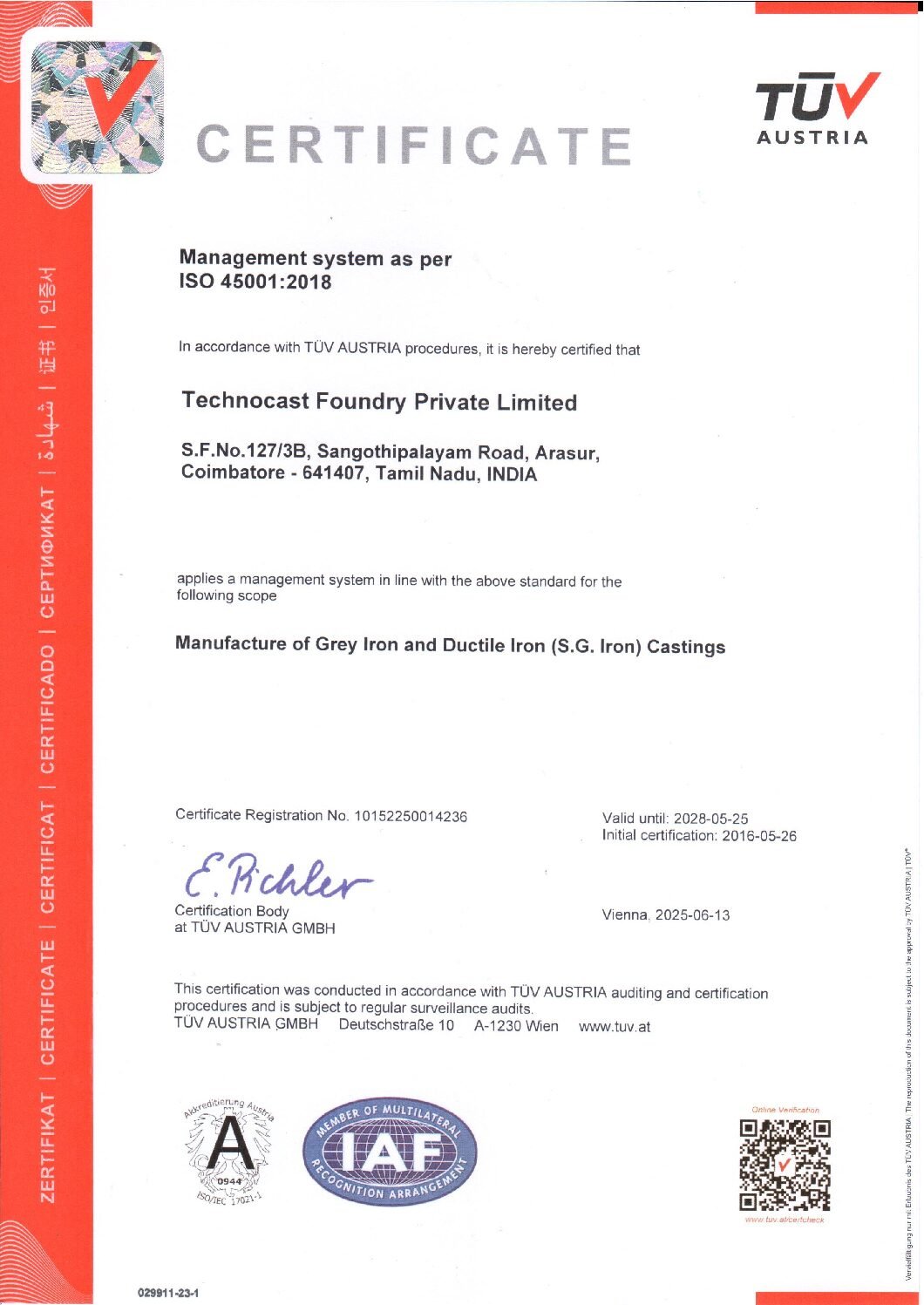
ISO 45001:2018
IATF 16949:2016
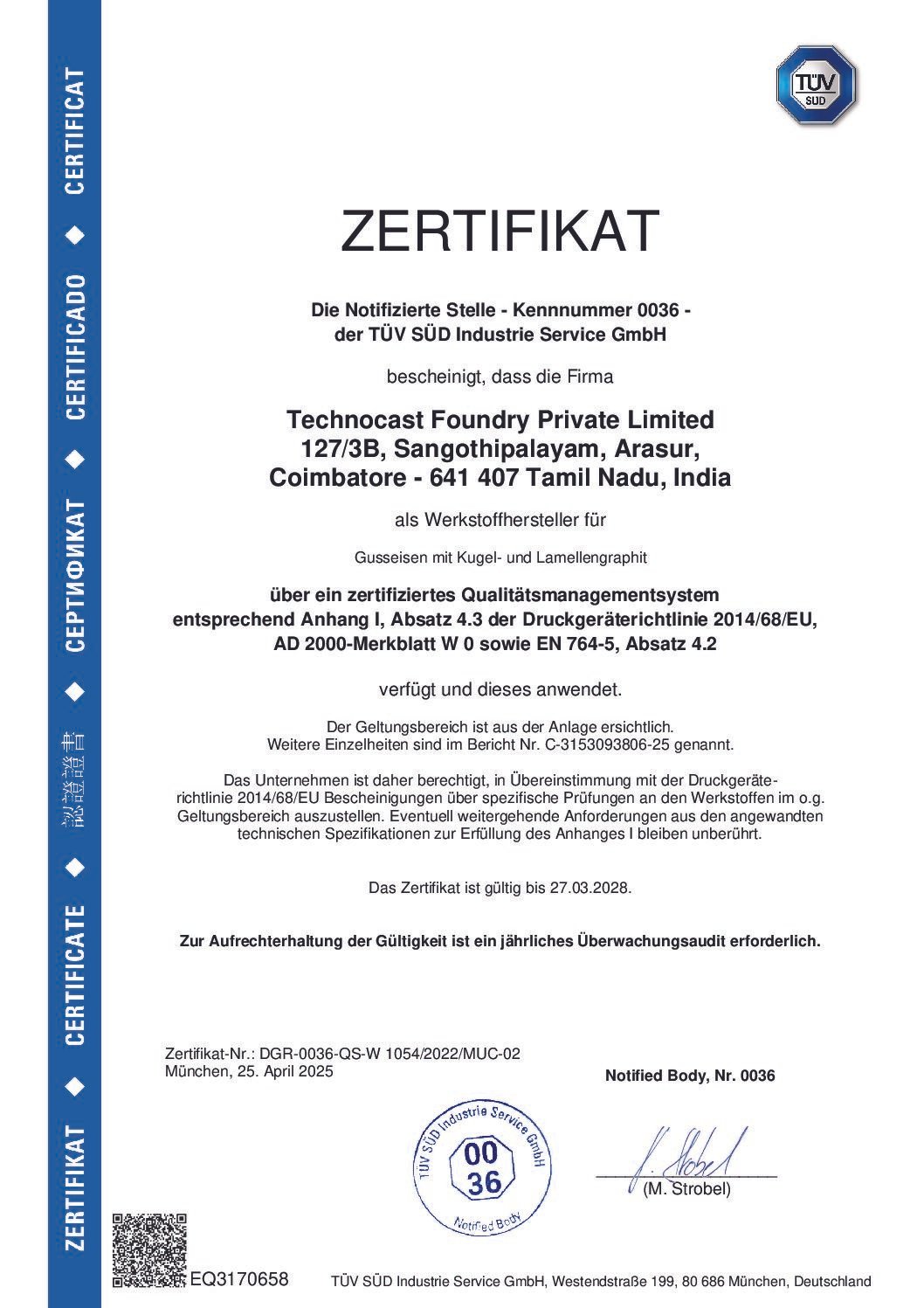
PED Certified

Send a Drawing

Need an Automotive Casting
Supplier in Coimbatore?

Send the drawing with the material grade, the single-piece weight, the annual volume and the finish you need. You get back the moulding route, a lead time and a price.