Machine Tool Castings
from Coimbatore, Tamil Nadu

Technocast Foundry casts machine beds and bases, columns, saddles, headstock housings, tables and faceplates in grey cast iron, ductile (SG) iron and steel, up to 1,500 kg in a single piece. Stress relieved, machined and measured on one site at Arasur, Coimbatore, Tamil Nadu, India.

Machine Tools

Which Machine Tool Parts
Do We Cast?

Grey iron structures that have to stay flat, straight and quiet for the life of the machine.

Machine tool work is about a tenth of what we pour, and Coimbatore is the right place for it - the district is one of India’s larger engineering and machine-building clusters, and our plant is at Arasur inside it. Typical parts are machine beds and bases, columns and uprights, saddles and slides, headstock and spindle housings, tables, faceplates and drive housings.

Machine tool structures are grey iron for one reason: grey iron damps vibration. Graphite flakes absorb the chatter that would otherwise show up in the surface finish of your customer’s part. We pour EN-GJL-250 to EN-GJL-300, and heavier structures run on the Alpha-set No Bake line and floor moulding at 2,000 x 2,000 x 700 mm, up to 1,500 kg in a single piece.

The thing that decides a machine tool casting is not the pour, it is what happens next. A bed that has not been stress relieved will move after it is machined, and the geometry goes with it. Stress relieving, normalising, annealing, hardening and tempering, and induction hardening are all done on site, then the part is machined on the vertical turn mill to 1,750 mm and proven on a Brown and Sharpe coordinate measuring machine. Approvals in this sector are held with precision equipment and machine building customers.

Why Machine Builders Come Here

What Does a Machine Tool
Casting Actually Need?

Consistent grey iron, a properly settled casting, machining reach and measured geometry. Get any of the four wrong and the machine never holds tolerance.

Grey Iron, Poured Consistently

EN-GJL-250 to EN-GJL-300, checked on an ARL spectrometer at every heat. Grey iron is about 30 per cent of our monthly output, so this is routine work here rather than an occasional job.

Grey iron ARL spectrometer Every heat
Stress Relieved Before It Ships

A bed that has not settled will move after machining and take the geometry with it. Stress relieving, normalising, annealing, hardening and tempering, and induction hardening are all done at Arasur.

Stress relieving Normalising Annealing

Machined on Real Machine Tools

Vertical turn mill to 1,750 mm cutting diameter and 1,100 mm height, five vertical turret lathes to 850 mm cutting and 1,000 mm swing, 20 VMC and 4 HMC including a five-axis. Beds and columns are finished here.

VTM 1,750 mm 5 VTL 20 VMC 4 HMC

Geometry Proven, Not Assumed

Flatness, squareness and bore positions are measured on a Brown and Sharpe CMM at 1,500 x 1,200 x 1,000 mm with a scanning probe, backed by contour testing and ring gauge masters.

Induction hardening Hardening Tempering 100 kg/hr

Specifications

What Are the Specs for
Machine Tool Castings?

Send a drawing and we will confirm against your part. The figures below are the working envelope at Arasur, Coimbatore.

Item What We Offer
MaterialsGrey cast iron EN-GJL-250 to EN-GJL-300 for structures, ductile (SG) iron EN-GJS-400-18 to EN-GJS-900-2 and cast steel to IS 1030 and ASTM A27 / A148 / A216 where strength is needed
Typical part weight1 kg to 1,500 kg in a single piece
Moulding routesAlpha-set No Bake fast loop line and floor moulding for large structures, ARPA 450 and ARPA 1300 for mid weights, DISA high pressure for smaller volume parts
Largest moulding boxFloor moulding at 2,000 x 2,000 x 700 mm
Heat treatmentStress relieving, normalising, annealing, hardening and tempering, and induction hardening
MachiningVertical turn mill to 1,750 mm cutting diameter and 1,100 mm height, five VTL to 850 mm cutting and 1,000 mm swing, 20 VMC with 4th axis, 4 HMC, 13 turning centres
Gear workGear shaping to 500 mm diameter and 90 mm height on a Fellows machine, plus dynamic balancing to 1 gram
MeasurementBrown and Sharpe CMM at 1,500 x 1,200 x 1,000 mm with scanning probe, contour testing and ring gauge masters
Supply conditionRaw casting, stress relieved, machined, or painted and assembled

Applications

Which Machine Structures
Do These Castings Become?

Six part families we run for machine tool and special-purpose machine builders.

Machine Beds and Bases

Large grey iron structures up to 1,500 kg, floor moulded with ribbed sections for stiffness, stress relieved, then machined flat and measured on the CMM.

Columns and Uprights

Tall cored structures where squareness to the bed decides the machine’s accuracy. Machined on the horizontal centres so faces stay true to each other.

Saddles and Slides

Moving members that carry the axis. Ways can be induction hardened where the drawing calls for it, so the slide surface lasts.

Headstock and Spindle Housings

Cored housings where bore alignment and roundness set spindle runout. Bored on the vertical turn mill and proven with ring gauge masters.

Tables and Faceplates

Round and rectangular grey iron tables, turned on the vertical turn mill to 1,750 mm diameter, then slotted and ground flat.

Gearboxes and Drive Housings

Cased parts in grey or ductile iron, gear cut on the Fellows shaper to 500 mm diameter and balanced to 1 gram where needed.

Quality Gates

How Are Machine Tool
Castings Checked?

Six checks between the furnace and the packing bay. On a machine structure, graphite structure and geometry are the two that matter most.

Melt Chemistry

Every heat is read on an ARL spectrometer before pouring. Grey iron chemistry controls the graphite structure, and the graphite structure is what damps vibration.

Graphite Structure

Checked under a microscope with image analyser for flake type, size and distribution, because that is what decides damping and machinability.

Mechanical Testing

Tensile strength and hardness on samples poured from the same heat as your casting, with digital micro Vickers for local readings.

Dimensional Proving

Flatness, squareness and bore positions measured on the 1,500 x 1,200 x 1,000 mm Brown and Sharpe CMM with a scanning probe.

Soundness

Ultrasonic and magnetic particle inspection in house. Radiographic inspection through an accredited partner when the drawing calls for it.

Final Inspection and Packing

Stress relief records, geometry report, then paint, packing and the documentation pack for your incoming inspection.

Common Questions

Machine Tool Casting
Questions, Answered

Where is your machine tool casting foundry located?

At 127/3B, Sangothipalayam Road, Arasur, Coimbatore, Tamil Nadu 641407, India – inside one of India’s larger engineering and machine-building clusters. Foundry, heat treatment, machine shop and metrology are all on one 523,200 sq ft site.

What machine tool castings do you make?

Machine beds and bases, columns and uprights, saddles and slides, headstock and spindle housings, tables and faceplates, and gearbox and drive housings.

Why are machine tool castings made in grey iron?

Grey iron damps vibration. The graphite flakes absorb chatter that would otherwise show up in the surface finish of the part your machine is cutting. We pour EN-GJL-250 to EN-GJL-300.

Do you stress relieve machine beds?

Yes, on site. A bed that has not settled will move after machining and take the geometry with it, so stress relieving is done here rather than sent out.

How large a machine bed can you cast?

Up to 1,500 kg in a single piece, floor moulded at 2,000 x 2,000 x 700 mm.

Can you machine the casting as well as pour it?

Yes. The vertical turn mill cuts to 1,750 mm diameter and 1,100 mm height, with five vertical turret lathes to 850 mm cutting and 1,000 mm swing, 20 vertical machining centres and 4 horizontals including a five-axis.

How do you prove the geometry of a machine structure?

Flatness, squareness and bore positions are measured on a Brown and Sharpe coordinate measuring machine at 1,500 x 1,200 x 1,000 mm with a scanning probe, backed by contour testing and ring gauge masters.

Can slide ways be hardened?

Yes. Induction hardening is available where the drawing calls for a harder wearing surface on slides and ways.

Do you supply machine tool builders?

Yes. Machine tool work is around a tenth of total output and covers machine builders and precision equipment manufacturers. Buyers in Coimbatore and across Tamil Nadu are welcome to audit the plant at Arasur.

Certifications

ISO 9001:2015
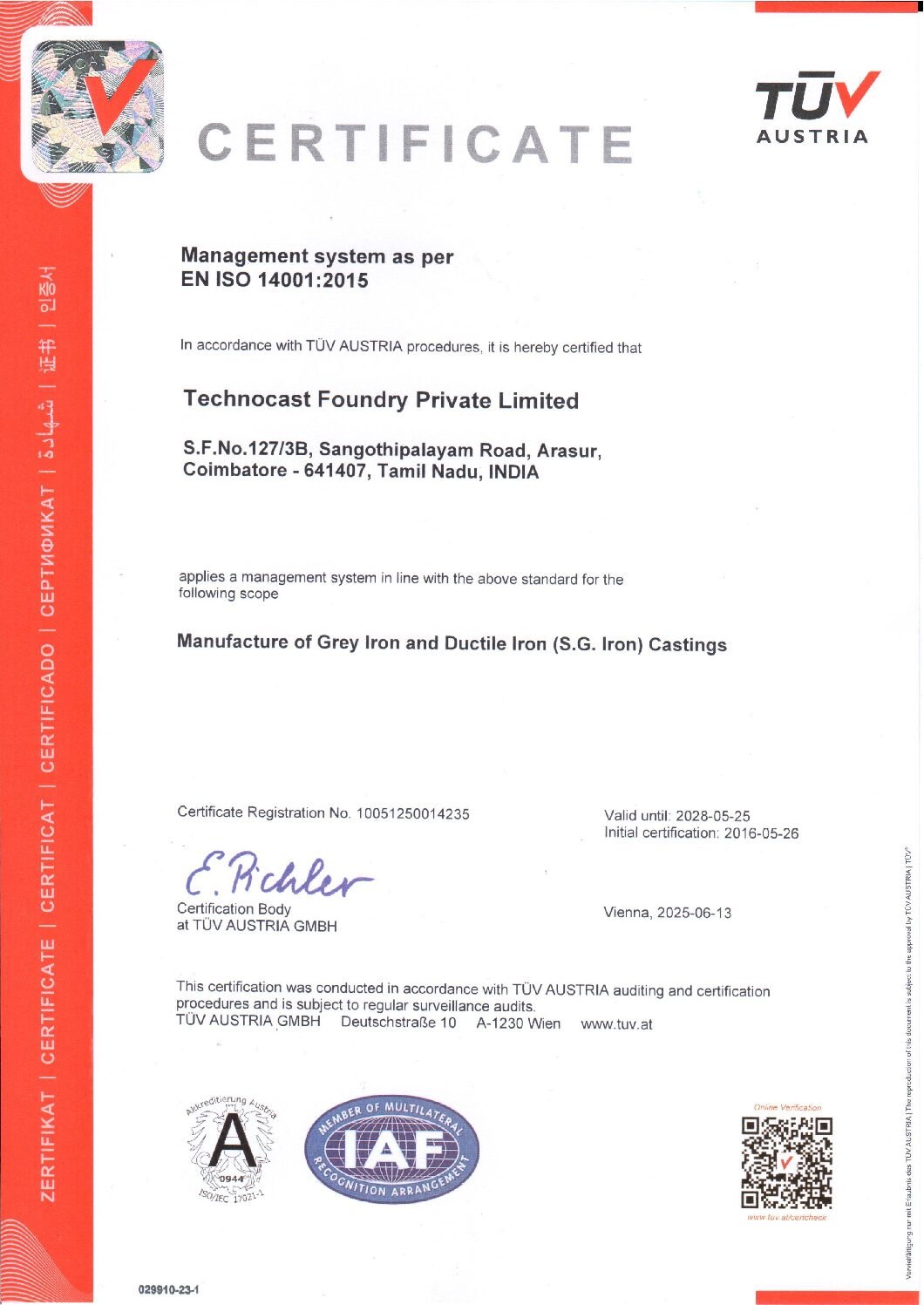
ISO 14001:2015
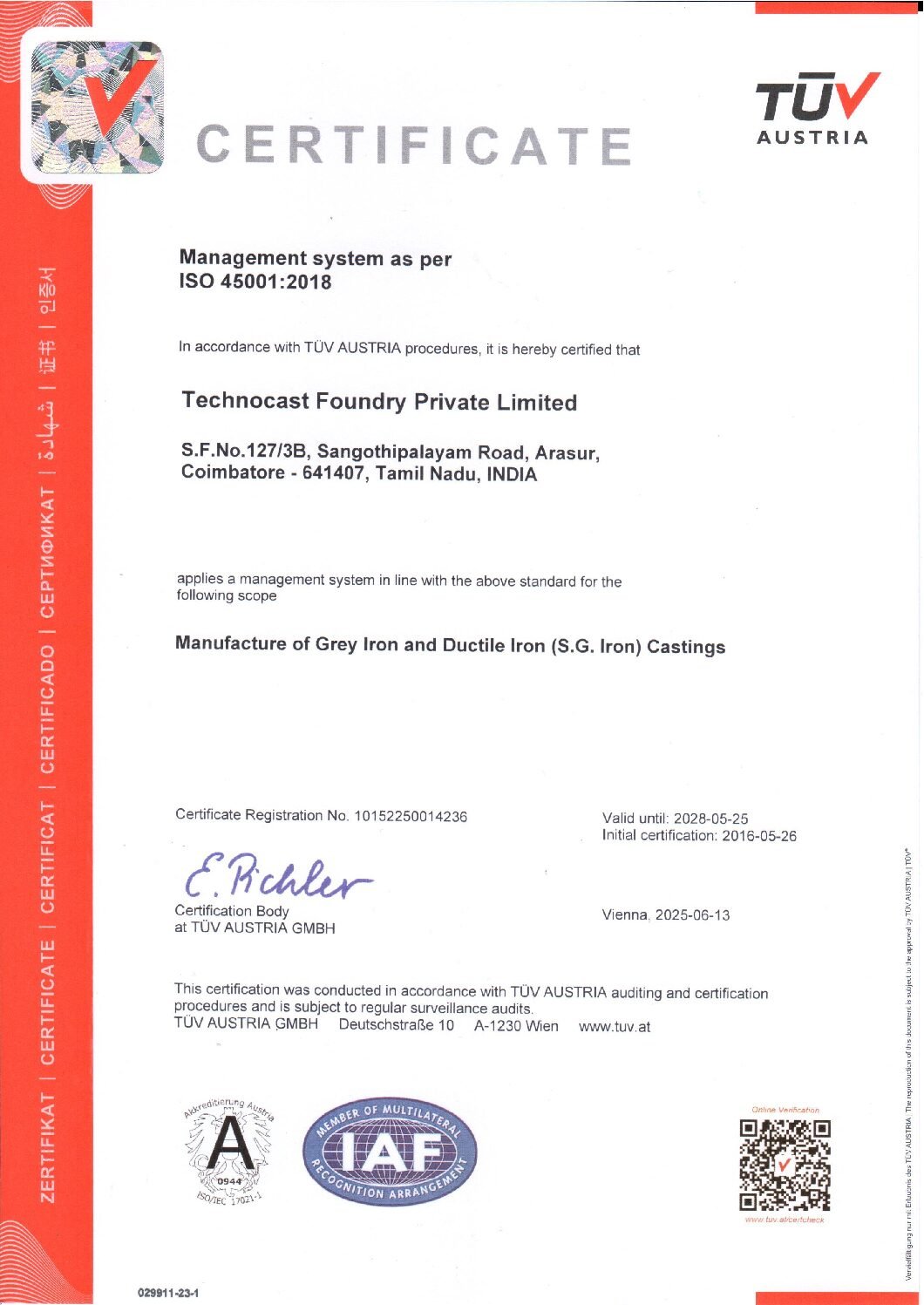
ISO 45001:2018
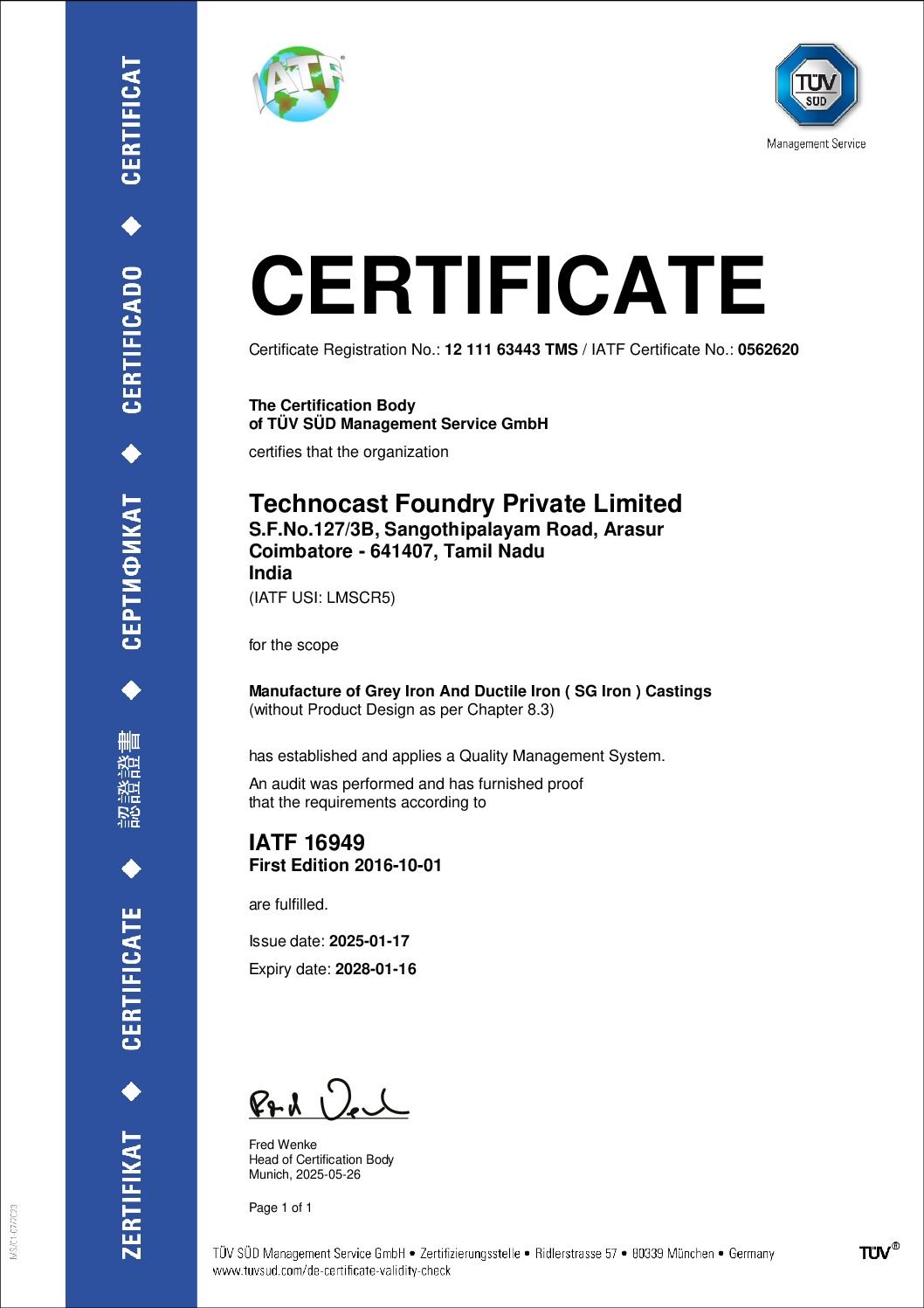
IATF 16949:2016
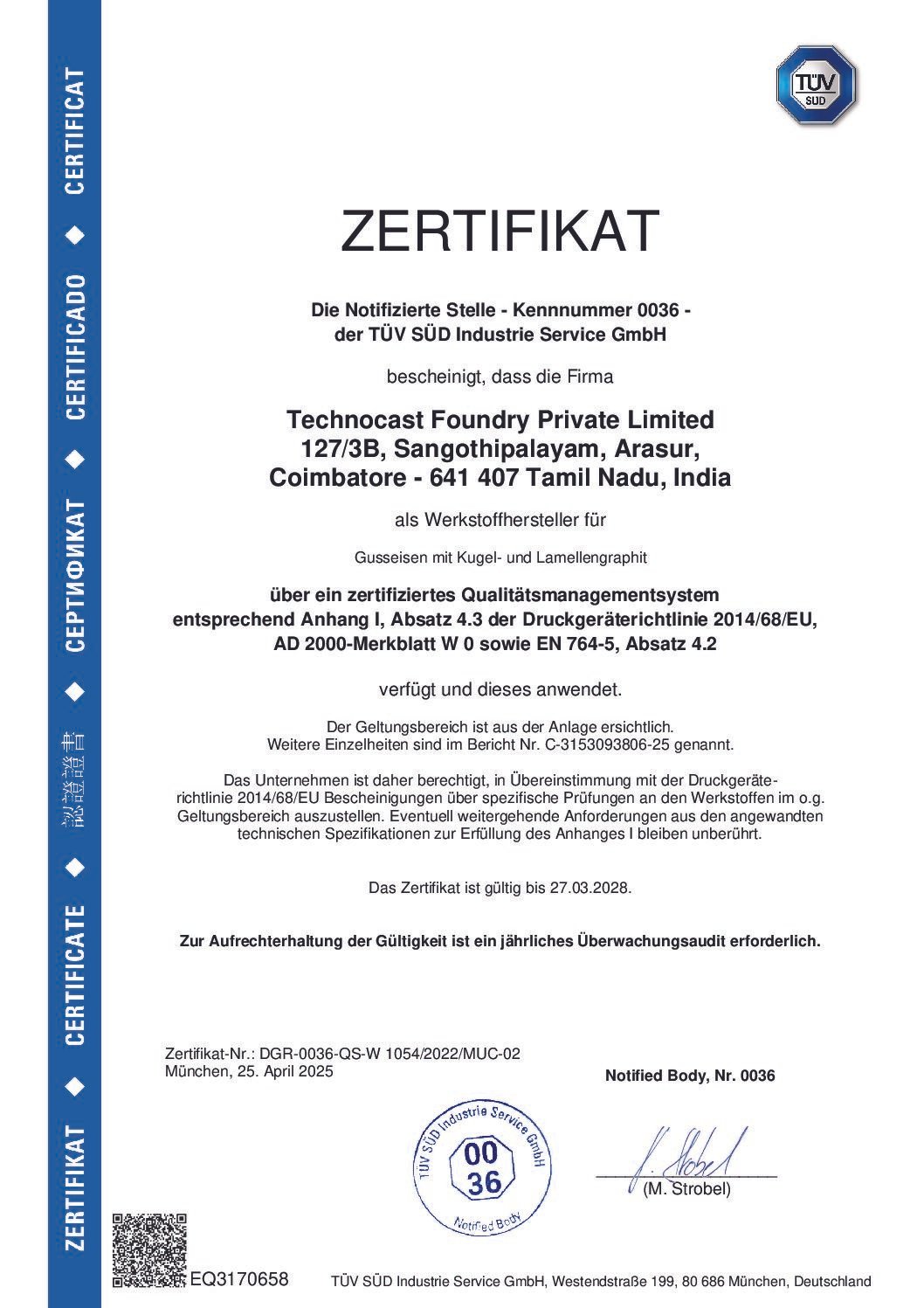
PED Certified

Send a Drawing

Need Machine Tool Castings
from a Coimbatore Foundry?

Send the drawing with the grey iron grade, the single-piece weight, the stress relief requirement and whether you want it raw or machined. You get back the moulding route, a lead time and a price.