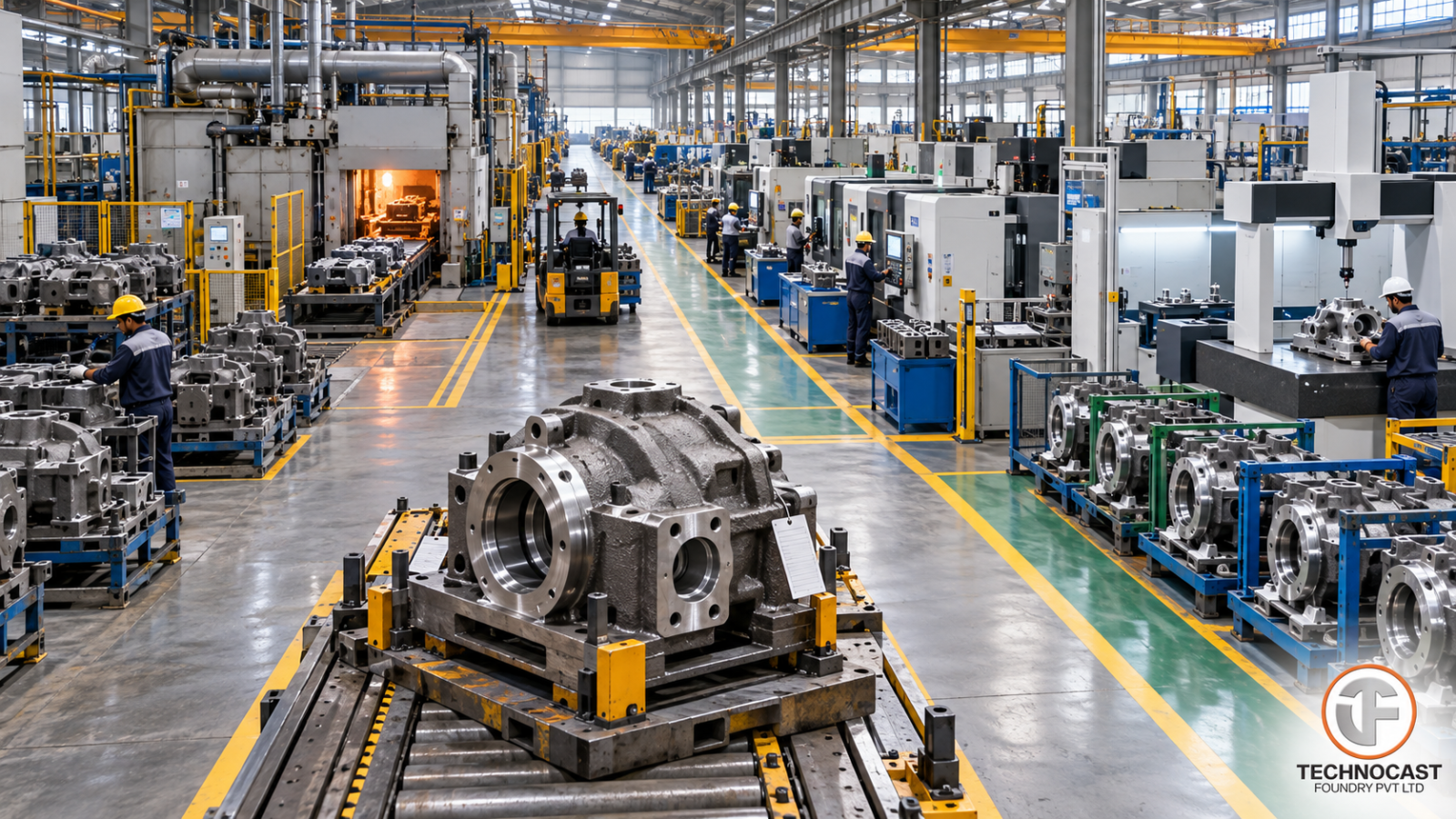
A casting can be perfectly acceptable when it leaves the foundry and still become a rejected finished component weeks later.
Why?
Because the casting may travel through multiple companies before it reaches the OEM:
Pattern supplier → Foundry → Heat treater → Machine shop → Finishing supplier → Inspection → Assembly → Packaging
Every handoff creates another point where:
- Parts can wait in a queue
- Dimensions can be misunderstood
- Traceability can be broken
- Components can be damaged
- Process responsibility can become unclear
- Engineering feedback can slow down
When a machined bore fails final inspection, the machine shop may blame casting variation.
The foundry may blame fixture or datum selection.
The heat-treatment supplier may be questioned about distortion.
Procurement is then left coordinating several companies to determine who owns the problem.
For OEM sourcing teams, this is why the discussion is shifting from:
“Who can supply the lowest-cost casting?”
to:
“Who can take responsibility for the component until it is ready for our production line?”
A single-site casting and machining model can reduce those interfaces by connecting:
Casting engineering → Metallurgy → Heat treatment → Machining → Inspection → Packaging
under one coordinated manufacturing system.
What Does “Single-Site Casting and Machining” Mean?
Single-site manufacturing does not simply mean that a foundry owns CNC machines.
The value comes from connecting the manufacturing stages around the same engineering intent.
A properly integrated workflow allows teams responsible for:
- Casting design
- Tooling
- Metallurgy
- Moulding
- Heat treatment
- Machining
- Dimensional inspection
to work from the same component requirements.
That creates one continuous manufacturing plan rather than several independent purchase orders.
The source describes Technocast’s intended model as casting and machining under one roof with single accountability.
Why Multi-Vendor Manufacturing Creates Hidden Cost
The purchase price shown on a casting quotation tells only part of the story.
A fragmented route can create additional cost through:
- Freight between suppliers
- Incoming inspection at every location
- Additional packaging
- Supplier coordination
- Buffer inventory
- Expediting
- Rework
- Repeated documentation
- Engineering travel
- Longer corrective-action loops
These costs do not always appear in the casting price.
They appear later in:
total landed cost and program-management effort.
Handoff Risk Example
Consider a differential housing.
The foundry produces the casting.
It is transported to a separate heat-treatment supplier.
After treatment, it moves to a machine shop.
The machine shop discovers that one bearing boss does not have enough machining stock.
Now several questions appear:
Was the casting undersized?
Did the component distort during heat treatment?
Was the machining datum incorrect?
Did the machining fixture locate from an unstable casting surface?
When all three operations belong to different suppliers, resolving those questions can take days.
With an integrated route, dimensional feedback can move directly back into:
- Casting method
- Tooling
- Machining allowance
- Heat-treatment sequence
- Fixture strategy
That is the real value of vertical integration.
Stage 1: DFM and Tooling Before Metal Is Poured
Single-source manufacturing starts before production.
The first step should be a combined review of:
- Casting geometry
- Machining requirements
- Functional datums
- Tolerances
- Critical features
A casting drawing should not be reviewed only for mouldability.
The engineering team should also ask:
Where will the machine shop locate this casting?
How much stock is required on the critical bore?
Which surface becomes Datum A after machining?
What distortion is likely after heat treatment?
This allows casting design and machining strategy to develop together.
Design-for-Casting Review
Typical casting-engineering considerations include:
- Draft
- Fillets
- Section transitions
- Shrinkage allowance
- Gating
- Risering
- Feeding
- Core strategy
Machining Review
At the same stage, machining engineering should consider:
- Datum strategy
- Machining stock
- Fixture access
- Tool access
- Critical GD&T
- Rough vs finish machining sequence
A problem corrected at the drawing stage is normally cheaper than a problem discovered after tooling.
Stage 2: Metallurgy and Casting Process Control
Casting quality begins with process discipline.
Important controls can include:
- Charge material
- Chemistry
- Melting
- Treatment practice
- Inoculation
- Mould quality
- Pouring temperature
- Heat identification
An integrated manufacturer can connect metallurgical records directly to the later machining and inspection history of the component.
This becomes valuable when investigating issues such as:
- Hard spots
- Tool wear
- Material inconsistency
- Bore distortion
- Mechanical-property variation
Chemistry Control
In-house spectrometry can provide rapid confirmation of heat chemistry before the component moves further into production.
If a chemistry condition falls outside control limits, containment can occur before machining value is added.
That is far less expensive than discovering the issue after a fully machined component reaches final inspection.
Stage 3: Moulding Route Selection
Different components require different casting processes.
The appropriate moulding route should be selected according to:
- Component weight
- Geometry
- Wall thickness
- Annual volume
- Surface requirement
- Dimensional expectation
Technocast’s established moulding capabilities include processes such as:
- DISA high-pressure moulding
- ARPA moulding
- Shell moulding
- No-bake moulding
depending on component requirements.
The advantage of multiple processes is not simply having more equipment.
It is being able to select the route that best matches the part rather than forcing every component into the same process.
Stage 4: Fettling and Surface Preparation
After shakeout, the casting typically moves through operations such as:
- Gate and riser removal
- Fettling
- Grinding where required
- Shot blasting
- Visual inspection
Surface preparation matters because later manufacturing stages depend on it.
A clean casting allows easier:
- Visual inspection
- Datum identification
- Handling
- Dimensional measurement
- Machining setup
It can also reveal surface conditions that were less visible immediately after shakeout.
Stage 5: Heat Treatment and Dimensional Stability
Some casting programs require heat treatment for reasons such as:
- Stress relief
- Microstructure control
- Mechanical properties
- Machinability
Heat treatment should not be treated as an isolated process.
It can influence final dimensions.
If the casting distorts during treatment, the machining operation needs sufficient stock to recover the required geometry.
This creates a direct engineering relationship between:
Casting design → Heat treatment → Machining allowance
An integrated workflow makes that relationship easier to manage.
Stage 6: CNC Machining
For many OEM customers, the requirement is not a raw casting.
It is a machined component.
Typical operations may include:
- Turning
- Milling
- Drilling
- Boring
- Reaming
- Grinding where required
The important issue is not simply owning CNC machines.
It is connecting the machining process back to casting behaviour.
Casting Datum vs Machining Datum
One of the most important integration opportunities is datum strategy.
A casting may have dimensional variation that is perfectly acceptable at the foundry stage.
The machining fixture must locate the component so that this variation does not consume stock on critical features.
For example, a housing may contain:
- Two critical bearing bores
- One machined mounting face
- Several secondary bosses
If machining location is poorly selected, one bore may clean up completely while the opposite bore loses stock.
Integrated engineering can establish the casting and machining datum strategy before production.
Machining Feedback Should Return to the Foundry
Suppose machining repeatedly finds excess material around one feature.
That may suggest an opportunity to:
- Reduce local machining allowance
- Adjust tooling
- Modify process centring
Similarly, repeated lack of stock may identify a casting or locating problem.
When casting and machining are disconnected, this feedback loop can take weeks.
When they operate within one manufacturing system, the feedback can be much faster.
Stage 7: In-Process Inspection
Quality should not depend only on a final inspection station.
Inspection needs to occur at relevant points throughout production.
Depending on the component, this may include:
- Chemistry verification
- Hardness
- Dimensional gauging
- CMM
- Ultrasonic testing
- Other specified NDT
Each inspection method answers a different engineering question.
Spectrometry
Confirms chemistry.
Hardness Testing
Provides evidence related to material or heat-treatment condition where applicable.
CMM Inspection
Verifies dimensional relationships and GD&T on machined components.
Ultrasonic Testing
Can be used for applicable internal-soundness requirements on suitable castings.
The advantage of integration is that inspection results can be linked back to the manufacturing stage responsible for the characteristic.
Stage 8: Final Inspection
Final inspection should verify the component against the customer’s released specification.
Depending on the product, this may include:
- Critical dimensions
- GD&T
- Material records
- NDT reports
- Heat-treatment records
- Traceability documentation
- Visual condition
The objective is to ensure that the customer receives a component that is not merely:
“machining complete”
but:
“verified against the agreed requirements.”
Stage 9: Packaging and Dispatch
A precision-machined component can still be rejected if it is damaged during transportation.
Packaging should therefore protect:
- Machined bores
- Sealing surfaces
- Threads
- Datums
- Coated surfaces
For export programs, additional considerations can include:
- Corrosion protection
- Moisture exposure
- Long transit duration
- Container movement
The packaging method should reflect the finished component—not just the raw casting weight.
From Raw Casting to Ready-to-Fit Component
OEM procurement strategies increasingly focus on reducing the number of suppliers they need to manage.
Instead of buying:
Raw casting
the customer may prefer:
Machined casting
or ultimately:
Production-ready component
where the agreed scope permits it.
This can reduce internal sourcing complexity.
However, capabilities such as:
- Press-fit assembly
- Inserts
- Stud fitting
- Surface treatment
- Functional testing
- Sub-assembly
should always be confirmed against the supplier’s current program capability before they are included in an OEM sourcing package.
Why Single Accountability Matters
Consider a dimensional problem.
In a fragmented supply chain:
OEM → Machine shop → Foundry → Heat treater → Tooling supplier
may all become involved.
Each supplier has different records and different responsibilities.
With an integrated manufacturing route, there can be a single accountable manufacturing owner coordinating:
- Casting
- Heat treatment
- Machining
- Inspection
This does not eliminate manufacturing problems.
It makes them easier to investigate.
Faster Corrective-Action Loops
Suppose a machined bore starts moving toward its upper tolerance.
An integrated team can investigate:
- Tool wear
- Fixture behaviour
- Casting stock
- Heat-treatment distortion
- Pattern/tool condition
within the same quality system.
Corrective action therefore has a better chance of addressing the complete process rather than only the final machining symptom.
Total Cost vs Piece Price
A multi-vendor route may initially appear cheaper because each supplier quotes only its own operation.
However, the OEM should compare:
Total manufacturing and supply-chain cost.
This includes:
- Part cost
- Freight
- Packaging
- Incoming inspection
- Inventory
- Supplier management
- Engineering coordination
- Rework
- Premium freight
- Delay risk
An integrated supplier may not always have the lowest individual casting price.
But it may offer a better total-cost result if it eliminates enough external interfaces.
Reduced Work-in-Progress
Every external manufacturing stage can create WIP.
For example:
100 castings wait at the foundry.
Then another batch waits at heat treatment.
Then another batch waits for machining.
These queues extend lead time.
Integrated planning can allow production stages to be scheduled around one manufacturing plan, potentially reducing the amount of material waiting between operations.
One Quality File
Another major benefit is documentation.
Instead of maintaining separate quality records from multiple suppliers, an integrated system can connect:
Heat → Casting lot → Heat treatment → Machining batch → Final inspection
This strengthens traceability.
For OEM programs requiring disciplined documentation, that can simplify:
- First-article approval
- PPAP where applicable
- Corrective action
- Engineering change management
Engineering Changes Become Easier to Coordinate
Imagine an OEM changes a bearing bore location.
In a fragmented supply chain, the change may affect:
- Pattern tooling
- Casting allowance
- Machining fixture
- CMM program
Each supplier needs the correct revision.
Integrated manufacturing can coordinate these changes through one engineering-change process.
That reduces the risk of:
- Old tooling
- Old CNC programs
- Old inspection programs
remaining active after a drawing revision.
A Typical Integrated Component Route
Consider a differential carrier.
The component contains:
- Bearing locations
- Mounting faces
- Structural ribs
- Critical machined interfaces
A practical integrated route might be:
1. DFM Review
Confirm:
- Gating
- Feeding
- Machining allowance
- Datum strategy
2. Tooling
Develop the casting tooling according to the approved manufacturing method.
3. Casting
Produce the component under controlled metallurgy and moulding conditions.
4. Cleaning
Perform fettling, blasting and preparation.
5. Heat Treatment
Where required by material or dimensional requirements.
6. CNC Machining
Machine:
- Bearing bores
- Mounting faces
- Holes
- Critical interfaces
7. Dimensional Inspection
Verify CTQs and GD&T.
8. Final Documentation
Compile relevant:
- Material
- Dimensional
- NDT
- Traceability
records.
9. Packaging
Protect the finished machined component for shipment.
The benefit is not that each manufacturing step becomes fundamentally different.
The benefit is that one system owns the complete route.
What OEM Buyers Should Audit in a Single-Source Supplier
Do not approve a vertically integrated supplier simply because several operations exist at one address.
Audit whether they are actually connected.
Engineering Integration
Ask:
Does the casting engineer understand final machining datums?
Does the machining team participate in DFM?
Traceability
Can a finished component be traced back to its heat or production lot?
Change Control
Does one drawing revision control:
- Tooling
- Machining
- Inspection?
Quality Feedback
Do machining defects trigger foundry investigation where appropriate?
Capacity
Can the supplier handle the complete route at forecast volume?
A bottleneck in machining can negate excess foundry capacity.
Inspection
Are the relevant measurement and NDT processes available and controlled?
Where Technocast Fits
Technocast’s strongest value proposition for suitable programs is not simply:
“We make castings.”
It is the ability to combine core ferrous-foundry operations with:
- Heat treatment
- CNC machining
- Spectrometry
- CMM inspection
- Ultrasonic testing
within a more integrated manufacturing route.
The sourcing discussion should therefore begin with the finished component requirement.
Customers should provide:
- Drawing
- Material grade
- Casting weight
- Annual volume
- Machining requirements
- CTQ dimensions
- NDT requirements
- Final supply condition
Technocast can then evaluate whether the program is suitable for an integrated casting-and-machining route.
Any additional requirements involving:
- Coating
- Sub-assembly
- Inserts
- Functional testing
- Special finishing
should be confirmed program by program before being included in the commercial scope.
RFQ Checklist for a Single-Source Casting and Machining Program
Include:
Drawing and 3D Model
Latest controlled revision.
Material
Specify the exact material standard and grade.
Raw Casting Weight
Where known.
Finished Component Weight
Where known.
Annual Volume
Include peak demand.
Moulding Requirements
If customer-specified.
Heat Treatment
Define the required condition.
Machining Scope
Clearly identify:
- Bores
- Faces
- Threads
- Holes
- Datums
GD&T
Identify critical functional relationships.
NDT
Specify method and acceptance criteria where applicable.
Documentation
Define required:
- Material certificate
- Dimensional report
- NDT report
- Traceability
- PPAP/FAI package where applicable
Final Supply Condition
Clarify whether the customer wants:
- Raw casting
- Heat-treated casting
- Machined casting
- Inspected finished component
- Additional value-added operations where agreed
Conclusion
OEMs do not make money managing supplier handoffs.
They need conforming components delivered when production requires them.
A fragmented manufacturing route can work well when the individual suppliers are properly managed.
But every additional interface adds another opportunity for:
- Delay
- Reinspection
- Inventory
- Miscommunication
- Accountability gaps
Single-site casting and machining offers a different model.
It connects:
Casting engineering + Metallurgy + Heat treatment + CNC machining + Inspection
around one component and one manufacturing plan.
For procurement, the benefit is potentially:
fewer supplier interfaces.
For engineering:
faster feedback between casting and machining.
For quality:
stronger end-to-end traceability.
And when a problem occurs, the OEM has one central question:
“Who owns the finished component?”
With the right integrated supplier, the answer should be clear.
Request a Cast-to-Machined Component Review
For a new or re-sourced component, send Technocast:
- Drawing / 3D model
- Material grade
- Single-piece weight
- Annual volume
- Machining scope
- CTQ dimensions
- Heat-treatment requirement
- NDT requirement
- Final supply condition
The complete manufacturing route can then be evaluated from casting feasibility through final machined inspection.
Frequently Asked Questions
What is single-site casting and machining?
It means casting production and CNC machining are coordinated within one manufacturing organization/site rather than purchasing the casting and machining from independent suppliers.
Why can integrated casting and machining reduce risk?
Machining feedback can be connected directly to casting tooling, machining allowance, heat-treatment behaviour and foundry process control, reducing supplier-to-supplier accountability gaps.
Is single-source manufacturing always cheaper?
Not necessarily on individual operation price. OEMs should compare total landed cost including freight, inspection, inventory, supplier management and quality risk.
Why is datum strategy important?
The way a casting is located during machining determines whether enough stock remains around critical features such as bores and mounting faces.
Does integrated machining eliminate casting variation?
No. Casting variation still needs to be controlled. Integration makes it easier to design machining and casting processes around the same functional requirements.
What quality systems are important for machined castings?
Depending on the application, important controls may include chemistry verification, in-process gauging, CMM inspection, NDT, traceability and capability monitoring.
Can a foundry supply fully ready-to-fit components?
Potentially, but the actual scope depends on the supplier’s confirmed machining, finishing, testing and assembly capability for that program.
What should I send for a casting-and-machining quotation?
Provide the drawing, material specification, raw/finished weight, annual volume, machining requirements, CTQs, heat-treatment requirement, NDT and required final supply condition.
Related at Technocast: CNC machine shop · Plant and equipment
Read next: Casting vs CNC machining · Sand casting tolerances and machining allowances