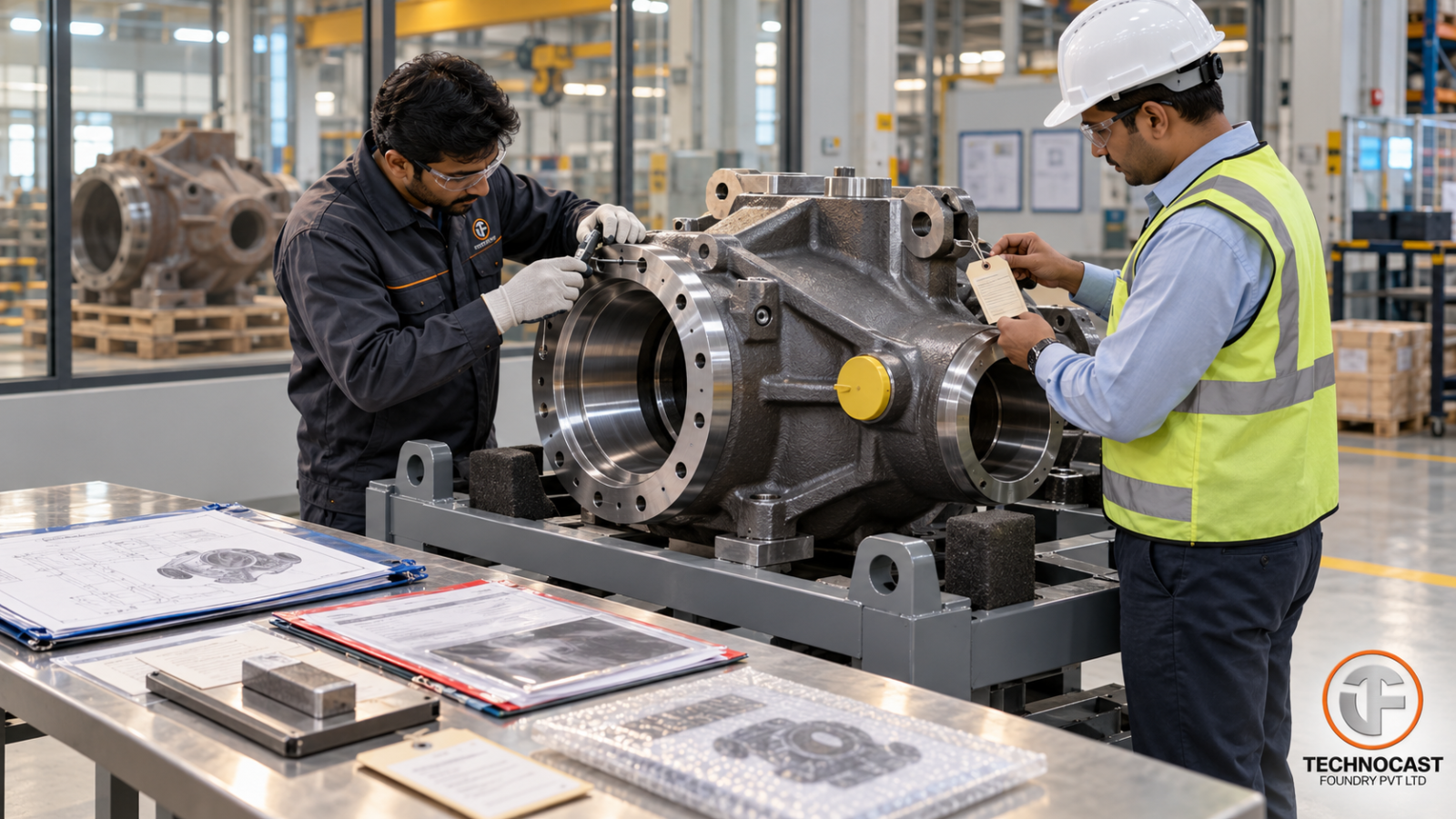
When customers come to us with a critical casting requirement, we do not look at it as just another part to pour.
We start by asking a different question:
What must this component do when it finally reaches the customer’s assembly line?
For a gearbox housing, producing the raw casting is only the beginning. The bearing locations must eventually align correctly after machining.
For a hydraulic valve body, an acceptable-looking casting is not enough. The finished component must maintain the required pressure boundary and sealing interfaces.
For a steering knuckle, axle housing or other highly loaded component, metallurgy, geometry and final dimensional condition all have to work together.
This is why, at Technocast Foundry Pvt. Ltd., we look at critical castings as a complete manufacturing responsibility—from the drawing and metallurgy through casting, machining, inspection and the agreed final delivery condition.
For us, the real question is not:
“Can we cast this component?”
It is:
“Can we control the complete journey well enough to deliver the component in the condition the customer actually needs?”
What Makes a Casting “Critical”?
Not every casting carries the same risk.
Some components are critical because a failure can affect safety.
Examples include steering, braking or other load-bearing vehicle components.
Some are critical because they contain pressure.
Pump casings, valve bodies and hydraulic housings fall into this category.
Others are structurally critical.
Differential housings, off-highway axle components and wind-energy support castings may carry substantial loads while also maintaining important dimensional relationships.
Before we discuss the foundry process, we therefore need to understand the component’s actual service conditions.
That means understanding things such as operating load, pressure, temperature, environment, functional interfaces and the condition in which the customer expects to receive the component.
That service requirement should drive the manufacturing plan.
A Material Name Alone Is Not Enough
One of the problems we frequently see in casting enquiries is an incomplete material specification.
“Ductile iron” is not a complete requirement.
“Alloy steel” is not a complete requirement.
We need to understand the actual grade, delivery condition and required mechanical properties.
Section thickness can also influence how a material behaves.
Heat treatment may be required.
Testing requirements can change depending on application.
For this reason, we prefer to discuss the material together with the geometry and service requirement rather than treating material selection as a separate purchasing line.
Define Acceptance Before Tooling Begins
Another important principle is to define what an acceptable component actually means before production starts.
An unrealistic statement such as:
“Casting must be defect-free”
does not give engineering or quality teams a measurable acceptance criterion.
Different areas of the same casting may carry very different risks.
A pressure wall may require one type of control.
A machined bearing seat may require another.
A highly stressed transition may require specific inspection.
A noncritical external surface may not require the same level of examination.
The Steel Founders’ Society of America makes an important point in its guidance on radiographic reference standards: reference images become acceptance criteria only when purchaser and producer agree on the acceptable severity.
We believe the same philosophy should be applied throughout the casting program.
Critical locations should be identified.
Inspection methods should be agreed.
Acceptance criteria should be measurable.
Zero-defect manufacturing should remain the objective, but measurable acceptance criteria are what allow both customer and supplier to make consistent production decisions.
We Look at the Casting and Machining Interface Together
A critical component can be perfectly acceptable as a raw casting and still fail during machining.
This is why the interface between casting and machining deserves special attention.
Before tooling is released, we want to understand:
- Which surfaces remain as-cast
- Which features will be machined
- Which datums control machining
- How much machining stock is required
- Which bores, faces or interfaces are critical
- How the finished geometry will be inspected
When these decisions are postponed until after castings have already been produced, problems become more expensive.
A machining fixture may reveal that a boss does not contain enough stock.
A bore may not completely clean up.
A datum selected by one supplier may not match the assumptions made by another.
Our preference is to identify these relationships early.
Design and Simulation Should Lead to Decisions
Casting engineering starts well before metal is poured.
During the design-for-manufacturing review, we look at issues such as wall transitions, heavy sections, cores, feeding, machining allowances and locating features.
Where simulation is used, the value is not simply the software name or the fact that a simulation was completed.
The important questions are:
What risk did the analysis identify?
Where is the difficult region?
What geometry or process change is being recommended?
How will the recommendation be verified during trials?
Simulation should help us make better manufacturing decisions before tooling and production become expensive to change.
Select the Moulding Route for the Component
A foundry should not force every component through the same moulding process.
At Technocast, the manufacturing route needs to match the component’s:
geometry, weight, section thickness, complexity and production volume.
Depending on the application, this may involve high-pressure green-sand moulding, shell moulding or no-bake moulding.
But the name of the process alone does not prove suitability.
The actual question is whether the proposed moulding route can repeatedly produce the required component.
Coremaking needs the same level of attention.
A foundry may have excellent moulding capability, but an internally complex casting can still fail if the core system is unstable.
That is why we review the complete mould-and-core arrangement together.
Metallurgy Has to Remain Connected to the Part
For critical castings, chemistry cannot become disconnected from traceability.
At Technocast, spectrometry forms part of the metallurgy-control process.
The useful requirement for the customer is not simply knowing that a spectrometer exists.
It is knowing how the heat identity, chemistry result and casting batch remain linked.
If an issue later appears in machining or inspection, the team should be able to trace the component back to the relevant manufacturing records.
That traceability becomes increasingly important as component criticality increases.
Heat Treatment Is Part of the Manufacturing Route
Heat treatment should not be treated as a separate afterthought.
Depending on the material and component, it may affect:
strength, microstructure, hardness, machinability and dimensional stability.
If a component will be machined after heat treatment, the sequence needs to be considered early.
We therefore prefer to define the required delivery condition and manufacturing sequence before production begins.
That allows machining allowance, dimensional movement and final inspection to be considered together.
“Fully Machined” Is Too Vague
Another phrase we see frequently in enquiries is:
“Supply fully machined.”
That description is not enough.
We need to know which features are included.
For example, the scope may involve turning, milling, drilling, boring, reaming, threads or other specific operations.
Critical features need to be defined.
The inspection method should also be connected to those features.
If a bearing bore is critical, how will it be measured?
If two bores must maintain alignment, how is that relationship verified?
If a sealing face requires a specific condition, where is that requirement documented?
The commercial scope should describe the actual component being supplied—not just use the words “fully machined.”
Inspection Should Answer Specific Questions
Inspection equipment only adds value when it answers the correct engineering question.
Dimensional inspection tells us whether geometry meets the drawing.
CMM measurement can help verify relationships between critical features and datums.
Magnetic-particle inspection, where specified and applicable, addresses certain surface and near-surface indications.
Ultrasonic examination may be used for agreed internal examination requirements on suitable components.
Pressure testing, where required by the application and confirmed within the agreed manufacturing scope, addresses pressure integrity.
These methods are not interchangeable.
The drawing and quality plan should define why each inspection exists and what constitutes acceptance.
Traceability Should Follow the Component
For a critical casting program, we want the manufacturing record to tell a complete story.
Where required by the program, the traceability path should be capable of connecting the material heat and casting batch with the relevant drawing revision, heat-treatment information, machining route, inspection results and final dispatch identification.
The exact level of traceability depends on the customer and application.
Some programs may require individual component identification.
Others may permit controlled batch identification.
The important point is to agree on that requirement before production begins.
Finishing Is Part of the Product Definition
“Painted casting” can also mean many different things.
Surface preparation, masking, coating system and protection of functional areas all need to be understood.
A primer-painted industrial housing and a component requiring a specialist coating are not equivalent delivery conditions.
Where an external specialist process is required, it should remain visible within the manufacturing route and documentation.
Our responsibility is to make sure the agreed component condition is clear rather than hiding complexity behind one broad description.
Ready-to-Fit Means Exactly That
The term ready-to-fit casting should be used carefully.
If a customer expects a component that goes directly into assembly, we need to understand everything included in that definition.
It may involve bought-out items, fasteners, bushes, seals or other installation requirements depending on the program.
Orientation, fit, cleanliness and functional checks may also matter.
The customer should not receive the component and discover that several undefined operations are still necessary before it can be used.
That is the standard we apply when discussing a finished or ready-to-fit scope.
What Happens When Porosity Appears After Machining?
This is one of the most important situations to define before serial production.
A casting may look completely acceptable before machining.
Machining can expose an internal discontinuity that was not visible earlier.
When that happens, the first response should not be an informal production adjustment.
The affected components should be identified and segregated.
The location and nature of the indication should be investigated.
Then the team can determine whether the issue is related to geometry, feeding, process variation or another cause.
If repair, impregnation or concession is being considered, the permitted route should come from the agreed customer specification.
A machining operator should never solve the problem by changing the part without an authorised engineering decision.
FMEA and Control Plans Should Reflect the Real Process
For critical components, process risk should be considered before production.
FMEA is useful because it forces engineering and manufacturing teams to identify:
what can fail, why it may fail, and what controls are required.
But FMEA should not exist only as a document for a customer audit.
The identified risks need to appear in the manufacturing process and control plan.
Where PPAP is required, someone must also own the complete submission.
Integrated responsibility is useful here because casting, machining and inspection decisions can be coordinated instead of being managed as unrelated supplier packages.
Why We Believe One Accountable Manufacturing Route Matters
Our view at Technocast is simple:
The customer is not buying molten metal.
The customer is not even buying a raw casting.
The customer is buying the performance of the finished component.
That component may require several disciplines to come together:
Metallurgy → Casting engineering → Moulding → Heat treatment → Machining → Inspection → Agreed finishing and assembly scope → Packaging
When those activities are disconnected, responsibility can become fragmented.
When a problem appears, one supplier may blame another.
Procurement then spends time managing interfaces instead of solving the technical problem.
This is why we continue to build our model around greater manufacturing integration and clear ownership of the finished requirement.
Not because every process must automatically happen at one machine or one work centre.
But because somebody has to own the outcome.
What We Ask Customers to Send Us
When you approach Technocast with a critical casting requirement, the most useful enquiry includes the component drawing, material specification, service conditions, annual demand and inspection requirements.
Where relevant, also include machining, coating, testing, packaging and assembly requirements.
The clearer the final delivery condition is at the beginning, the better we can evaluate the correct manufacturing route.
Our Approach to Critical Castings
For us, a critical casting program should connect four things:
The service requirement.
The manufacturing process.
The inspection evidence.
The final delivery condition.
If any one of those is unclear, risk remains in the program.
Our role as a manufacturing partner is to identify those gaps early—before tooling, before production and preferably before the drawing is completely frozen.
Because the most expensive casting problem is often not the defect we find in the foundry.
It is the problem discovered after machining, assembly or field use that should have been resolved much earlier.
Discuss Your Critical Casting Program With Technocast
If you are developing or re-sourcing a critical casting, send us:
- Drawing and 3D model where available
- Material specification
- Component weight
- Annual volume
- Service conditions
- Critical characteristics
- Machining requirements
- Inspection and testing requirements
- Required final delivery condition
At Technocast Foundry Pvt. Ltd., our objective is to review the component as a complete manufacturing responsibility—from raw casting requirements through the agreed finished-part condition.
Send us your critical casting requirement and let us review the complete route—not just the casting.