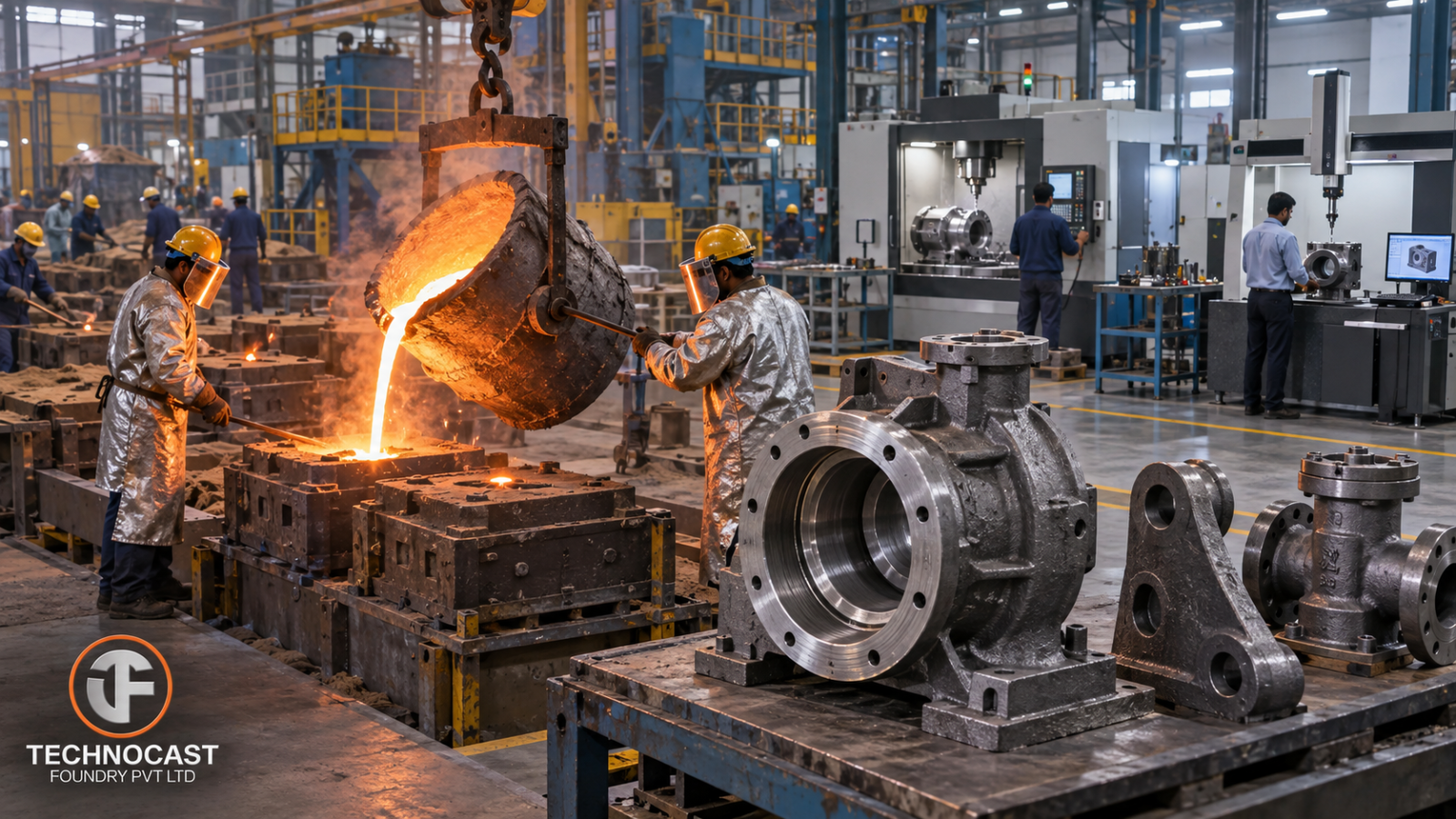
Metal casting is one of the fundamental manufacturing processes used to produce complex industrial components.
At its simplest, the process involves melting metal, pouring it into a mould containing the required geometry, allowing it to solidify, and removing the finished or near-net-shape component from the mould.
But modern industrial casting is far more than simply pouring molten metal into a cavity.
For an OEM, the quality and cost of a casting depend on decisions made throughout the process—from material grade and pattern design to moulding method, melt chemistry, gating and feeding, machining allowance, inspection and final finishing.
When those variables are engineered correctly, casting can produce complex components that would be expensive, wasteful or sometimes impractical to manufacture entirely by machining or fabrication.
This guide explains how metal casting works, the major casting processes, common ferrous casting materials, applications, quality requirements and what OEM buyers should look for when selecting a foundry.
What Is Metal Casting?
Metal casting is a manufacturing process in which molten metal is introduced into a mould cavity shaped like the required component.
After the metal cools and solidifies, the mould is opened or broken away and the casting is removed.
Depending on the application, the casting may then undergo:
- Fettling
- Shot blasting
- Heat treatment
- CNC machining
- Surface treatment
- Dimensional inspection
- Non-destructive testing
The result can be either an as-cast component or a fully machined, ready-to-assemble part.
Casting is particularly useful when a component contains:
- Internal cavities
- Complex external geometry
- Ribs
- Bosses
- Curved transitions
- Variable wall thickness
- Large cross-sections
These features can often be produced directly during casting instead of being created through extensive material removal or welded fabrication.
The supplied industry material also notes that global casting production exceeds 110 million metric tonnes annually, reflecting how deeply casting is integrated into durable-goods manufacturing worldwide.
Why Do Manufacturers Use Metal Casting?
The main advantage of casting is its ability to create complex geometry close to the final component shape.
Consider a gearbox housing.
Machining the complete housing from a solid billet would require removing large volumes of material to produce:
- Internal cavities
- Bearing locations
- Mounting bosses
- Structural ribs
- Flanges
- External contours
Casting creates most of this geometry directly.
CNC machining can then be concentrated on the features that genuinely require precision, such as:
- Bearing seats
- Datum surfaces
- Bores
- Sealing faces
- Threads
- Mounting holes
This creates a practical manufacturing philosophy:
Cast the geometry. Machine the precision.
For suitable components, this can improve material utilisation and reduce unnecessary machining compared with manufacturing the complete shape from solid material.
How Does the Metal Casting Process Work?
Although individual foundries use different technologies, most casting processes follow the same fundamental production sequence.
1. Pattern Making
The process begins with a pattern representing the component geometry.
A casting pattern is not always an exact copy of the final machined part.
The foundry engineer may need to incorporate:
- Shrinkage allowance
- Machining allowance
- Draft
- Core prints
- Parting-line requirements
- Foundry-specific process allowances
The quality of pattern engineering directly influences mould accuracy and the repeatability of the final casting.
2. Mould and Core Making
The pattern is used to create the mould cavity.
The mould controls the external shape of the component.
Where the component requires internal holes, passages or cavities, cores can be positioned inside the mould.
For example, cores may be used to create internal flow paths in:
- Pump housings
- Valve bodies
- Gearbox housings
- Hydraulic components
Good core design is critical because movement or dimensional variation can affect internal geometry and machining stock.
3. Melting and Pouring
The required metal grade is melted in the furnace.
This stage requires control of:
- Chemical composition
- Melt temperature
- Alloy additions
- Treatment practice
- Slag and inclusions
- Pouring temperature
- Pouring behaviour
Metal chemistry is particularly important.
A component can look dimensionally correct but still fail its performance requirement if the required material chemistry or microstructure is not achieved.
Modern foundries therefore use equipment such as spectrometers to verify chemistry during production.
4. Solidification
Once molten metal enters the mould, it begins to cool and solidify.
This is one of the most critical stages of the casting process.
Metal contracts during solidification.
The gating and feeding system must therefore be engineered so that the casting solidifies in a controlled manner.
Poor solidification management can contribute to defects such as:
- Shrinkage
- Porosity
- Hot spots
- Internal discontinuities
This is why gating and risering are engineering functions—not simply additional pieces of metal attached to a casting.
5. Shakeout and Fettling
After the component has solidified sufficiently, it is removed from the mould.
In sand casting, this usually involves separating the casting from the moulding sand.
The gating and feeding system is then removed.
Additional finishing can include:
- Grinding
- Fettling
- Shot blasting
- Surface cleaning
At this stage the component begins to resemble the final industrial casting.
6. Heat Treatment Where Required
Some material grades and applications require heat treatment to achieve specified mechanical or metallurgical properties.
Heat treatment may be used to influence:
- Strength
- Hardness
- Toughness
- Microstructure
- Residual stresses
The exact cycle depends on material grade and customer specification.
7. CNC Machining
Not every surface on a casting requires machining.
The objective is normally to machine only those features where dimensional accuracy or surface finish demands it.
Typical machined areas include:
- Bores
- Bearing seats
- Flange faces
- Threads
- Sealing surfaces
- Datum locations
- Precision mounting holes
This is where integrating casting and machining can improve manufacturing accountability.
8. Inspection
Inspection verifies that the finished component meets the customer’s dimensional, metallurgical and functional requirements.
Depending on the component, this may include:
- Visual inspection
- Spectrometer analysis
- Dimensional inspection
- CMM inspection
- Ultrasonic testing
- Pressure testing
- Mechanical-property testing
The supplied source describes casting production through the same core sequence of pattern making, mould/core making, melting and pouring, solidification, shakeout, finishing and inspection.
Major Types of Metal Casting
There is no single casting process suitable for every component.
The correct moulding route depends on:
- Component size
- Weight
- Geometry
- Required volume
- Material
- Tolerance
- Surface requirement
- Tooling economics
Green Sand Casting
Green sand casting is one of the most widely used industrial casting methods.
Despite the name, the moulding sand is not necessarily green in colour. The term refers to sand being used in a moist, uncured state.
Green sand moulding is particularly attractive where manufacturers require:
- Repeatable production
- Economical moulding
- Medium- to high-volume output
- Wide material flexibility
Automated moulding systems can increase productivity and reduce variation between moulds.
High-Pressure Automated Moulding
High-pressure moulding systems such as DISA-type vertical moulding lines are designed for repeatable series production.
The mould is produced automatically under controlled pressure, helping maintain consistency across large production quantities.
Advantages can include:
- High moulding productivity
- Consistent mould density
- Reduced mould mismatch
- Repeatability
- Scalable production
Technocast’s supplied capability information includes DISA high-pressure moulding and ARPA 450/1300.
Shell Moulding
Shell moulding uses resin-coated sand to form a relatively thin but rigid mould shell.
Compared with conventional sand moulding, shell moulding can provide:
- Better dimensional repeatability
- Improved surface finish
- Reduced machining allowance
- Good reproduction of detailed geometry
These benefits can make shell moulding attractive for components where downstream machining cost is important.
A higher mould or tooling cost does not necessarily mean a higher finished-component cost if the process reduces machining operations.
No-Bake Moulding
No-bake casting uses chemically bonded sand that cures without conventional baking.
It is particularly useful for:
- Larger castings
- Heavy engineering components
- Complex geometries
- Lower and medium production volumes
- Applications requiring flexible tooling
No-bake can be commercially attractive where automated high-volume moulding is not suitable because of component size or production requirements.
Technocast’s stated capability includes both shell and no-bake moulding routes, allowing different component families to be matched with different manufacturing processes.
Investment Casting
Investment casting uses wax patterns and ceramic shells to produce detailed components with relatively fine surface finish and dimensional capability.
It can be useful for:
- Complex small-to-medium components
- Thin sections
- Intricate geometries
- Applications where machining needs to be minimised
Investment casting is an important industry process, but it should not be confused with Technocast’s listed moulding capabilities above; the supplied Technocast capability information specifically identifies DISA, ARPA, shell and no-bake routes.
Common Metal Casting Materials
Selecting the correct casting material requires more than comparing tensile strength.
Engineers must consider:
- Mechanical loading
- Impact
- Fatigue
- Wear
- Corrosion
- Temperature
- Vibration
- Machinability
- Cost
- Applicable standards
Grey Cast Iron
Grey iron contains graphite primarily in flake form.
Common specifications include the EN-GJL family under EN 1561.
Grey cast iron is widely used because of its:
- Excellent vibration damping
- Good machinability
- Dimensional stability
- Good compressive properties
- Cost-effective manufacturing characteristics
Common applications include:
- Machine bases
- Gearbox housings
- Pump bodies
- Equipment housings
- Structural machine components
Its damping characteristics make it particularly useful in applications where vibration and noise control matter.
Ductile Iron
Ductile iron—also known as nodular or spheroidal graphite iron—contains graphite in nodular form.
Common specifications include the EN-GJS family under EN 1563 and grades under ASTM A536.
Compared with conventional grey iron, ductile iron generally provides:
- Higher tensile strength
- Greater elongation
- Improved toughness
- Better fatigue performance
Applications can include:
- Structural brackets
- Automotive components
- Heavy-equipment components
- Drivetrain housings
- Load-bearing industrial components
The choice between grey iron and ductile iron should therefore be driven by the component’s functional requirement rather than assuming one material is universally superior.
Carbon and Alloy Cast Steel
Steel castings become important when the application requires combinations of:
- Strength
- Toughness
- Temperature capability
- Weldability
- Impact resistance
Standards such as ASTM A216 and ASTM A352 are used for particular steel casting applications.
Typical uses include:
- Valves
- Pressure-containing components
- Mining equipment
- Heavy engineering components
- Structural nodes
Compared with conventional cast iron, steel casting generally requires different melting, feeding and process-control considerations.
Stainless Steel Castings
Stainless steel casting grades such as those under ASTM A351 are commonly used where corrosion resistance is required.
Typical applications include:
- Pumps
- Valves
- Process equipment
- Chemical-industry components
The supplied source identifies grey iron, ductile iron, carbon/cast steel and stainless steel as common industrial casting families with different performance requirements.
Where Are Metal Castings Used?
Casting is used across almost every major industrial manufacturing sector.
Automotive
Automotive castings can include:
- Brake components
- Steering components
- Transmission housings
- Engine components
- Brackets
- Structural housings
High-volume applications often benefit from automated moulding because repeatability and cycle time become critical.
Pumps and Valves
Pump and valve applications can include:
- Pump housings
- Volutes
- Valve bodies
- Impellers
- Pressure-containing castings
These components may require a combination of:
- Metallurgical control
- Dimensional accuracy
- Machining
- Pressure integrity
- Inspection
Wind and Energy
Large cast components can be used in structural and drivetrain applications where:
- Stiffness
- Fatigue resistance
- Dimensional stability
- Machinability
are important.
Construction and Heavy Equipment
Heavy-equipment components can experience significant:
- Shock loading
- Wear
- Vibration
- Structural stress
Material selection and casting integrity therefore become critical.
Machine Tools
Cast iron has historically been highly suitable for machine-tool structures because of its damping and dimensional characteristics.
Applications include:
- Machine beds
- Bases
- Frames
- Housings
The source specifically identifies automotive, wind, pumps/valves, construction equipment and machine tools among the major sectors using engineered cast components.
Casting vs Machining From Solid
Casting and CNC machining are not competing technologies in every application.
In many cases, they work best together.
Machining from solid can be attractive when:
- Production quantities are low
- Geometry is simple
- Designs are changing
- Tight tolerances are needed across many surfaces
Casting becomes attractive when:
- Geometry is complex
- Large internal cavities are required
- Significant billet material would otherwise become chips
- Production volumes justify tooling
- Multiple fabricated pieces can potentially become one casting
For many OEM components, the optimal manufacturing strategy becomes:
Near-net casting + CNC finish machining.
Casting creates the component shape.
Machining creates the final precision.
This approach can reduce material waste and avoid applying machining cost to surfaces that do not require machining-level tolerances.
Metal Casting Quality Control
A good casting cannot be judged only by appearance.
Quality begins before molten metal enters the mould.
Chemistry Verification
The chemical composition of the melt influences:
- Mechanical properties
- Microstructure
- Castability
- Hardness
- Machinability
Spectrometer analysis can be used to confirm that the material chemistry is within the required limits.
Dimensional Inspection
Casting dimensions should be evaluated according to realistic casting tolerances.
ISO 8062 provides a framework for dimensional tolerances for cast components.
The important principle is not to apply machined-component tolerance expectations unnecessarily to every as-cast surface.
Critical areas can instead be machined to their final tolerance.
Coordinate Measuring Machine Inspection
CMM inspection is useful for verifying critical dimensions and geometric relationships on machined and cast components.
It can support verification of:
- Datums
- Hole positions
- Bore locations
- GD&T requirements
- Dimensional relationships
Ultrasonic Testing
Ultrasonic testing can be used for suitable components to detect internal discontinuities.
The exact inspection method should always be aligned with:
- Material
- Geometry
- Component criticality
- Customer specification
Pressure Testing
Pump, valve and fluid-containing components may require pressure testing to verify integrity.
The appropriate test pressure and acceptance criteria should be defined according to the component’s specification.
The supplied Technocast information identifies spectrometry, CMM, ultrasonic testing and pressure testing as relevant inspection tools for industrial castings.
How to Choose a Metal Casting Manufacturer
Selecting a foundry should not be based only on the lowest quoted piece price.
The supplier is managing several risks on behalf of the OEM:
Metallurgical risk
Will the material consistently meet the specified chemistry and properties?
Dimensional risk
Can the casting and machining processes repeatedly achieve critical dimensions?
Quality risk
How are defects identified, controlled and prevented?
Capacity risk
Does the foundry have the appropriate moulding process and production capacity?
Supply-chain risk
Can the supplier consistently meet volume and delivery requirements?
A practical evaluation should therefore include the following.
1. Quality Management System
Look for a documented quality-management system appropriate for the supply requirement.
Technocast’s supplied company information identifies ISO 9001:2015 certification.
2. Moulding Process Capability
Do not ask only:
“Can you manufacture this casting?”
Ask:
“Which moulding process will you use and why?”
A supplier with multiple moulding routes has more flexibility to match the process to component geometry, weight and production volume.
Technocast lists:
- DISA high-pressure moulding
- ARPA 450/1300
- Shell moulding
- No-bake moulding
among its capabilities.
3. Casting Weight Capability
Component size must match the foundry’s handling, moulding, melting and process capability.
The supplied Technocast information states support for castings up to 1,500 kg.
4. In-House Machining
When castings require substantial machining, sourcing casting and machining separately creates another supplier interface.
Integrated CNC machining can improve coordination around:
- Machining allowance
- Datums
- Fixtures
- Inspection
- Final component responsibility
5. Heat Treatment
Where required by material or application, integrated heat-treatment capability can reduce external handoffs and simplify production control.
6. Inspection Capability
Ask what evidence will be supplied with production components.
Depending on requirements, this can include:
- Chemistry reports
- Dimensional reports
- CMM reports
- Mechanical test certificates
- UT reports
- Pressure-test records
7. Export Experience
International customers should also evaluate:
- Export packaging
- Documentation
- Traceability
- Logistics coordination
- Repeatability across production batches
A supplier capable of producing a good sample but unable to maintain delivery and quality across repeated export orders creates significant sourcing risk.
Why Early Foundry Involvement Matters
One of the largest opportunities to reduce casting cost occurs before tooling is released.
When the foundry is involved early, engineers can review:
- Wall thickness
- Section transitions
- Fillet radii
- Draft
- Core design
- Gating and feeding
- Machining allowance
- Datum locations
- Material grade
- Moulding route
This can reveal opportunities to reduce:
- Casting weight
- Tooling complexity
- Machining
- Rejection risk
- Production cost
A foundry should therefore be treated as an engineering partner during design-for-manufacture discussions—not simply as a supplier asked to quote an already-frozen drawing.
Technocast Foundry: From Casting to Finished Component
For OEM sourcing teams, managing separate suppliers for casting, heat treatment, machining and inspection can create additional handoffs and accountability gaps.
Technocast Foundry Pvt. Ltd.’s supplied capability profile combines:
- Grey iron casting
- Ductile iron casting
- Steel casting capabilities
- DISA high-pressure moulding
- ARPA 450/1300
- Shell moulding
- No-bake moulding
- In-house CNC machining
- Heat treatment
- Inspection capability
- Export supply experience
- ISO 9001:2015 quality management
with stated casting capability up to 1,500 kg.
For customers, the objective is not simply to purchase a raw casting.
The objective is to establish a controlled manufacturing route from drawing to finished component.
Conclusion
Metal casting remains one of the most effective manufacturing routes for producing complex, durable industrial components at scale.
Its real strength is not simply the ability to melt metal and reproduce a shape.
It is the ability to combine:
Material engineering + geometry + moulding + metallurgy + machining + inspection
into a repeatable production process.
Grey iron can provide excellent damping and machinability.
Ductile iron can provide greater strength, elongation and toughness.
Cast steel can support applications requiring higher toughness, temperature capability or demanding service conditions.
And different moulding routes—DISA high-pressure moulding, shell moulding and no-bake—allow the manufacturing process to be matched to component size, complexity and quantity.
For OEMs, the right foundry should therefore do more than quote a price from a drawing.
It should help determine:
- Whether the material is appropriate
- Which moulding route fits the component
- Where machining is genuinely required
- How the casting will be inspected
- How repeatability will be maintained across production
Have a new casting project?
Send Technocast your:
- Component drawing
- Material grade
- Single-piece weight
- Annual volume
- Machining requirements
- Inspection requirements
Technocast can review the requirement and confirm manufacturing feasibility, suitable moulding route, tooling requirements and commercial quotation.
Frequently Asked Questions
What is metal casting?
Metal casting is a manufacturing process where molten metal is poured into a mould containing the required component geometry. The metal solidifies inside the mould and is then removed, cleaned, inspected and machined where required.
What are the main types of metal casting?
Common industrial processes include green sand casting, automated high-pressure moulding, shell moulding, no-bake casting and investment casting. The correct process depends on component size, material, quantity, tolerance and geometry.
What metals can be cast?
Common ferrous casting materials include grey iron, ductile iron, carbon steel, alloy steel and stainless steel. Material selection depends on mechanical, thermal, corrosion, wear and manufacturing requirements.
What is the difference between sand casting and shell moulding?
Sand casting provides broad flexibility across component sizes and volumes. Shell moulding typically offers improved surface finish and dimensional repeatability, which can help reduce downstream machining on suitable components.
Why are cores used in casting?
Cores create internal geometry that cannot be produced directly by the external mould cavity. They are commonly used for internal passages, cavities and hollow sections in pump, valve and housing components.
Do castings always require CNC machining?
No. Some components can be used in the as-cast condition. Others require machining only on functional areas such as bores, sealing faces, bearing locations, threads and datum surfaces.
How are metal castings inspected?
Depending on the component and specification, inspection can include visual examination, spectrometer chemistry analysis, dimensional measurement, CMM inspection, ultrasonic testing, mechanical testing and pressure testing.
What information should I send a foundry for a quotation?
For a useful technical and commercial review, provide the component drawing, material grade, approximate casting weight, annual quantity, required machining, inspection requirements and applicable standards.
Related at Technocast: Plant and equipment · Our casting product ranges
Read next: Iron casting types and grades · Casting vs CNC machining