For an OEM engineer or sourcing team, choosing between casting and CNC machining should not begin with the question:
“Which process is better?”
The better question is:
“Which manufacturing route gives us the required performance at the lowest total component cost?”
CNC machining from solid stock is highly effective when production quantities are low, designs are still changing, or several surfaces require tight tolerances.
But when a component contains ribs, bosses, cavities, curved profiles or variable wall thickness, machining the entire geometry from solid material can mean paying for metal only to turn a large percentage of it into chips.
That is where near-net-shape casting followed by CNC finish machining can become a much stronger manufacturing strategy.
Instead of machining every feature from a billet, the foundry creates most of the component geometry during casting. CNC machining is then used only where precision is actually required.
The result can be better material utilisation, shorter machining cycles and lower overall manufacturing cost.
Casting vs CNC Machining: Understanding the Cost Structure
Casting and CNC machining operate with very different cost models.
CNC Machining Cost
The cost of machining a component from solid material is influenced by:
- Starting billet or bar-stock cost
- Machine-hour rate
- Programming
- Setup time
- Number of machining operations
- Fixtures
- Cutting tools
- Material removal
- Inspection
- Rework and scrap
Machine time is especially important.
Every component requires spindle time.
If one part needs one hour of machining, producing 1,000 components still requires a substantial amount of machine capacity even after setup efficiencies are considered.
This means the manufacturing cost does not fall dramatically simply because production volume increases.
The source material describes CNC machining cost as being driven primarily by machine time, setup/programming, tooling wear and starting material.
Casting Cost
Casting follows a different model.
There is usually an initial investment in:
- Patterns
- Core boxes
- Fixtures
- Gauges
- Process development
The recurring component cost then includes:
- Moulding
- Melting
- Pouring
- Cleaning and fettling
- Inspection
- Heat treatment where required
- Finish machining
The important difference is tooling amortisation.
The same tooling can be used across a production program.
As the number of components increases, the tooling cost allocated to each part becomes smaller.
A simplified model is:
Casting unit cost = Tooling ÷ production quantity + casting cost + finish machining
This is one of the main reasons casting becomes increasingly attractive as production volume rises.
The Hidden Cost of Machining From Solid
Material utilisation is one of the most important factors in the casting-versus-machining decision.
Imagine that an OEM needs a finished component weighing 15 kg.
If production begins with a 30 kg billet, approximately half the purchased metal must be removed.
Those chips may have recycling value, but scrap value rarely compensates for the full cost of:
- Purchasing the additional metal
- Transporting it
- Handling it
- Storing it
- Machining it
- Consuming cutting tools
- Using CNC capacity
This difference between purchased material and finished-part mass is sometimes considered through a buy-to-fly ratio.
The higher the ratio, the stronger the reason to investigate a near-net manufacturing route.
Casting places metal much closer to where the final component actually requires it.
The source identifies material utilisation as one of the major hidden cost advantages of casting complex geometries.
When Component Geometry Starts Favouring Casting
Casting becomes particularly attractive when CNC machining would need to remove large amounts of material to generate the component’s shape.
Internal Cavities
Pump bodies, valve bodies and gearbox housings commonly contain significant internal cavities.
Creating those cavities entirely through machining may require deep pockets, multiple setups and extensive material removal.
Casting can create much of this internal geometry using cores.
Ribs
Ribs provide structural rigidity without making the complete component thicker.
They are relatively natural casting features.
Machining a ribbed component from solid material, however, often means removing most of the surrounding billet.
Bosses
Mounting bosses, bearing locations and connection points can be incorporated directly into the casting geometry.
CNC machining can then finish only the functional surface, bore, thread or hole.
Variable Wall Thickness
Many engineered components require additional metal only in high-load regions.
Casting allows material distribution to follow the component’s structural requirements.
Machining from solid often means starting with stock sized according to the component’s maximum envelope.
Complex Three-Dimensional Geometry
Curved profiles, structural pockets and irregular shapes can require numerous tool paths and machining setups.
Near-net casting can form much of that geometry directly.
When Does Casting Become Cheaper Than CNC Machining?
There is no fixed quantity at which every component should move from CNC machining to casting.
The break-even point changes according to:
- Component geometry
- Material
- Casting tooling cost
- Starting billet cost
- Machining time
- Casting yield
- Tolerances
- Annual demand
- Program lifetime
The supplied research suggests a practical crossover of approximately 500–1,000 pieces in many situations where the design is stable and the component can be produced near net shape.
The same source describes the broad manufacturing pattern as:
1–200 units: CNC often remains attractive.
200–1,000 units: hybrid evaluation becomes increasingly relevant.
Above 1,000 units: near-net casting economics can become considerably stronger where yield and machining allowances are controlled.
These numbers should be treated as guidance rather than a universal rule.
A simple component may remain economical to machine at considerably higher quantities.
A complex component manufactured from expensive material may justify casting at substantially lower volumes.
Calculating the Break-Even Point
OEM sourcing teams can make the comparison more objective with two simple equations.
Machining From Solid
Machined unit cost ≈ Material + machining hours × machine rate + tooling + overhead
Near-Net Casting
Cast unit cost ≈ Tooling ÷ quantity + casting cost + finish machining
The source uses essentially the same break-even logic: tooling cost per component reduces as quantity rises, while machining minutes generally remain attached to each manufactured part.
Consider a simplified example.
Assume:
CNC-machined component cost: ₹6,000
Casting tooling: ₹5,00,000
Recurring casting + finish-machining cost: ₹3,700
At 100 components:
Tooling contribution = ₹5,000/component
Casting is unlikely to make economic sense.
At 1,000 components:
Tooling contribution = ₹500/component
Approximate total:
₹3,700 + ₹500 = ₹4,200/component
At 5,000 components:
Tooling contribution = ₹100/component
The initial tooling investment now has relatively little impact on unit cost.
That is why production volume should always be considered before rejecting casting based solely on tooling cost.
The Better Answer Is Often Casting + CNC Machining
For many industrial components, the strongest process is not purely casting or purely CNC machining.
It is:
Near-net casting + precision CNC machining
Each process is used where it creates the most value.
Consider a gearbox housing.
Casting can create:
- External housing geometry
- Internal cavities
- Structural ribs
- Bosses
- Mounting features
- General wall sections
CNC machining can then finish:
- Bearing seats
- Datum faces
- Precision bores
- Mounting holes
- Threads
- Sealing surfaces
The idea is simple:
Cast the complexity. Machine the precision.
This prevents expensive machine capacity from being consumed generating geometry that does not require CNC-level accuracy.
Grey Iron and Near-Net Manufacturing
Grey iron grades such as EN-GJL-250 and EN-GJL-300 are commonly considered where vibration damping, dimensional stability and compressive performance are important.
Typical components can include:
- Machine housings
- Gearbox housings
- Pump casings
- Bases
- Industrial equipment structures
Grey iron also offers favourable machinability compared with many steel materials.
This combination makes it particularly suitable for a cast-near-net-and-machine-critical-features approach.
The source specifically highlights grey iron’s damping behaviour, machinability and suitability for housings and casings.
Ductile Iron
Ductile iron provides greater tensile strength and ductility than conventional grey iron.
Depending on grade, it can be considered for:
- Structural brackets
- Carriers
- Heavy equipment components
- Safety-related housings
- Parts exposed to fatigue or impact loading
Higher-strength grades may also require greater machining effort.
Producing the component closer to final geometry through casting therefore reduces the amount of higher-strength material that must later be machined.
The source discusses the EN-GJS-400 to EN-GJS-900 family and notes that machinability can become more demanding as strength increases.
Carbon Steel Castings
Cast steel can be appropriate where strength, toughness and weldability requirements make an iron grade unsuitable.
The supplied material references standards including:
ASTM A27
and
ASTM A216
Steel generally requires greater machining effort than conventional grey iron.
For bulky or complex components, forming the majority of the geometry through casting can therefore avoid removing significant amounts of steel from a large billet.
Material Cost Changes the Equation
The more expensive the starting material, the more important material utilisation becomes.
If an OEM purchases a costly alloy block and then removes 60% of it during machining, the material-removal strategy deserves scrutiny.
The source specifically notes that high-value material and high geometric complexity can move the casting break-even point toward lower volumes.
In these applications, the decision should not be based only on the quoted CNC hourly rate.
The team should calculate:
Starting material cost
versus
finished component material content
along with the machine time required to remove the difference.
Machine Capacity Is Also a Cost
Consider an OEM requiring 5,000 components per year.
If each component takes two hours to machine from solid, that represents approximately:
10,000 machining hours
Now assume near-net casting reduces final machining to 30 minutes.
The CNC requirement drops to approximately:
2,500 machining hours
The difference is not merely an accounting saving.
It releases CNC capacity for operations where high-precision machining actually adds value.
For manufacturers dealing with machining bottlenecks, subcontracting constraints or long production queues, this capacity benefit can be significant.
Casting Is Not Automatically the Cheapest Route
Near-net casting can reduce machining, but poor foundry engineering can destroy that advantage.
Casting cost is influenced by:
- Gating
- Risering
- Metal yield
- Moulding consistency
- Core accuracy
- Metallurgical control
- Rejection
- Rework
- Inspection
Porosity, shrinkage and inclusions can lead to scrap or additional processing.
This is why casting economics depend on more than simply producing the shape.
The process must consistently produce acceptable components.
The supplied material specifically identifies process controls, gating and risering optimisation, and defect prevention as important cost levers.
Design for Casting, Not Just Conversion From a CNC Drawing
A common mistake is to take a component designed entirely around machining and send the same geometry directly for casting.
That misses many of the advantages of the process.
An early foundry design review should evaluate:
- Wall thickness
- Section transitions
- Fillet radii
- Draft
- Core strategy
- Gating
- Risering
- Machining allowance
- Datum strategy
- Critical dimensions
The goal is not simply to cast a shape that was originally designed for CNC manufacturing.
The goal is to develop a component where:
Casting produces the geometry efficiently
and
CNC machining produces the precision efficiently.
When CNC Machining Is Still the Better Choice
Casting should not be forced into every application.
CNC machining can remain the better manufacturing route when:
Volumes Are Very Low
Prototype and small-batch programs may not justify tooling investment.
Designs Are Still Changing
When engineering revisions are frequent, machining provides greater flexibility.
Geometry Is Simple
A shaft, plate or straightforward block may require relatively little material removal.
Most Surfaces Require Precision
If nearly the entire component must be machined after casting, the near-net advantage can become much smaller.
Speed to First Component Matters
For some prototype or validation programs, the ability to machine immediately from available stock can outweigh higher recurring production cost.
Process selection should therefore be made according to the actual component and program—not according to a preference for one manufacturing method.
What OEMs Should Review Before Choosing the Manufacturing Route
Before deciding between casting and machining from solid, engineering and sourcing teams should ask:
What is the finished component weight?
What is the starting billet weight?
What percentage of material is being removed?
How many CNC hours are required?
How many machining setups are required?
Which surfaces actually require tight tolerances?
What is the annual production quantity?
What is the expected lifetime volume?
Is the component design stable?
Can the part be redesigned around casting?
When a large amount of expensive metal is being removed simply to create the component geometry, a near-net casting review should be considered.
Technocast Foundry: Casting and CNC Machining Under One Roof
The decision between casting and CNC machining becomes easier when the complete manufacturing route can be considered together.
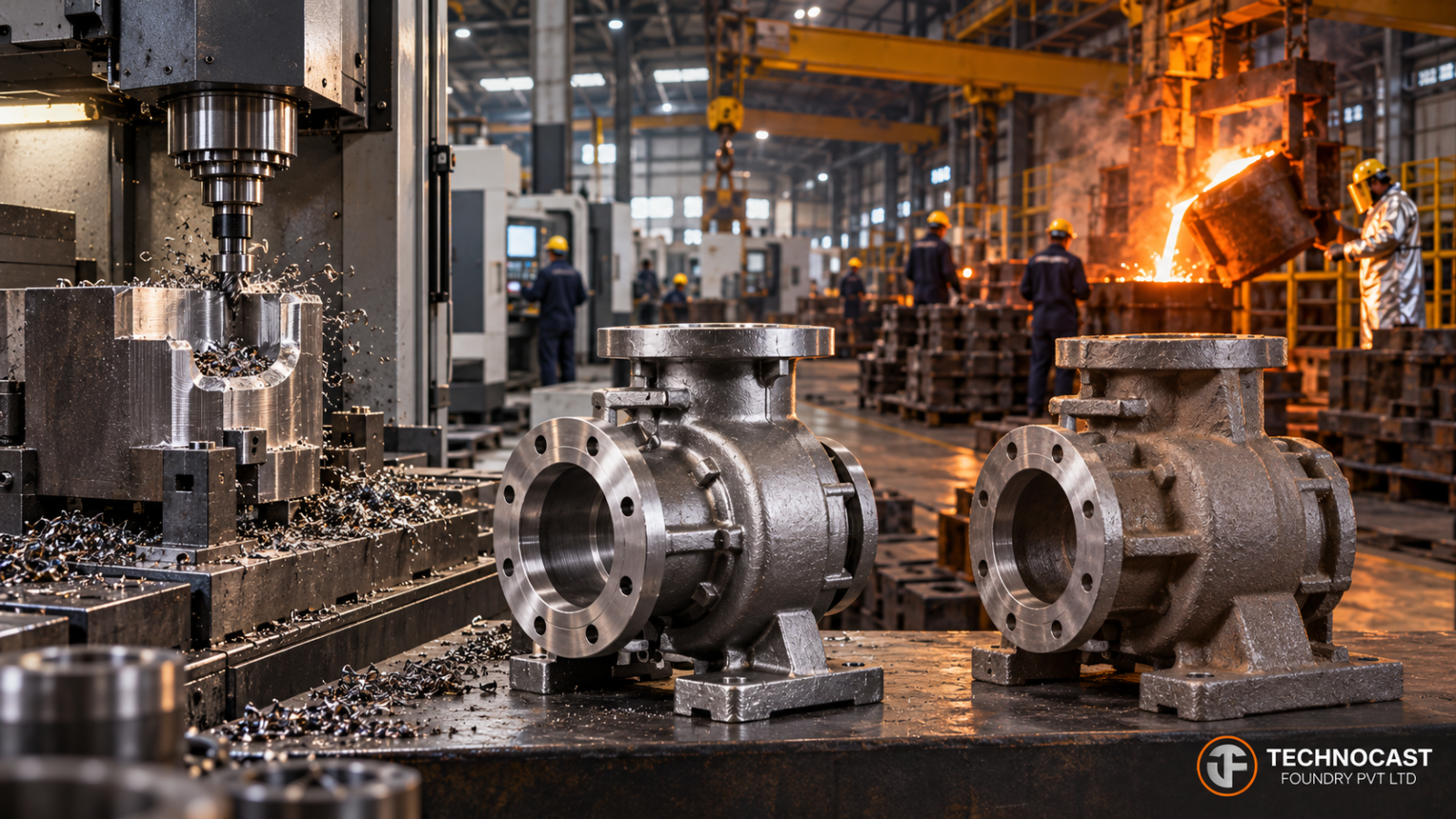
Technocast Foundry Pvt. Ltd. combines in-house foundry capability with CNC machining, allowing industrial components to be evaluated based on geometry, material, quantity and final tolerance requirements.
Depending on the application, the manufacturing route may include:
CNC machining from solid
for suitable prototype and low-volume requirements.
Near-net-shape casting
where geometry and production quantity favour the casting process.
Casting + CNC finish machining
where casting produces the bulk of the component geometry and machining completes critical precision features.
This integrated approach can also improve accountability between casting and machining operations.
Instead of one supplier producing a raw casting and another managing machining, the complete component can be considered around:
- Casting geometry
- Machining allowances
- Datum planning
- CNC operations
- Dimensional inspection
- Final quality
The source specifically identifies Technocast’s in-house foundry plus CNC machining capability as supporting this hybrid manufacturing strategy.
Conclusion: Cast the Shape, Machine the Precision
CNC machining is highly flexible and precise.
But machining every feature from a solid block is not automatically the most economical approach.
When a component contains complex geometry and a large percentage of the starting material must be removed, the OEM is paying not only for the material but also for the machine time required to turn that material into chips.
Near-net casting changes that equation.
The casting process creates the majority of the geometry first.
CNC machining is then concentrated where dimensional accuracy, surface finish and positional control genuinely matter.
For low-volume or changing designs, machining from solid may remain the strongest option.
As quantities increase and designs stabilise, near-net casting plus CNC finishing can provide a more efficient balance of material utilisation, machine capacity and total manufacturing cost.
For OEM teams reviewing an existing machined-from-solid component, one of the most useful questions to ask is:
“How much of the material we are buying actually remains in the finished component?”
If the answer is surprisingly low, it may be time to evaluate a near-net casting route.
FAQs
Is casting cheaper than CNC machining?
Not automatically. CNC machining can be more economical for prototypes and low-volume components because dedicated casting tooling may not be required. As production quantity and material removal increase, near-net casting can become significantly more attractive.
At what quantity should we consider switching from CNC machining to casting?
There is no fixed quantity. The supplied research suggests that approximately 500–1,000 components can be a useful review range for many stable, near-net geometries, but the actual break-even point depends on material, machining time, tooling and component complexity.
Why combine casting with CNC machining?
Casting is highly efficient at creating complex three-dimensional geometry. CNC machining is highly efficient at creating precise surfaces and features. Combining them allows each process to perform the work it is best suited for.
Which components are good candidates for near-net casting?
Components with cavities, ribs, bosses, irregular profiles, variable wall thickness or high material-removal requirements are strong candidates for evaluation. Housings, pump bodies, brackets and heavy industrial components are common examples.
Does a casting still need machining?
Often yes. Critical surfaces such as bearing locations, flange faces, bores, threads and sealing interfaces commonly require machining. The objective of near-net casting is not necessarily to eliminate machining completely, but to eliminate unnecessary machining.