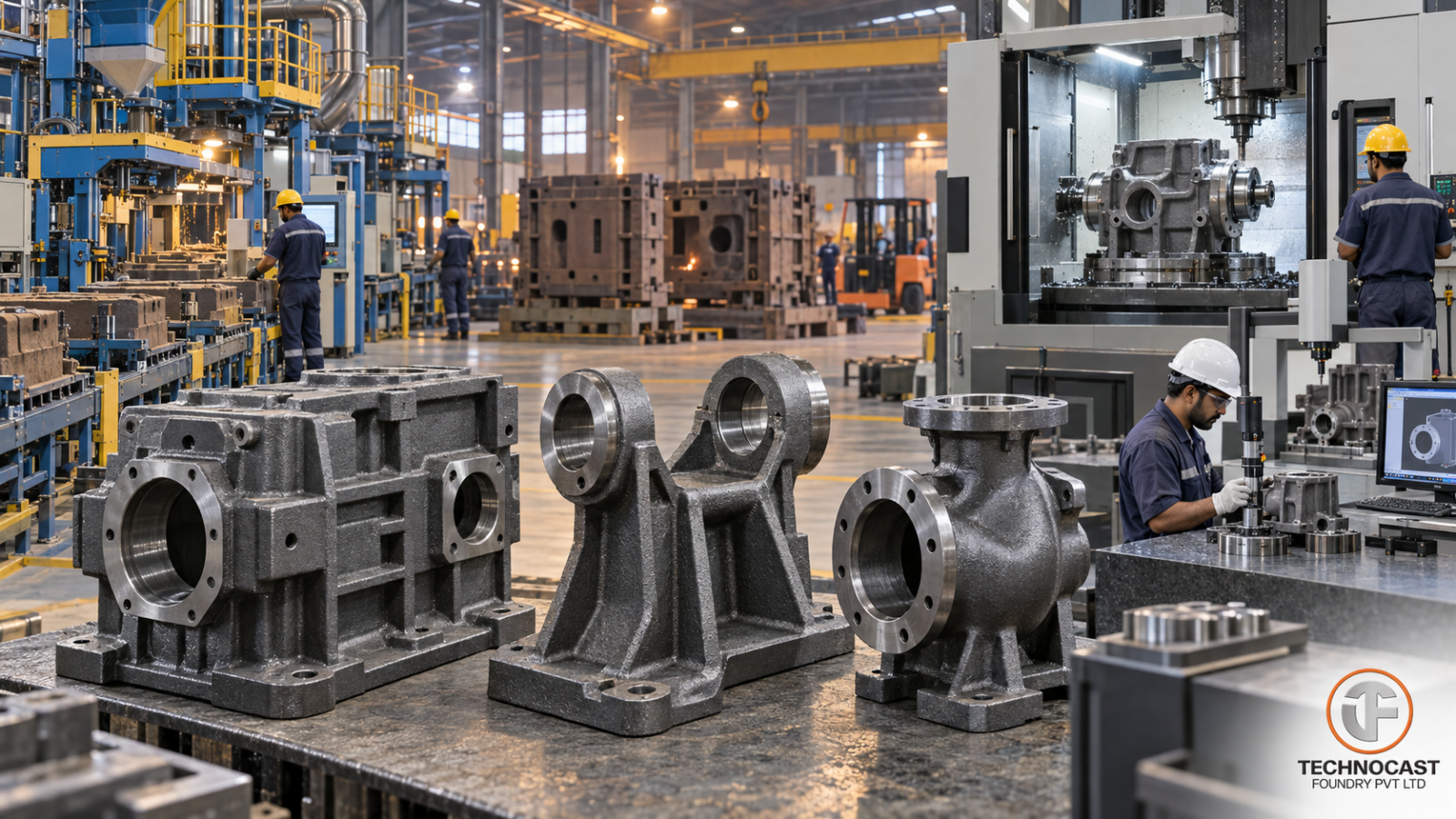
Iron castings are used across some of the most demanding industrial applications—from machine-tool structures and automotive housings to pumps, valves, wind-energy components and heavy construction equipment.
But for an OEM or procurement team, specifying an iron casting involves considerably more than choosing a drawing and asking a foundry for a price.
The important questions are:
Which type of cast iron is appropriate?
Which material grade meets the actual loading and service conditions?
Which moulding process fits the component geometry and annual volume?
How will metallurgy, dimensions and internal integrity be controlled?
Can the foundry deliver the same quality repeatedly across production batches?
The cheapest quoted casting is of little value if inconsistent metallurgy, poor machining control or internal defects create assembly problems or field failures.
For industrial buyers, iron casting should therefore be treated as an engineered manufacturing route rather than a commodity purchase.
This guide explains the main types of iron casting, common EN material grades, moulding processes, industrial applications and the practical factors OEM buyers should evaluate before qualifying an iron foundry.
What Is Iron Casting?
Iron casting is a manufacturing process in which an iron-based alloy is melted, poured into a mould and allowed to solidify into a required component shape.
The resulting casting can be supplied:
- As-cast
- Heat treated
- Partially machined
- Fully CNC machined
- Inspected and ready for assembly
depending on the OEM requirement.
The major advantage of casting is its ability to produce complex shapes efficiently.
A casting can incorporate features such as:
- Internal cavities
- Ribs
- Bosses
- Curved profiles
- Flanges
- Mounting features
- Variable wall thickness
without machining the entire geometry from a large billet.
This makes iron casting particularly relevant for components where stiffness, durability, damping, wear behaviour or complex geometry must be achieved at commercially viable production volumes.
Main Types of Iron Casting
Not all cast iron behaves the same way.
The structure and form of carbon within the material significantly influence:
- Strength
- Ductility
- Hardness
- Vibration damping
- Machinability
- Wear resistance
Most engineering iron-casting requirements can be grouped into four major families.
1. Grey Cast Iron
Grey iron contains graphite primarily in flake—or lamellar—form.
This graphite structure gives grey iron some of its most valuable engineering characteristics:
- Excellent vibration damping
- Good machinability
- Good thermal behaviour
- Dimensional stability
- Cost-effective production
Its main limitation is lower tensile strength and ductility compared with ductile iron.
Grey iron is therefore particularly suitable when stiffness, damping and machinability are more important than high impact resistance or elongation.
Common applications include:
- Machine-tool bases
- Gearbox housings
- Pump housings
- Automotive housings
- Industrial machine structures
- Equipment frames
A commonly specified grade is:
EN-GJL-250
The supplied material lists a minimum tensile strength of approximately 250 MPa for this grade, with typical hardness around 190–240 HB, subject to section size and specification.
Another commonly used class is:
EN-GJL-300
where greater strength is required while retaining the basic advantages of lamellar graphite iron.
2. Ductile Iron
Ductile iron is also known as:
- Nodular cast iron
- Spheroidal graphite iron
- SG iron
Unlike grey iron, the graphite in ductile iron forms primarily as rounded nodules rather than flakes.
This difference significantly changes the mechanical behaviour of the material.
Ductile iron can provide:
- Higher tensile strength
- Greater elongation
- Improved toughness
- Better fatigue resistance
- Good castability
- Useful machinability
The graphite structure is typically produced through controlled melt treatment, including magnesium treatment.
Ductile iron is widely used in components exposed to:
- Structural loads
- Fatigue
- Impact
- Pressure
- Repeated loading
Typical applications include:
- Axle housings
- Hubs
- Structural brackets
- Drivetrain components
- Pump and valve bodies
- Wind-energy components
- Construction machinery parts
The supplied technical source identifies high-strength grades extending to EN-GJS-700-2 and EN-GJS-900-2 for strength-driven applications.
3. White Cast Iron
In white cast iron, much of the carbon is present as hard carbide phases rather than free graphite.
The result is:
- Very high hardness
- Strong abrasion resistance
- Relatively low ductility
- Difficult machinability
This makes white iron more suitable for wear applications than general structural components.
Potential applications include components exposed to:
- Abrasive minerals
- Sliding wear
- Crushing
- Material handling
It should not be selected simply because high hardness sounds desirable.
Low ductility can make it unsuitable for components requiring significant impact tolerance or deformation.
4. Malleable Cast Iron
Malleable iron begins from a white-iron structure and undergoes heat treatment to modify the carbon structure and improve ductility.
Historically, it has been used for:
- Small fittings
- Hardware
- Brackets
- Connecting components
where greater toughness is required than conventional white iron can provide.
For many modern heavy engineering applications, however, ductile iron offers a wider range of useful mechanical-property combinations.
Grey Iron vs Ductile Iron: Which Should You Choose?
One of the most common material-selection questions is whether a component should use grey iron or ductile iron.
There is no universal winner.
The decision should follow the component’s actual failure mode and functional requirements.
Choose Grey Iron When the Priority Is:
- Vibration damping
- Dimensional stability
- Machinability
- Rigidity
- Cost efficiency
This often applies to:
- Machine bases
- Housings
- Casings
- Frames
Consider Ductile Iron When the Priority Is:
- Tensile strength
- Elongation
- Fatigue resistance
- Impact performance
- Structural loading
This often applies to:
- Hubs
- Brackets
- Axle housings
- Load-bearing structures
- Pressure components
The practical rule from the supplied source is similar: grey iron is generally favoured for damping, thermal behaviour and cost, while ductile iron becomes more relevant where strength, ductility and fatigue performance dominate.
Understanding Common EN Iron Casting Grades
Industrial buyers should specify material using recognised standards rather than relying on broad descriptions such as:
“cast iron”
or
“SG iron.”
For grey iron, EN 1561 covers grades such as EN-GJL.
For ductile iron, EN 1563 covers EN-GJS grades.
The designation gives the engineer useful information about the expected mechanical-property class.
Common Grey Iron Grades
EN-GJL-250
A commonly specified industrial grey iron grade.
The supplied source lists:
Tensile strength: ≥250 MPa
Typical hardness: approximately 190–240 HB
It can be suitable for:
- Housings
- Frames
- Machine structures
- Components requiring damping
EN-GJL-300
This is a higher-strength grey iron class.
It can be considered where an application benefits from grey iron’s damping and machining characteristics while requiring somewhat greater strength.
Actual properties should still be verified against:
- Casting section thickness
- Applicable standard
- Customer specification
Common Ductile Iron Grades
EN-GJS-400-18
This grade combines relatively moderate tensile strength with high elongation.
The supplied source references approximately:
400–420 MPa tensile strength
and around:
18% elongation
depending on applicable test conditions and section size.
It can be attractive where ductility and toughness are important.
Common applications may include:
- Valve bodies
- Waterworks components
- General engineering castings
EN-GJS-500-7
This grade provides a stronger balance between strength and ductility.
The supplied material references:
500 MPa class tensile strength
and approximately:
7% elongation.
It is widely relevant to structural industrial castings where higher load capacity is required without moving to very high-strength, low-elongation grades.
EN-GJS-600-3
This grade moves further toward strength.
The supplied source lists:
≥600 MPa tensile strength
with lower elongation than the 400 and 500 classes.
Applications should be evaluated carefully where toughness and impact performance remain critical.
EN-GJS-700-2
The supplied source identifies:
700 MPa tensile-strength class
with approximately:
2% minimum elongation
for this high-strength ductile-iron family.
This can be relevant in strength-driven applications where component geometry and loading justify the higher grade.
EN-GJS-900-2
This represents an even higher-strength ductile-iron class.
The source identifies:
900 MPa tensile strength
and approximately:
2% elongation.
Higher grade does not automatically mean better.
As strength rises, machinability, ductility, heat treatment and process control can become more demanding.
The correct engineering question remains:
What does the component actually need to survive its duty cycle?
Mechanical Properties Depend on Section Size
Material tables should never be treated as a substitute for actual casting engineering.
Casting properties can be influenced by:
- Section thickness
- Cooling rate
- Graphite morphology
- Matrix structure
- Heat treatment
- Inoculation
- Melt treatment
- Chemistry
A 20 mm section and a 150 mm section within the same large casting do not necessarily solidify under identical thermal conditions.
That is why the supplied source correctly notes that mechanical-property values must be interpreted alongside casting section size, matrix and heat treatment.
Iron Casting Manufacturing Processes
Choosing the correct material is only half the job.
The moulding route also influences:
- Unit cost
- Surface finish
- Dimensional repeatability
- Production capacity
- Tooling economics
- Component size
- Core complexity
A good foundry should select the process according to the component rather than force every part through one production route.
Green Sand Moulding
Green sand is one of the most established iron-casting processes.
It can provide:
- Cost-effective moulding
- Wide size flexibility
- High production scalability
- Good compatibility with iron casting
The economics become especially attractive for repeat production.
DISA High-Pressure Moulding
Automated high-pressure moulding is particularly important for medium- and high-volume production.
DISA-type moulding systems can provide:
- Fast production cycles
- Repeatable mould characteristics
- Controlled mould density
- Reduced mould variation
- High production consistency
This makes automated moulding particularly attractive for OEM programs where thousands of components must meet similar dimensional and metallurgical requirements.
The supplied Technocast information states that the company operates DISA high-pressure moulding and ARPA 450/1300 moulding capability.
Shell Moulding
Shell moulding uses resin-coated sand to create a rigid mould shell.
Compared with conventional sand moulding, potential advantages can include:
- Better surface finish
- Improved dimensional repeatability
- Reduced machining stock
- Good reproduction of detailed features
This can be useful for components where downstream machining cost is significant.
Technocast’s supplied capability information includes shell moulding for suitable components.
No-Bake Moulding
No-bake—or resin-sand—moulding is particularly valuable for:
- Large castings
- Heavy sections
- Complex cores
- Lower-to-medium production quantities
- Flexible industrial production
The mould gains strength through chemical bonding rather than high-speed automated compaction.
This makes it suitable for heavy engineering castings that cannot easily fit high-speed automated lines.
The source identifies no-bake moulding as part of Technocast’s manufacturing route for heavier or more complex requirements.
Why In-House CNC Machining Matters
Many industrial iron castings are not delivered purely in the as-cast condition.
They require machining on features such as:
- Bearing bores
- Sealing faces
- Flanges
- Threads
- Mounting holes
- Datum surfaces
When the casting and machining operations are separated between two unrelated suppliers, several issues can arise.
The machine shop may find insufficient machining allowance.
A datum selected by the foundry may not suit the final machining strategy.
Dimensional problems can lead to disputes over whether the casting or machining operation created the nonconformance.
An integrated casting + CNC route reduces these handoffs.
The foundry can plan:
Casting geometry → machining allowance → datum strategy → machining → final inspection
as one manufacturing process.
The supplied Technocast profile specifically includes in-house CNC machining among its downstream capabilities.
Iron Casting Applications by Industry
Automotive and Commercial Vehicles
Grey iron is commonly used in housings and structures where:
- Machinability
- Vibration damping
- Dimensional stability
are important.
Ductile iron becomes more relevant for components requiring:
- Higher structural strength
- Fatigue resistance
- Greater load capacity
The supplied source also identifies higher-strength ductile-iron grades for demanding mechanical applications.
Pumps, Valves and Waterworks
Pumps and valves frequently require a combination of:
- Pressure integrity
- Machinability
- Dimensional control
- Corrosion or environmental resistance
- Ductility
The source specifically identifies EN-GJS-400-18 as a commonly considered grade for valve-body and waterworks applications where strength and ductility are useful.
Wind Energy
Wind-energy components operate under repeated cyclic loading.
Potential casting applications include:
- Hubs
- Carriers
- Nacelle structures
- Drivetrain housings
Ductile iron is commonly considered because it can provide a useful balance between structural performance and castability.
The source identifies grades such as:
EN-GJS-500-7
EN-GJS-600-3
and higher-strength classes for relevant structural applications.
Construction and Mining Equipment
Construction and mining machinery places substantial loads on cast components.
Applications can include:
- Axle housings
- Structural brackets
- Hubs
- Heavy housings
- Equipment carriers
Depending on the component, the material may need to resist:
- Shock
- Bending
- Fatigue
- Abrasive conditions
High-strength ductile iron grades can become relevant in these applications, subject to the complete engineering requirement.
Machine Tools
Machine tools represent one of the classic applications for grey iron.
Bases and frames benefit from:
- Rigidity
- Dimensional stability
- Excellent damping
The graphite structure helps absorb vibration generated during machining.
The source identifies EN-GJL-300 as one grade commonly associated with machine-tool structures requiring strong damping behaviour.
How to Evaluate an Iron Casting Foundry
The lowest quoted casting price should not be the only supplier-selection criterion.
A professional foundry evaluation should cover the complete process.
1. Metallurgy and Melt Control
Ask how the foundry controls:
- Charge material
- Chemistry
- Inoculation
- Nodularisation
- Pouring temperature
- Material traceability
For ductile iron especially, melt treatment directly affects graphite formation and final mechanical behaviour.
An in-house spectrometer allows chemistry to be checked during production rather than relying solely on external testing.
The supplied sourcing checklist specifically calls for spectrometry and controlled inoculation/nodularisation practices.
2. Moulding Process Capability
Do not simply ask whether the foundry can manufacture the component.
Ask:
Which moulding process will you use?
and:
Why is that process appropriate for my weight, geometry and annual volume?
For example:
High-volume repeat parts may fit automated high-pressure moulding.
Large complex castings may require no-bake.
Components demanding better surface quality may justify shell moulding.
The manufacturing route should match the application.
3. Core-Making Capability
Components such as:
- Pump housings
- Valve bodies
- Gearbox housings
can contain complex internal passages.
Core dimensional accuracy therefore matters almost as much as external mould accuracy.
Incorrect core positioning can lead to:
- Uneven wall thickness
- Machining problems
- Internal flow variation
- Local structural weakness
4. CNC Machining Integration
Ask whether the foundry can manage:
- Datum definition
- Machining allowance
- Fixtures
- GD&T
- Final dimensional verification
In-house machining reduces the commercial and technical interface between raw casting and finished component.
5. Heat Treatment
Depending on material grade and application, heat treatment can be important for:
- Microstructure
- Mechanical properties
- Stress relief
- Dimensional stability
The supplied Technocast capability statement includes heat treatment as part of its integrated manufacturing route.
6. Inspection and Testing
OEM buyers should define what evidence they expect from the foundry.
This can include:
Spectrometry
For chemistry verification.
CMM Inspection
For critical dimensions, datums and GD&T.
Mechanical Testing
Where required by material specification or customer standard.
Ultrasonic Testing
For suitable integrity-critical components.
Heat/Lot Traceability
So the supplied casting can be traced back through production.
These are not paperwork exercises.
They are tools for reducing uncertainty in serial production.
7. Quality Management System
Look for a documented quality-management system aligned with the type of OEM supply being considered.
Technocast’s supplied profile lists:
ISO 9001:2015
as its quality-management certification.
8. Export Capability
International OEM sourcing involves much more than making the component.
The supplier also needs capability around:
- Export packing
- Corrosion protection
- Traceability
- Shipping documentation
- Incoterms
- First-article documentation
- PPAP/FAI where required
A foundry capable of making one acceptable sample but unable to maintain documentation or shipping consistency can still create significant supply-chain risk.
Why OEM Buyers Source Iron Castings From India
India has developed a broad foundry and engineering manufacturing ecosystem.
The supplied source identifies three particularly relevant advantages.
Competitive Conversion Cost
Casting and machining conversion costs can be commercially attractive compared with many higher-cost manufacturing regions.
But comparisons should always be made using:
Total landed cost
rather than only the ex-works casting price.
Manufacturing Process Breadth
India’s foundry ecosystem includes:
- Automated high-volume moulding
- Conventional sand casting
- Shell moulding
- No-bake routes
- Machining
- Heat treatment
This allows buyers to source different component families within the same manufacturing ecosystem.
Engineering and Export Capability
Export-oriented suppliers increasingly operate with:
- International material standards
- CNC machining
- CMM inspection
- Spectrometry
- Quality documentation
The source recommends that international buyers still validate actual repeatability through qualification, pilot orders and capability studies rather than assuming capability based solely on location or price.
Iron Casting RFQ Checklist
A strong RFQ gives the foundry enough information to recommend the right process.
Include:
Component Drawing
Preferably a controlled drawing with revision status.
3D Model
Where available, this helps evaluate geometry, parting strategy and machining.
Material Standard and Grade
For example:
- EN-GJL-250
- EN-GJL-300
- EN-GJS-400-18
- EN-GJS-500-7
Do not simply write “cast iron.”
Single-Piece Weight
Provide estimated raw or finished weight where available.
Annual Volume
This can influence whether the component is better suited to:
- DISA
- Shell
- No-bake
- Another suitable manufacturing route
Lifetime Volume
Tooling economics should be assessed over the complete expected program.
Machining Requirements
Clearly identify:
- Machined faces
- Bores
- Threads
- Critical datums
- GD&T
Inspection Requirements
Define only what is functionally required:
- Chemistry
- Hardness
- Mechanical properties
- CMM
- UT
- Microstructure
- Other NDT
Heat Treatment
Specify required final properties rather than simply naming a treatment without acceptance criteria.
Packaging and Logistics
For export programs, include:
- Delivery destination
- Packaging requirements
- Incoterm
- Corrosion-protection requirements
Technocast Foundry: Integrated Iron Casting Manufacturing
For OEM sourcing teams, one advantage of an integrated foundry is reducing the number of suppliers involved between molten metal and the finished component.
According to the supplied capability profile, Technocast Foundry Pvt. Ltd. supports:
- DISA high-pressure moulding
- ARPA 450/1300 moulding
- Shell moulding
- No-bake moulding
- In-house CNC machining
- Heat treatment
- CMM inspection
- Spectrometry
- Ultrasonic testing
- ISO 9001:2015 quality systems
- Export supply
These capabilities allow iron-casting programs to be considered around the complete manufacturing route instead of treating casting, machining and inspection as unrelated operations.
For an OEM, the objective should be:
Drawing → Material → Moulding → Casting → Heat Treatment → Machining → Inspection → Shipment
with clear process ownership throughout.
Conclusion
Successful iron casting sourcing starts with one basic principle:
Choose the material and manufacturing process according to the component’s actual functional requirement—not simply the cheapest grade or casting quote.
Grey iron remains highly effective where:
- Damping
- Rigidity
- Machinability
- Cost efficiency
are important.
Ductile iron becomes increasingly valuable when the component requires:
- Higher tensile strength
- Greater elongation
- Fatigue resistance
- Structural performance
The moulding route then needs to match:
- Weight
- Geometry
- Volume
- Tolerance
- Surface requirement
And the supplier needs to demonstrate control over:
- Chemistry
- Moulding
- Heat treatment
- Machining
- Inspection
- Traceability
For OEM buyers, this is the difference between purchasing a casting and establishing a reliable long-term casting supply program.
Request an Iron Casting Quote
If you are evaluating a new iron casting or re-sourcing an existing component, send Technocast:
- Component drawing
- Required material grade
- Single-piece weight
- Annual production volume
- Machining requirements
- Inspection requirements
Technocast can then review the manufacturing feasibility, suitable moulding route, tooling requirement and commercial quotation.
Frequently Asked Questions
What are the main types of cast iron?
The four common families are grey cast iron, ductile or nodular iron, white cast iron and malleable cast iron. Grey and ductile iron are particularly common in industrial OEM applications.
What is the difference between grey iron and ductile iron?
Grey iron contains flake graphite and provides excellent vibration damping and machinability. Ductile iron contains spheroidal graphite and generally offers higher tensile strength, elongation and fatigue resistance.
What does EN-GJL mean?
EN-GJL refers to grey cast iron with lamellar graphite under the EN 1561 classification system. EN-GJL-250 and EN-GJL-300 are commonly specified strength classes.
What does EN-GJS mean?
EN-GJS identifies spheroidal graphite—or ductile—cast iron. Grades such as EN-GJS-400-18 and EN-GJS-500-7 indicate minimum mechanical-property classes defined under the relevant standard.
Which moulding process is best for iron castings?
There is no single best process. Automated high-pressure moulding can be suitable for repeat high-volume production, shell moulding for components requiring improved finish and dimensional control, and no-bake moulding for heavier or more complex castings.
Why is spectrometer testing important?
Spectrometry helps confirm chemical composition during production. This is essential because casting performance depends on achieving the required material chemistry consistently from heat to heat.
Why should I choose a foundry with in-house CNC machining?
Integrated machining allows the casting supplier to control machining allowances, datums, GD&T and final inspection rather than transferring those responsibilities to another supplier.
What information should I send for an iron casting quotation?
Send the drawing, material grade, single-piece weight, annual quantity, machining requirements, inspection plan and any applicable standards or customer-specific requirements.
Related at Technocast: Our casting product ranges · DISA high pressure moulding line
Read next: Grey iron, ductile iron and steel casting costs · What is metal casting?