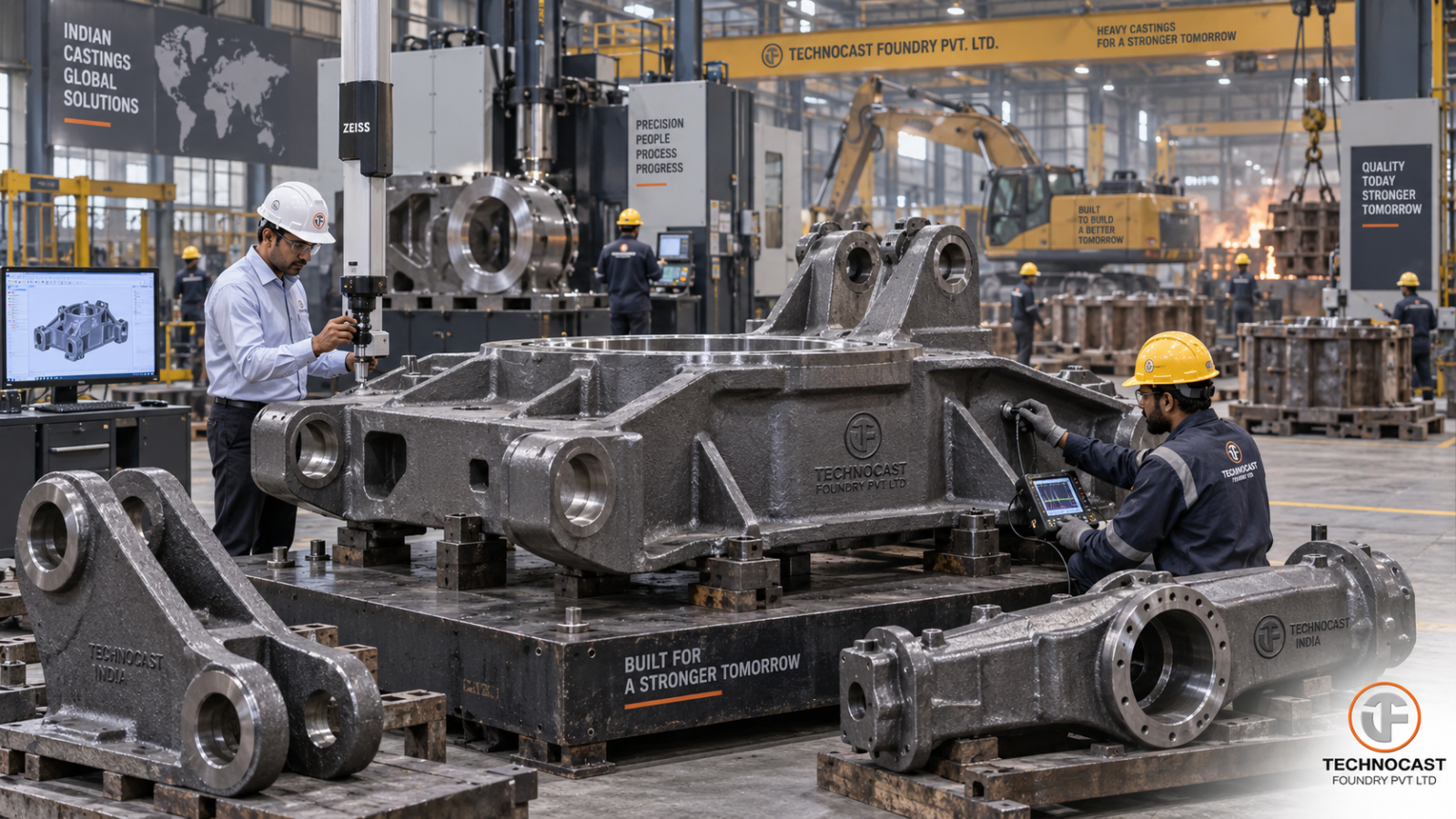
Construction and earth-moving equipment operates under conditions that expose components to repeated shock, vibration, fatigue, abrasive environments and high structural loads.
For an excavator, loader or other off-highway machine, the performance of a heavy casting cannot be evaluated only by whether it meets the drawing dimensions.
A swing frame may experience repeated torsional loading during slewing.
A boom bracket must transfer high loads through pin bores without developing premature fatigue cracks.
An axle housing must maintain bearing alignment while transmitting torque and resisting bending loads.
For these components, metallurgical consistency, internal soundness, heat-treatment control, machining accuracy and inspection evidence are all part of the final product.
That makes construction-equipment casting sourcing fundamentally different from buying a simple commodity component.
OEM sourcing and engineering teams need to know not only:
“Can the foundry manufacture this casting?”
but also:
“Can the foundry repeatedly manufacture it to the required mechanical, dimensional and inspection requirements at production volume?”
The supplied technical brief identifies these as the core sourcing concerns: mechanical-property compliance, defect control, stable production and objective inspection evidence through methods such as NDT, CMM and spectrometry.
Why Casting Quality Matters in Construction Machinery
Heavy equipment components regularly experience combinations of:
- Cyclic loading
- Impact
- Bending
- Torsion
- Abrasive contamination
- High bearing loads
- Vibration
- Temperature variation
A defect that appears minor during manufacturing can become much more significant after thousands of operating cycles.
For example, internal shrinkage near a highly stressed rib intersection may create a fatigue initiation point.
Poor control of machining datums can produce pin-bore misalignment.
Residual stresses in a large casting may cause dimensional movement after rough machining.
Inconsistent metallurgy may produce different hardness or mechanical behaviour from one production batch to another.
This is why heavy-equipment casting programs need to combine:
Material specification + process engineering + heat treatment + machining + inspection.
Common Cast Components in Construction and Earth-Moving Equipment
Different construction-machinery components fail in different ways, so they should not all be approached with the same casting and inspection strategy.
Swing Frames and Upper-Structure Components
The swing frame—or slew-platform structure in certain machine designs—carries significant structural loads generated during digging and machine rotation.
Typical loading concerns include:
- Torsion during slewing
- Repeated digging-cycle loads
- Shock
- Stress concentration around ribs
- Fatigue at section transitions
For a heavy cast structure, the engineering focus can include:
- Internal soundness
- Thick-section solidification
- Residual-stress management
- Mounting-surface flatness
- Bore alignment
- Machining stability
For suitable large and complex castings, no-bake sand moulding can be considered because it provides flexibility for heavy sections, cores and larger geometries.
Boom Brackets and Boom-Foot Lugs
Boom connections transfer substantial forces between the boom, frame and hydraulic system.
Pin-bore regions are particularly important.
Potential engineering concerns include:
- High bearing stresses
- Fatigue
- Micro-shrinkage
- Inclusion control
- Bore distortion
- Fillet consistency
The casting must provide enough machining stock to produce the final bore while avoiding unnecessary excess material.
Depending on component size and production quantity, the process route may involve no-bake moulding for larger components or automated moulding for repeatable mid-weight components.
Arm and Link Brackets
Arm brackets and linkage components often experience combinations of bending, shock and repeated articulation.
The pin-bore geometry is especially important because dimensional variation can affect:
- Assembly alignment
- Bearing or bush loading
- Wear
- Linkage movement
- Service life
For these parts, the drawing should clearly define:
- Machining datums
- Critical bore relationships
- Casting tolerances
- Machining allowances
- Required inspection
Where dimensional relationships are critical, CMM inspection can provide objective verification.
Axle Housings
Axle housings must maintain geometric stability while transmitting substantial loads.
Engineering concerns can include:
- Torque
- Bending
- Bearing alignment
- Sealing surfaces
- Internal cleanliness
- Housing rigidity
Large housings may favour flexible sand-casting routes, while repeatable medium-size housings may suit automated moulding where the line’s size and weight capability permits it.
Wheel Hubs
Wheel hubs experience rotating load, bearing stress and repeated operational cycles.
Critical areas commonly include:
- Bearing seats
- Flange locations
- Mounting features
- Concentricity
- Material consistency
The casting process should therefore be designed around the final machined geometry rather than only the rough casting dimensions.
Steering Knuckles
Steering knuckles are highly loaded components where fatigue performance and dimensional accuracy can be particularly important.
Engineering control can include:
- Chemistry
- Microstructure
- Mechanical properties
- Machining datums
- Bearing interfaces
- Joint interfaces
- CMM inspection
The supplied brief specifically identifies high-cycle fatigue, impact loading and tight machining tolerances as important considerations for steering-knuckle applications.
Selecting the Right Material
Material selection should begin with the expected failure mode rather than simply selecting the highest-strength grade available.
Important questions include:
Is fatigue the primary risk?
Does the component experience severe impact?
Is wear the dominant requirement?
Does the part need to be welded into another structure?
Will the component require significant machining?
Different answers can lead to different material choices.
Ductile Iron
Ductile—or spheroidal graphite—iron can provide a useful combination of:
- Strength
- Elongation
- Castability
- Machinability
- Fatigue performance
Typical grades identified in the supplied material include:
EN-GJS-400-15
Minimum tensile strength referenced: approximately 400 MPa
Minimum elongation: approximately 15%
This relatively ductile grade can be considered where toughness and elongation are important.
EN-GJS-500-7
Minimum tensile strength referenced: approximately 500 MPa
Minimum elongation: approximately 7%
This provides a higher-strength balance suitable for a range of structural and machinery castings.
EN-GJS-600-3
Minimum tensile strength referenced: approximately 600 MPa
Minimum elongation: approximately 3%
This grade provides higher strength with reduced elongation compared with lower-strength ductile-iron grades.
The supplied technical brief identifies these EN 1563 grades as examples used for machinery structures, housings, hubs and brackets.
The correct grade should always be selected according to the component’s actual loading and specification rather than treating higher tensile strength as automatically better.
Carbon Steel Castings
Carbon steel castings may be specified when the application requires combinations of:
- Strength
- Toughness
- Weldability
- Structural performance
The source identifies standards including:
IS 1030
ASTM A27
ASTM A216 WCB
for relevant engineering casting applications.
Steel casting requires careful attention to:
- Solidification
- Feeding
- Heat treatment
- Weld-repair requirements where permitted
- Machining
- Inspection
The applicable material standard and acceptance criteria should be defined before the foundry develops the manufacturing route.
Alloy and Case-Hardening Steel
The source also discusses 20MnCr5 as a case-hardening material option for applications requiring a hard wear-resistant surface combined with a tougher core.
Where such materials are considered, the sourcing package needs to define the complete treatment and acceptance route rather than specifying only a material name.
That can include:
- Chemistry
- Heat-treatment specification
- Required hardness
- Case-depth requirements
- Distortion control
- Final machining
The exact manufacturability of any specific alloy and component should be confirmed with the foundry before design release.
Choosing the Casting Process for Heavy Components
Material selection alone does not determine casting quality.
The moulding process must suit:
- Casting weight
- Component envelope
- Geometry
- Section thickness
- Core complexity
- Annual quantity
- Required repeatability
No-Bake Sand Casting
No-bake—or air-set—moulding is particularly relevant for larger and more complex industrial castings.
It offers flexibility for:
- Heavy castings
- Thick sections
- Large moulds
- Complex core arrangements
- Lower-to-medium production quantities
Applications can include:
- Swing frames
- Large axle housings
- Large structural brackets
- Heavy off-highway components
The source identifies no-bake as a strong process fit for heavy construction-equipment geometries where coring and section control are important.
DISA High-Pressure Moulding
Automated high-pressure moulding becomes attractive when production requires:
- Higher output
- Repeatability
- Consistent mould characteristics
- Reduced mould-to-mould variation
For suitable component envelopes and weights, this makes DISA-type moulding useful for repeat-production programs.
Potential applications can include:
- Brackets
- Housings
- Hubs
- Medium-size structural components
The process should be selected only after confirming that component dimensions, weight and geometry fall within the actual moulding-line capability.
Shell Moulding
Shell moulding is more suited to smaller precision components than extremely large structural castings.
Its advantages can include:
- Improved surface finish
- Better dimensional repeatability
- Reduced machining allowance
- Good reproduction of detailed features
It may therefore be appropriate for smaller construction-equipment brackets and precision subcomponents rather than very heavy swing-frame-type castings.
Why Heat Treatment Matters
The casting process does not always finish when the component cools.
Heat treatment can have an important influence on:
- Mechanical properties
- Residual stress
- Distortion
- Hardness
- Microstructure
- Machining stability
Normalising
Normalising can be used for appropriate carbon and alloy steel castings to refine grain structure and improve consistency across sections.
Hardening and Case Hardening
For wear-related applications, suitable alloys may undergo processes such as:
- Carburising
- Quenching
- Hardening
These treatments can create a hard wear-resistant surface while retaining a tougher core.
Stress Relieving
Stress relief is particularly important for large castings.
Different sections of a casting cool at different rates.
This can leave residual stresses within the component.
Those stresses may later become visible as:
- Distortion after rough machining
- Loss of flatness
- Bore misalignment
- Dimensional movement
For heavy structural castings, heat-treatment strategy should therefore be considered together with machining sequence.
The source particularly highlights residual-stress control for swing frames and other large brackets where dimensional stability matters after machining.
Inspection Requirements for Construction Machinery Castings
Quality documentation becomes increasingly important as casting criticality increases.
OEM buyers should define inspection requirements before production rather than adding them after first-article problems occur.
Spectrometer Analysis
Optical emission spectrometry can verify melt chemistry against the specified EN, ASTM or IS grade.
This becomes particularly important for:
- Material traceability
- Batch control
- Supplier qualification
- New-source approval
Ultrasonic Testing
Ultrasonic testing can help identify internal discontinuities in suitable casting geometries and materials.
For large, thick-section structural components, UT can be particularly valuable in critical areas.
However, inspection scope and acceptance levels should be clearly agreed.
The specification should define:
- Areas to inspect
- Inspection method
- Acceptance criteria
- Reporting requirements
CMM Inspection
Coordinate Measuring Machines can verify important geometric relationships after casting and machining.
Typical construction-equipment applications include checking:
- Bore positions
- Datum relationships
- Mounting faces
- Centre distances
- GD&T requirements
For articulated components, bore alignment can directly affect assembly and service performance.
Pressure or Leak Testing
Where a housing contains fluid, pressure or sealed cavities, leak testing may form part of the validation plan.
Not every construction-equipment casting requires pressure testing, so it should be specified according to the actual function.
The supplied brief groups spectrometry, UT, CMM and pressure/leak testing among the main objective verification tools available to OEM buyers.
Dimensional Tolerance Planning
One common sourcing mistake is applying machining tolerances to every as-cast surface.
This can make the casting unnecessarily expensive or difficult to manufacture.
Instead, engineering teams should separate:
As-cast dimensions
from
machined critical dimensions.
Casting tolerances can be planned using frameworks such as ISO 8062, while machining can be reserved for:
- Pin bores
- Bearing seats
- Mounting surfaces
- Datums
- Sealing locations
This allows the process to place precision where it delivers functional value.
Why DFM Matters for Heavy Castings
Foundry involvement before drawing release can materially affect manufacturability.
A DFM review should consider:
- Section thickness
- Thick-to-thin transitions
- Rib geometry
- Fillet radii
- Core design
- Parting line
- Gating
- Feeding
- Machining allowance
- Datums
- Heat-treatment distortion
Consider a heavily loaded bracket.
Adding metal everywhere may look like the safest engineering response.
But additional mass can also create:
- Hot spots
- Greater feeding requirements
- Longer cooling times
- Higher residual stress
- More machining
The better solution can be to optimise the geometry rather than simply increase section thickness.
This is why early collaboration between OEM designers and foundry engineers can reduce both technical risk and production cost.
Sourcing Construction Machinery Castings From India
For international OEMs, India can provide access to an established foundry and machining manufacturing ecosystem.
However, purchasing decisions should not be based solely on labour-cost assumptions.
A heavy-casting sourcing program should evaluate three areas.
Cost Competitiveness
The final comparison should include:
- Casting price
- Tooling
- Machining
- Heat treatment
- Inspection
- Packaging
- Logistics
- Quality risk
The lowest ex-works casting price does not necessarily produce the lowest landed component cost.
Engineering Capability
Look for a supplier capable of discussing:
- Material grade
- Casting DFM
- Gating and feeding
- Machining allowances
- Inspection planning
- Heat treatment
- Defect prevention
The objective should be engineering collaboration, not simply drawing-to-quotation conversion.
Export Readiness
International supply also requires control of:
- Packaging
- Corrosion protection
- Traceability
- Documentation
- Incoterms
- Inspection hold points
- Delivery planning
These factors should be agreed during supplier qualification rather than after serial production begins.
Construction Casting RFQ Checklist
Before sending an RFQ for a heavy equipment casting, provide the foundry with as much of the following information as possible.
Drawing Revision
Clearly identify the latest drawing and revision level.
Material Specification
Specify the required:
- EN
- ASTM
- IS
standard and exact material grade.
Annual and Lifetime Volume
This influences:
- Process selection
- Tooling
- Automation
- Commercial amortisation
Single-Piece Weight
Provide estimated raw and/or finished component weight where available.
Tolerance Plan
Define:
- Casting tolerance
- Machining allowance
- Critical dimensions
- Datum strategy
Inspection Plan
Identify required:
- Chemistry verification
- UT
- CMM inspection
- Hardness
- Mechanical testing
- Microstructure checks
only where functionally necessary.
Heat Treatment
Define whether the component requires:
- Normalising
- Stress relief
- Hardening
- Case hardening
and include final property requirements.
Defect Acceptance Criteria
Agree on:
- Permitted indications
- NDT acceptance criteria
- Repair rules
- Welding restrictions
before production.
Logistics Requirements
Specify:
- Packaging
- Corrosion protection
- Delivery location
- Incoterm
- Documentation
The source provides a similar RFQ framework covering material specification, ISO 8062 tolerance planning, inspection, heat treatment, defect acceptance, process selection, lead time and logistics.
Technocast Foundry for Construction Machinery Castings
Construction-equipment sourcing requires more than a foundry capable of pouring heavy metal components.
The manufacturing partner needs to connect:
Material → Moulding → Heat Treatment → Machining → Inspection
into one controlled production route.
Technocast Foundry’s documented manufacturing profile includes high-pressure moulding capability and supports process selection for industrial casting programs. The supplied construction-equipment brief also identifies no-bake and automated moulding as relevant process routes depending on component weight, geometry and production quantity.
For a new construction-machinery casting enquiry, the technical evaluation should begin with:
- Component drawing
- Material specification
- Approximate casting weight
- Annual volume
- Machining requirements
- Heat-treatment requirements
- Inspection plan
From there, the foundry can evaluate the appropriate material, moulding process, tooling concept and manufacturing route.
Conclusion
Construction-equipment castings operate in an environment where small manufacturing inconsistencies can become expensive field problems.
For components such as:
- Swing frames
- Boom brackets
- Arm brackets
- Axle housings
- Wheel hubs
- Steering knuckles
successful sourcing requires more than comparing piece prices.
OEM engineering and procurement teams should evaluate:
Metallurgy
Is chemistry and microstructure controlled?
Casting soundness
How are shrinkage and internal defects managed?
Heat treatment
Will the component remain mechanically and dimensionally stable?
Machining
Are critical bores and datums controlled?
Inspection
Can the supplier provide objective evidence through spectrometry, UT and CMM where required?
Process capability
Does the selected moulding route genuinely match the weight, geometry and production volume?
The right foundry should therefore be capable of discussing the entire manufacturing route—not simply responding with a price per kilogram.
Request a Construction Machinery Casting Quote
If you are developing or re-sourcing a swing frame, boom bracket, axle housing, steering component or other heavy construction-equipment casting, send Technocast:
- Your component drawing
- Required material grade
- Estimated casting weight
- Annual production quantity
- Machining requirements
- Inspection requirements
The manufacturing route, process feasibility, tooling requirement and commercial quotation can then be evaluated around the actual component.
Frequently Asked Questions
What materials are commonly used for construction machinery castings?
Depending on loading and application requirements, materials can include ductile iron, carbon cast steel and suitable alloy steels. The grade should be selected according to fatigue, impact, wear, strength and machining requirements.
Which casting process is suitable for heavy construction components?
Large and complex components can be candidates for no-bake sand casting, while repeatable medium-size components may suit automated high-pressure moulding where the machine envelope permits. Process selection depends on weight, dimensions, geometry and production quantity.
Why is ultrasonic testing used on heavy castings?
UT can help identify internal discontinuities in suitable thick-section castings. The exact inspection zones and acceptance criteria should be specified according to component criticality.
Why are swing-frame castings difficult to manufacture?
Large structural castings can combine thick sections, ribs, complex load paths and tight machined relationships. Solidification control, residual stress, internal soundness and dimensional stability therefore become important.
What information should an OEM provide when requesting a casting quote?
Provide the drawing, material standard, component weight, annual volume, machining requirements, heat treatment, inspection requirements and applicable acceptance criteria.
Can a foundry supply a completely machined construction-equipment component?
Potentially, where the supplier has suitable machining capability. For such programs, the foundry and machining process should be planned together so that machining allowances, datums and inspection requirements are controlled from the beginning.