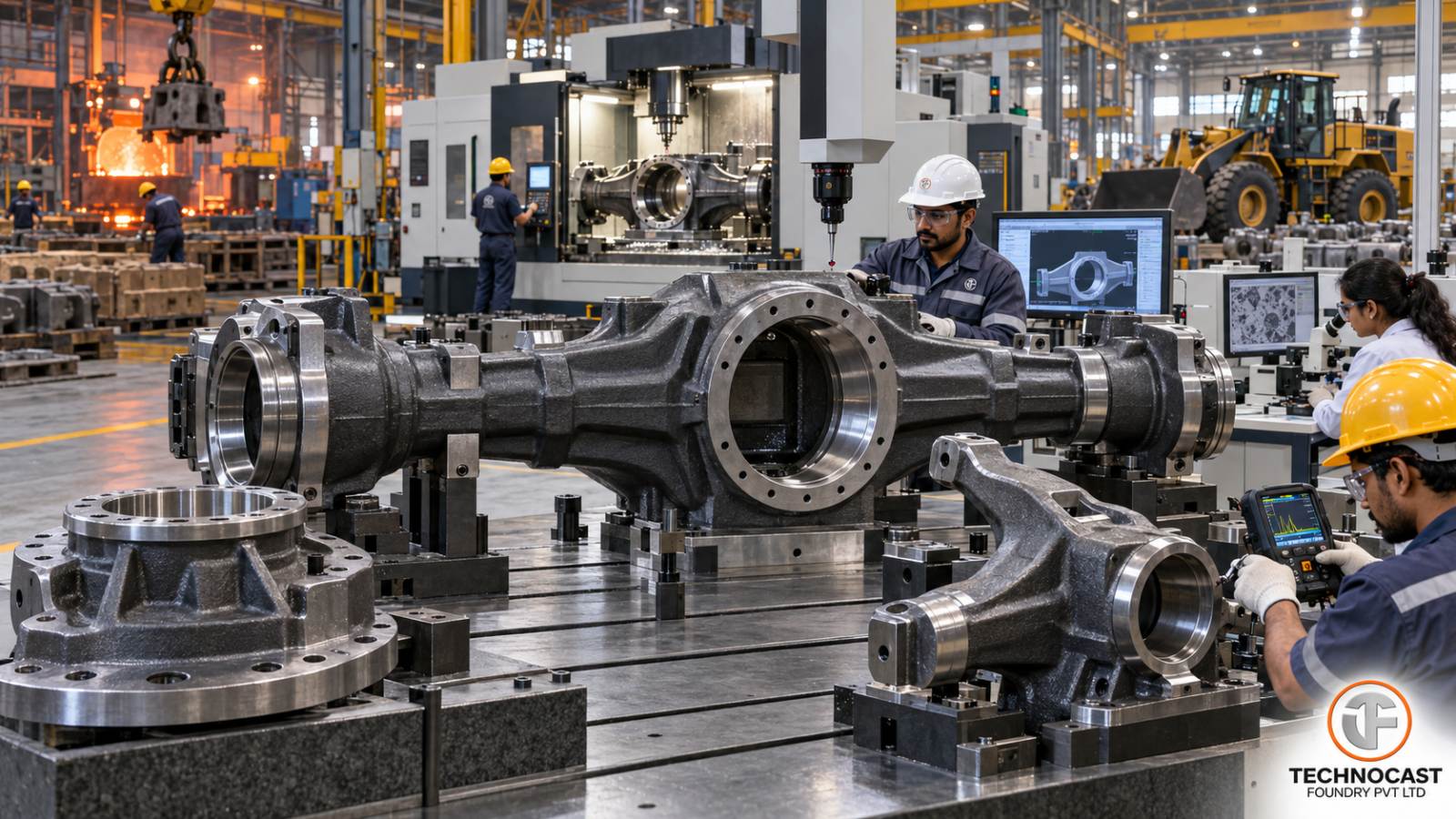
Off-highway equipment operates in an environment where load conditions are rarely gentle or predictable.
A tractor, wheel loader, backhoe loader, mining vehicle or other heavy machine may experience high payloads, uneven terrain, sudden steering loads, braking forces, vibration, contamination and repeated impact—all within a single operating shift.
That places unusual demands on structural cast components such as:
- Axle housings
- Wheel hubs
- Steering knuckles
- Carriers
- Heavy structural brackets
- Wheel-end components
For these parts, a casting defect is not simply a visual quality issue.
A small region of porosity near a highly loaded fillet, poor graphite nodularity, dimensional movement after heat treatment or an incorrectly positioned bearing bore can eventually become:
- Fatigue cracking
- Premature bearing wear
- Alignment problems
- Wheel-end failure
- Leakage
- Assembly difficulty
- Warranty exposure
That is why successful off-highway casting sourcing must bring together:
material selection + casting design + melt control + heat treatment + machining + inspection + traceability.
For OEM procurement and engineering teams, the right question is not:
“Can this supplier cast our part?”
It is:
“Can this supplier repeatedly manufacture the part for the actual duty cycle our machine will experience?”
What Are Off-Highway Castings?
Off-highway castings are structural or functional metal components used in machines that operate primarily outside conventional paved-road environments.
Applications include equipment such as:
- Agricultural tractors
- Wheel loaders
- Backhoe loaders
- Mining vehicles
- Haul trucks
- Earth-moving equipment
- Industrial utility vehicles
These machines can experience far less predictable load histories than conventional on-road vehicles.
Typical conditions include:
- Pothole impact
- Ditch crossings
- Uneven terrain
- High vertical acceleration
- Heavy steering loads
- Repeated braking
- Payload variation
- Dust and contamination
- Temperature swings
The supplied technical brief notes that field duty cycles can include severe acceleration events, which is one reason steering knuckles and axle-end components need to be engineered around combined impact, bending and fatigue rather than nominal static load alone.
The casting must therefore survive both:
normal repeated operating loads
and
occasional severe events.
Axle Housing Castings
Axle housings are among the most structurally significant cast components in an off-highway drivetrain.
Depending on the vehicle architecture, the housing may locate:
- Gears
- Bearings
- Differential components
- Steering pivots
- Bushing locations
- Sealing interfaces
The component must remain stiff enough to maintain geometry while simultaneously carrying substantial bending and torsional loads.
Key Engineering Requirements
Structural Stiffness
The housing must resist deflection under load.
Excess movement can influence:
- Gear alignment
- Bearing loads
- Seal performance
- Shaft alignment
Fatigue Resistance
Axle housings experience repeated loading throughout machine operation.
A local casting discontinuity located near a high-stress transition can significantly reduce fatigue life.
Mixed Loading
The housing may experience:
bending + torsion + shock
at the same time.
This is one reason simply selecting a material based on tensile strength can be misleading.
Dimensional Stability
Critical machined locations can include:
- Bearing bores
- Flange faces
- Kingpin bores
- Bushing locations
- Differential mounting positions
These dimensions need to remain stable after:
- Heat treatment
- Rough machining
- Finish machining
and through service.
Solidification Control
Large axle housings can combine thick structural nodes with thinner walls and ribs.
This creates a solidification challenge.
Potential high-risk regions include:
- Rib-to-wall intersections
- Bosses
- Heavy flange transitions
- Bearing support regions
Poor feeding or risering can contribute to shrinkage or micro-porosity in exactly the regions carrying the highest stress.
The source identifies repeatable bore position, distortion control and internal soundness as some of the major manufacturing concerns for axle-housing programs.
Wheel Hub Castings
Wheel hubs and carriers combine structural loading with rotating fatigue.
Unlike a stationary housing, the hub repeatedly rotates while transmitting load through:
- Bearings
- Stud locations
- Flanges
- Wheel interfaces
This makes geometric and surface quality important.
Key Risk Areas
Bearing Seats
Bearing interfaces need controlled:
- Diameter
- Roundness
- Concentricity
- Surface finish
A dimensional issue here may accelerate bearing wear.
Flange Transitions
Sharp geometric transitions can increase local stress concentration.
Good fillet and radius control can improve fatigue performance.
Stud Holes
Stud-hole regions can act as fatigue stress raisers if geometry or surface integrity is poor.
Rotating Fatigue
Every machine rotation produces repeated loading.
This means relatively small material or dimensional inconsistencies can accumulate over large numbers of operating cycles.
The supplied source specifically highlights notch sensitivity around stud holes, flange transitions and bearing shoulders.
Steering Knuckle Castings
Steering knuckles are especially demanding because multiple loads converge into a relatively compact component.
A knuckle can experience:
- Vertical wheel loading
- Braking torque
- Steering forces
- Bending
- Shock impact
- Repeated fatigue loading
Critical regions can include:
- Steering-arm transitions
- Bearing interfaces
- Spindle areas
- Joint locations
- Fillets
Why Metallurgy Matters
For ductile-iron steering knuckles, the nominal material grade alone does not guarantee fatigue performance.
The actual casting also depends on:
- Graphite nodularity
- Nodule distribution
- Matrix structure
- Porosity
- Inclusions
- Section cooling behaviour
A drawing may specify the correct material grade, but poor metallurgical execution can still produce a weak component.
That is why microstructure and defect population should be treated as part of the durability system.
The supplied brief specifically connects steering-knuckle fatigue performance with graphite morphology, porosity, inclusions and overall microstructural quality.
Why Ductile Iron Is Widely Used
Ductile iron is attractive for off-highway applications because it combines:
- Castability
- Strength
- Elongation
- Fatigue performance
- Machinability
- Cost efficiency
Unlike conventional grey iron, ductile iron contains graphite primarily in spheroidal—or nodular—form.
That changes the material’s mechanical behaviour significantly.
For global OEM sourcing, ductile iron grades are commonly specified through standards such as:
EN 1563
or
ISO 1083
with ASTM A536 also frequently relevant in international sourcing discussions.
The important point is not to treat ductile iron as one material.
Different EN-GJS grades provide different balances between:
strength
and
ductility.
EN-GJS-400-18U-LT
Where impact toughness and low-temperature performance are important, a ferritic ductile-iron grade can become attractive.
The supplied source describes an EN-GJS-400-18U-L(T) family with approximately:
≥400 MPa tensile strength
≥250 MPa yield strength
≥18% elongation
along with low-temperature impact requirements in LT variants.
This type of material can be relevant to axle-housing applications operating in colder environments where impact margin is important.
A ferritic microstructure can improve ductility and toughness, although the complete requirement should always follow the applicable standard and customer specification.
EN-GJS-450-10
This represents a stronger grade while retaining useful elongation.
The source describes approximate minimum values around:
450 MPa tensile strength
310 MPa yield strength
10% elongation.
Potential applications can include:
- Wheel hubs
- Carriers
- Structural housings
where a balance between strength and machinability is required.
EN-GJS-500-7
EN-GJS-500-7 is a widely relevant engineering ductile-iron class.
The supplied material references approximately:
≥500 MPa tensile strength
≥320 MPa yield strength
≥7% elongation.
Its ferritic-pearlitic balance can provide useful strength while retaining more ductility than higher-strength grades.
Potential applications include:
- Steering knuckles
- Axle structures
- Hubs
- Heavy brackets
depending on the specific duty cycle.
The source also discusses normalising as one possible processing route for managing property consistency in appropriate applications.
EN-GJS-600-3
Where packaging space or structural load drives the design toward higher strength, EN-GJS-600-3 may be considered.
The supplied material references approximately:
≥600 MPa tensile strength
≥370 MPa yield strength
~3% elongation.
But the trade-off is important.
Increasing tensile strength while reducing elongation is not automatically an improvement for every off-highway component.
A high-impact application may benefit more from toughness and ductility than maximum tensile strength.
Do Not Select Ductile Iron by Tensile Strength Alone
A common sourcing mistake is to compare:
400 MPa
500 MPa
600 MPa
and conclude that the highest number is the best material.
That ignores the actual duty cycle.
Material selection needs to consider:
- Tensile strength
- Yield strength
- Elongation
- Impact requirements
- Operating temperature
- Wall thickness
- Heat treatment
- Fatigue
- Machining requirements
Heavy casting sections also cool differently from thin sections.
The resulting microstructure and mechanical properties can therefore vary according to geometry.
The source specifically warns buyers to consider grade + heat treatment + section thickness + temperature requirement rather than selecting the alloy from one mechanical-property number.
Major Manufacturing Challenges in Off-Highway Castings
Heavy-equipment castings are difficult because multiple manufacturing challenges occur in the same component.
1. Heavy-Section Solidification
An axle housing may have:
- Thin walls
- Thick bosses
- Structural ribs
- Heavy bearing supports
all in one casting.
These sections do not cool at the same rate.
If feeding and solidification are poorly controlled, defects can develop around thick nodes.
The foundry therefore needs to engineer:
- Gating
- Risering
- Feeding
- Section transitions
around the actual geometry.
2. Microstructure Across Different Wall Thicknesses
Cooling rate influences ferrite and pearlite development.
A thin section may behave differently from a thick section even though both belong to the same casting.
Heat treatment can help modify the final structure, but it introduces another variable:
distortion.
That means the complete manufacturing route should be designed together.
3. Datum Strategy
One of the most overlooked issues in heavy-equipment castings is datum planning.
An axle housing may pass rough dimensional checks and still become problematic after machining if the datum strategy does not account for casting variation and distortion.
The process may need to consider:
casting datum → rough machining → stress relief where required → final machining → CMM inspection
as one planned route.
The supplied source identifies heavy-section solidification, microstructure uniformity and machining-datum/distortion management as the three recurring manufacturing challenges.
Heat Treatment and Dimensional Stability
Heat treatment should be selected according to what the material and component actually require.
Possible objectives include:
- Ferritic structure
- Greater toughness
- More consistent mechanical properties
- Stress relief
- Dimensional stability
But heat treatment is not automatically beneficial.
A poorly controlled heat-treatment process can cause:
- Distortion
- Bore movement
- Flatness variation
- Additional machining requirements
This is why heat treatment and machining sequence need to be developed together.
For large axle housings, for example, a useful process review should consider:
- Initial casting geometry
- Heat treatment
- Rough machining
- Residual-stress behaviour
- Finish machining
- Final CMM verification
Quality Assurance for Off-Highway Castings
No single inspection method can prove every aspect of casting quality.
A strong QA plan combines several methods, each targeting a different risk.
Ultrasonic Testing
UT can be used to evaluate internal integrity in appropriate sections.
This can be valuable around areas such as:
- Heavy bosses
- Thick junctions
- Structural nodes
- Critical fillet regions
The actual inspection scope should define:
- Inspection location
- Method
- Acceptance standard
- Reporting requirements
rather than simply stating:
“UT required.”
Magnetic Particle Inspection
For suitable ferromagnetic components, MPI can be used to identify surface and near-surface indications.
It may be particularly useful after machining where crack-sensitive areas become accessible.
The inspection requirement should still follow the applicable customer or industry specification.
CMM Inspection
Coordinate Measuring Machines are particularly important for geometric relationships that determine assembly performance.
For axle housings, hubs and steering knuckles, this can include:
- Bore position
- Coaxiality
- Datum relationships
- Flange geometry
- Centre distances
- GD&T features
CMM inspection can also help identify process drift between:
- Mould sets
- Machining fixtures
- Production batches
Hardness Testing
Hardness is a relatively quick method for monitoring material consistency.
Unexpected hardness variation may indicate changes in:
- Microstructure
- Heat treatment
- Cooling behaviour
It should not replace full mechanical or metallurgical testing where those are required, but it can be a valuable production-control tool.
Metallography and Nodularity
For ductile iron, graphite nodularity is fundamental.
Metallographic evaluation may be used to assess:
- Graphite shape
- Nodule distribution
- Matrix
- Carbides
- Other microstructural features
This becomes particularly important for fatigue-sensitive components.
Traceability
For structural or safety-related components, traceability should link the finished casting back to relevant production information.
Depending on the program, that may include:
- Heat number
- Melt chemistry
- Treatment record
- Test coupon
- Heat-treatment batch
- Machining batch
- Inspection report
The source identifies UT, CMM, hardness, metallography/nodularity and heat/lot traceability as important layers in an off-highway casting QA plan.
How Procurement Teams Should Qualify an Off-Highway Casting Supplier
Supplier qualification should test the process—not just the finished sample.
A strong first casting does not prove that serial production will remain stable.
Audit the complete manufacturing route.
Melt Control
Review:
- Charge control
- Chemistry
- Magnesium treatment
- Inoculation
- Nodularity
- Pouring practice
Moulding and Core Control
Evaluate:
- Sand control
- Core positioning
- Mould repeatability
- Tooling condition
Solidification Engineering
Discuss:
- Feeding
- Risering
- Hot spots
- Shrinkage-risk regions
Heat Treatment
Where relevant, verify:
- Cycle
- Temperature control
- Batch traceability
- Distortion management
Machining
Review:
- Datum scheme
- Fixtures
- Rough/finish machining sequence
- Tool control
Inspection
Confirm:
- CMM
- UT
- Hardness
- Metallography
- Other NDT
according to the component requirement.
Process Approval
For OEM programs, use structured first-article or PPAP-style approval where appropriate.
The source specifically recommends auditing melt treatment, nodularity, inoculation and heat-treatment uniformity in addition to part approval.
Sourcing Off-Highway Castings From India
India has a mature industrial foundry ecosystem serving:
- Automotive
- Agriculture
- Construction
- Mining
- Heavy engineering
- Pumps
- Industrial machinery
For international OEMs, the attraction can include:
- Established casting capability
- Engineering talent
- Integrated machining
- Competitive conversion economics
- Export experience
But country-level advantages should never replace plant-level qualification.
The actual supplier must still prove:
- Metallurgy
- Repeatability
- Machining
- Inspection
- Documentation
- Delivery capability
What to Ask an Indian Off-Highway Casting Supplier
For a ductile-iron program, request evidence around:
Material Compliance
Can the foundry produce the required EN-GJS grade according to the specified standard?
Heat Treatment
Does the supplier understand why the selected heat-treatment route is required?
Section Thickness
How will properties be controlled through heavy regions of the component?
CMM Capability
Can critical bores and datums be reported objectively?
Internal Integrity
What UT or other NDT plan applies to critical areas?
Metallography
How is graphite morphology and matrix structure controlled?
Traceability
Can a finished component be traced back to its melt and inspection records?
The supplied source recommends this same standards-first qualification approach for Indian off-highway casting suppliers.
Evaluating Technocast Foundry for Off-Highway Programs
According to the supplied brief, Technocast Foundry Pvt. Ltd. is positioned as an Indian supplier for ductile-iron castings used in demanding industrial applications.
For an OEM evaluating Technocast for an axle housing, wheel hub, steering knuckle or similar component, qualification should be based on the same evidence expected from any serious production supplier.
Request the relevant:
- Current quality certifications
- Material capability
- Process flow
- Heat-treatment route
- Inspection plan
- CMM capability
- Applicable NDT capability
- Traceability process
- Sample reports
- Export references where relevant
For the specific part under review, the discussion should begin before tooling is released.
That allows the OEM and foundry to align:
material grade → casting design → heat treatment → machining → inspection
around the actual duty requirement.
Off-Highway Casting RFQ Checklist
When sending an RFQ, include:
Drawing
Use the latest controlled revision.
3D Model
Where available.
Material Standard and Grade
For example:
- EN-GJS-400-18 family
- EN-GJS-450-10
- EN-GJS-500-7
- EN-GJS-600-3
depending on engineering requirements.
Heat-Treatment Intent
Do not simply state a treatment without defining the required final property.
Single-Piece Weight
Provide casting and/or finished weight where known.
Annual Volume
This affects tooling and process selection.
Lifetime Volume
Useful for commercial and capacity planning.
Critical Dimensions
Identify:
- Bearing bores
- Flanges
- Pin bores
- Datum relationships
- Coaxiality
- GD&T
Inspection Requirements
Define:
- CMM
- UT
- Hardness
- Mechanical testing
- Impact testing where required
- Metallography
- Nodularity
Traceability
Specify expected heat/lot identification.
Packaging
For export programs, include corrosion protection and handling requirements.
Conclusion
Axle housings, wheel hubs and steering knuckles do not fail because a material specification looked weak on paper.
They fail when the complete durability system is not controlled.
For off-highway equipment, that system includes:
Duty cycle
Material grade
Graphite structure
Section thickness
Solidification
Heat treatment
Machining
Dimensional stability
Internal integrity
Traceability
The strongest sourcing decision therefore comes from qualifying the complete manufacturing route.
For procurement teams, the key question should be:
“Can this foundry prove that the casting will remain metallurgically and dimensionally stable through real heavy-equipment service?”
That requires more evidence than a quotation and material certificate.
It requires a controlled process.
Request an Off-Highway Casting Technical Review
If you are developing or re-sourcing an:
- Axle housing
- Wheel hub
- Steering knuckle
- Carrier
- Structural ductile-iron component
send Technocast:
- Drawing
- Material grade
- Single-piece weight
- Annual volume
- Heat-treatment requirement
- Critical dimensions
- Inspection/NDT requirements
The component can then be reviewed for manufacturing feasibility, process route, machining and quality-control requirements before tooling release.
Frequently Asked Questions
What materials are commonly used for off-highway axle and wheel-end castings?
Ductile-iron grades under standards such as EN 1563 or ISO 1083 are commonly relevant because they offer useful combinations of strength, elongation, castability and fatigue performance.
Why is ductile iron used for steering knuckles?
Ductile iron can provide a balance of strength, toughness, castability and machining economics. However, fatigue performance also depends heavily on graphite nodularity, porosity, inclusions and overall process control.
Is EN-GJS-600-3 always better than EN-GJS-500-7?
No. EN-GJS-600-3 provides higher tensile strength but lower elongation. Material selection should follow the component’s impact, fatigue, temperature and packaging requirements rather than choosing the highest tensile-strength grade.
Why is CMM inspection important for axle housings?
Bearing bores, flange faces and datum relationships must remain accurately positioned for proper drivetrain assembly. CMM inspection provides objective verification of these geometric relationships.
Why is UT used on heavy castings?
Ultrasonic testing can help identify internal discontinuities in suitable thick sections and critical structural areas.
Why is nodularity important in ductile iron?
The graphite needs to form predominantly as spheroidal nodules to achieve the mechanical behaviour associated with ductile iron. Poor graphite morphology can reduce fatigue and mechanical performance.
What should an OEM send when requesting an off-highway casting quotation?
Provide the drawing, material specification, component weight, annual quantity, heat-treatment requirement, machining details, critical dimensions and inspection requirements.
Related at Technocast: Off-highway castings · ARPA 450 and ARPA 1300 moulding lines
Read next: Construction machinery castings · Gearbox and differential housing castings