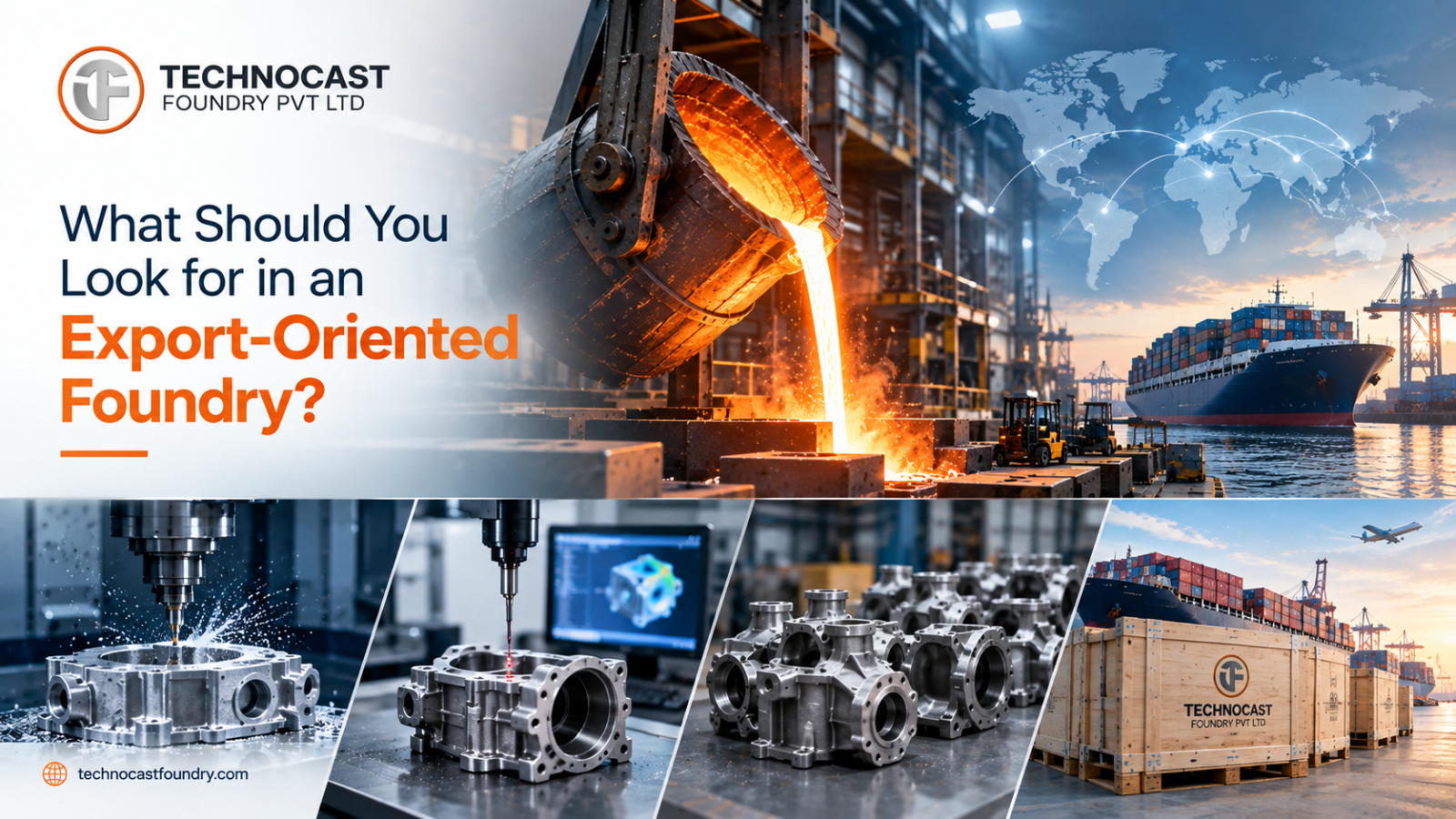
Choosing the right export-oriented foundry is an important decision for any company sourcing iron or steel castings. The lowest quoted price does not always represent the lowest overall cost. Casting quality, metallurgical control, dimensional accuracy, machining capability, inspection systems, documentation, packaging, and delivery reliability all influence the success of an international casting supply program.
A reliable foundry should be able to convert your drawing and material requirements into consistent, traceable castings while meeting the required international standards.
This guide explains the key factors to consider when selecting an export-oriented foundry for iron and steel castings.
1. Foundry Manufacturing Capability
The first step is to understand whether the foundry has the manufacturing capability required for your components.
Ask about:
- Types of iron and steel grades produced
- Casting weight range
- Monthly production capacity
- Moulding processes
- Melting capacity
- Core-making facilities
- Heat treatment capability
- Machining facilities
- Inspection and testing equipment
A foundry with integrated manufacturing capabilities can reduce the number of external suppliers involved in the production process.
Technocast Foundry operates as a one-stop casting and machining solution, with an approximate production capacity of 1,500 tonnes per month and the capability to manufacture components ranging from 1 kg to 1,500 kg. Approximately 75% of its production is exported, supporting experience in international customer requirements, documentation, packaging, and logistics.
2. Metallurgical Control and Material Quality
Casting quality begins with metallurgy.
The final mechanical properties of a casting depend on several controlled manufacturing stages, including charge material selection, chemical composition, melting temperature, inoculation, nodularisation where applicable, mould conditions, and solidification.
For example, ductile iron grades such as ASTM A536 65-45-12 require minimum mechanical properties including:
- Tensile strength: 448 MPa
- Yield strength: 310 MPa
- Elongation: 12%
These properties cannot simply be achieved through final inspection. They must be developed through proper metallurgical and process control throughout production.
When evaluating a foundry, ask for:
- Heat-wise chemical analysis
- Spectrometer reports
- Material test certificates
- Mechanical test results
- Heat number traceability
- Test coupon records
Technocast follows heat-wise spectrometer checking to support chemical composition control and traceability.
3. Quality Management System
A structured Quality Management System (QMS) is essential for consistent casting production.
For general industrial requirements, ISO 9001:2015 provides a framework for areas such as document control, calibration, traceability, corrective action, and quality management.
For automotive and other demanding applications, customers may also require suppliers to work according to IATF 16949:2016 expectations.
Depending on the application, this may involve:
- APQP – Advanced Product Quality Planning
- PPAP – Production Part Approval Process
- FMEA – Failure Mode and Effects Analysis
- SPC – Statistical Process Control
- MSA – Measurement System Analysis
- Control Plans
- Process Flow Documentation
Do not evaluate a certification only by looking at the certificate. A capable foundry should also be able to demonstrate how the quality system is implemented through actual production records, inspection reports, calibration records, and corrective-action documentation.
4. Engineering and Casting Technology
Engineering support plays an important role in producing repeatable castings.
A foundry should be capable of reviewing your:
- 2D drawings
- 3D models
- Material specifications
- Casting requirements
- Machining allowances
- Dimensional tolerances
- Inspection requirements
The engineering team should then translate these requirements into an appropriate casting process, including mould design, core requirements, gating, risering, feeding, and machining considerations.
Dimensional tolerances should be clearly defined using recognized standards such as ISO 8062. For green-sand castings, tolerance requirements can vary depending on casting geometry, process capability, and customer specifications.
Instead of relying on general statements such as “high accuracy,” customers should ask for documented dimensional capability and inspection results.
5. In-House CNC Machining Capability
Casting and machining are closely connected.
When machining is handled by a separate supplier, additional transportation, packaging, inspection, communication, and dimensional-control stages are introduced. An integrated foundry and machining facility can reduce these interfaces.
When evaluating machining capability, check whether the supplier can handle critical features using equipment such as:
- Vertical Machining Centers (VMC)
- Horizontal Machining Centers (HMC)
- Vertical Turning Lathes (VTL)
- CNC turning equipment
- Coordinate Measuring Machines (CMM)
CMM inspection is particularly useful for verifying critical dimensions and geometric requirements against the customer’s drawing.
Technocast’s one-stop manufacturing approach combines casting, machining, and inspection support, helping maintain continuity between casting datums, machining datums, and final inspection.
6. Capability to Meet ASTM and EN Standards
International customers often work with different material standards depending on their country and industry.
An export-oriented foundry should therefore understand commonly specified ASTM and EN material grades.
For example, gray iron may be specified according to ASTM A48, while ductile iron may be specified according to ASTM A536 or relevant EN standards.
Examples include:
ASTM A48 Gray Iron
Different ASTM A48 classes specify different minimum tensile strength requirements. For example, Class 30 corresponds to a minimum tensile strength of approximately 207 MPa.
ASTM A536 Ductile Iron
ASTM A536 grades such as 80-55-06 specify minimum mechanical properties including 552 MPa tensile strength, 379 MPa yield strength, and 6% elongation.
EN-GJS-500-7
This ductile iron grade specifies a minimum tensile strength of 500 MPa and minimum elongation of 7%.
The exact material grade should always be confirmed against the customer’s drawing, purchase specification, applicable standard, and testing requirements.
A good practice is to request recent material test certificates and test-coupon results for the specific grade being purchased.
7. Inspection and Testing Facilities
Inspection should be matched to the casting’s application and potential failure modes.
A capable foundry should have appropriate inspection systems for:
- Chemical composition
- Mechanical properties
- Dimensional accuracy
- Surface condition
- Internal soundness
- Material identification
- Traceability
Spectrometer Testing
Spectrometer testing provides heat-wise chemical analysis and helps verify that the melt composition meets the specified material requirements.
Heat numbers should be linked to production and inspection records to maintain traceability.
Radiographic Testing
Radiographic Testing (RT) uses X-rays or gamma radiation to identify internal discontinuities in castings.
It can be useful for applications where internal soundness is critical.
Ultrasonic Testing
Ultrasonic Testing (UT) uses sound waves to identify internal discontinuities and evaluate casting integrity.
The applicable acceptance criteria and testing procedure should be established according to the customer’s specification and relevant standard.
Magnetic Particle Inspection
Magnetic Particle Inspection (MPI) is used for detecting surface and near-surface discontinuities in suitable ferromagnetic materials.
Liquid Penetrant Testing
Liquid Penetrant Testing (LPT) identifies surface-breaking discontinuities and can be applied to suitable casting materials and components.
Dimensional Inspection
Dimensional inspection confirms that the finished casting or machined component meets the drawing requirements.
For critical components, CMM inspection can provide repeatable dimensional measurement and documented inspection results.
8. Production Capacity and Consistency
Production capacity is important, but capacity alone does not guarantee consistent quality.
When qualifying a foundry, look at:
- Monthly production volume
- Melting capacity
- Number of production shifts
- Equipment availability
- Rejection and scrap trends
- Heat-wise yield
- Process capability
- On-time production performance
A foundry should be able to maintain consistent production quality when volumes increase.
Technocast’s stated production capacity of approximately 1,500 tonnes per month provides the production infrastructure required for regular casting programs. Customers should still evaluate consistency through production records, quality data, rejection trends, and delivery performance.
9. Export Packaging and Logistics
A casting that leaves the foundry in perfect condition can still be damaged during international transportation if it is not packaged correctly.
Export packaging should protect components against:
- Corrosion
- Moisture
- Impact damage
- Surface damage
- Contamination
- Identification loss
Depending on the product and destination, export packaging may include:
- ISPM-15 compliant wooden pallets or crates
- VCI bags or other corrosion-protection methods
- Protective separators
- Properly secured components
- Clear part identification
- Heat-number traceability
- Packing-list references
Packaging requirements should be agreed upon before production and documented as part of the supply process.
10. Documentation and Traceability
International casting supply requires more than producing the physical component.
The supplier may need to provide documentation such as:
- Material certificates
- Chemical analysis reports
- Mechanical test reports
- Dimensional inspection reports
- NDT reports
- Heat numbers
- CMM reports
- Packing lists
- Certificates of conformity
- Inspection certificates
For applications requiring EN 10204 documentation, the customer should clearly specify whether Type 3.1 or Type 3.2 certification is required.
Strong traceability connects the material heat, casting batch, inspection results, machining records, and final shipment documentation.
11. Communication and Project Management
Good communication is especially important during new casting development.
The foundry should have a clear process for:
- Drawing review
- Feasibility analysis
- Casting process development
- Pattern and tooling development
- Sample production
- Inspection
- Customer approval
- Production release
- Final inspection
- Export shipment
For automotive-style projects, PPAP documentation may also be required.
A structured project-management process helps identify manufacturing issues before they become production problems.
12. Lead Time and Delivery Reliability
Lead time should be considered from the beginning of the project.
The overall timeline can depend on:
- Pattern and tooling development
- Casting complexity
- Material grade
- Production volume
- Machining requirements
- Heat treatment
- NDT requirements
- Inspection requirements
- Packaging
- Shipping arrangements
Pattern development may typically require around 4–6 weeks, while production may require approximately 3–5 weeks, depending on the component and process requirements.
Customers should also evaluate delivery performance through actual shipment records and On-Time-In-Full (OTIF) performance.
13. Evaluate Total Cost, Not Only Casting Price
The lowest casting quotation may not always provide the lowest overall procurement cost.
Total Cost of Ownership (TCO) can include:
- Casting price
- Tooling cost
- Machining cost
- Inspection cost
- NDT cost
- Packaging
- Freight
- Incoming inspection
- Rework
- Scrap
- Production delays
- Premium freight
- Documentation requirements
A casting supplier that provides integrated casting, machining, inspection, and export support can reduce the number of supplier interfaces involved in the overall process.
Why Choose an Export-Oriented Foundry?
For international buyers, the right foundry should combine metallurgical expertise, casting technology, quality control, machining capability, inspection systems, documentation, packaging, and delivery discipline.
Technocast Foundry provides a one-stop manufacturing approach with approximately 1,500 tonnes per month of production capacity, a casting range from 1 kg to 1,500 kg, approximately 75% export production, heat-wise spectrometer checking, machining capabilities, and CMM inspection support.
These capabilities provide a foundation for supplying consistent iron and steel castings to international customers.
Send Your Casting Drawing for a Quote
Looking for an export-oriented foundry for your next casting project?
Share your casting drawing, material grade, component weight, annual volume, machining requirements, and inspection requirements with Technocast Foundry.
Our team can review the requirements and provide information on casting feasibility, moulding process, tooling requirements, machining, inspection, documentation, and quotation.
Technocast Foundry – Your One-Stop Partner for Quality Iron and Steel Castings.
Visit technocastfoundry.com to learn more about our casting and machining capabilities.
Related at Technocast: Industries we supply · Quality and certifications
Read next: Automotive casting supplier checklist · Sourcing wind energy castings in India