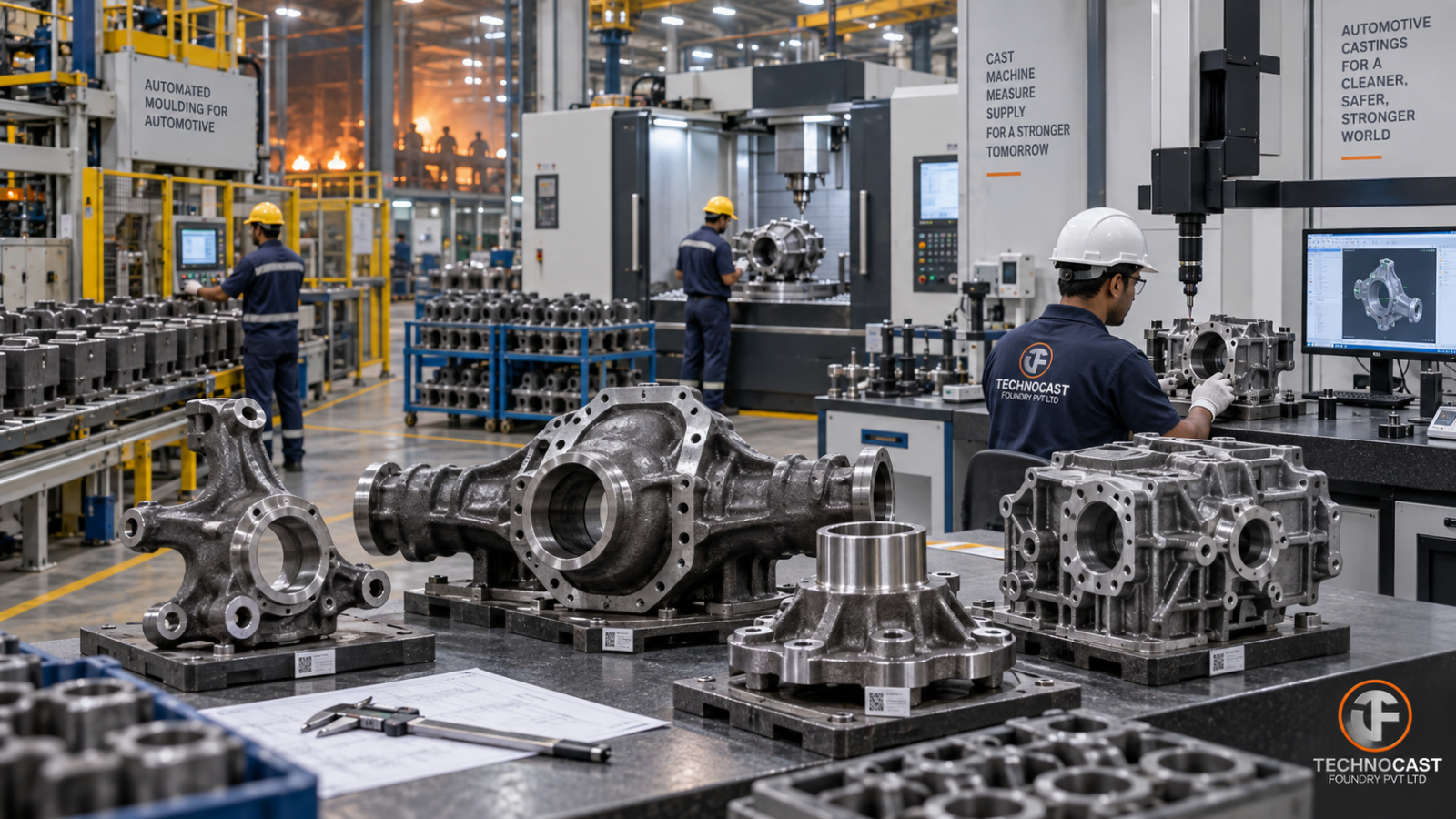
Choosing an automotive casting manufacturer is not the same as purchasing a general industrial casting.
For an automotive OEM or Tier-1 supplier, a casting supplier can directly influence:
- Vehicle safety
- Warranty exposure
- Assembly-line continuity
- Dimensional capability
- Supplier PPM
- Traceability
- Field reliability
- Launch performance
A casting that costs slightly less per piece can become significantly more expensive if unstable metallurgy, dimensional drift or poor traceability leads to containment, rework, production stoppage or field failures.
That is why automotive supplier qualification should begin with a different question.
Not:
“Who can give us the lowest casting price?”
But:
“Which supplier can repeatedly control metallurgy, casting, machining, inspection and corrective action throughout the complete production program?”
For automotive sourcing teams, the strongest supplier is therefore not necessarily the foundry with the most equipment.
It is the foundry that can demonstrate process control and repeatability with objective evidence.
This guide explains what OEM procurement teams, supplier-quality engineers and design teams should evaluate when qualifying an automotive casting manufacturer.
Why Automotive Casting Supplier Qualification Matters
Automotive castings often operate under repeated dynamic loading.
A component may experience:
- Fatigue
- Vibration
- Impact
- Torque
- Thermal cycling
- Bearing loads
- Steering forces
- Suspension loading
At the same time, thousands—or sometimes hundreds of thousands—of parts must remain dimensionally and metallurgically consistent.
That creates two requirements.
The casting must perform technically.
And the manufacturing process must remain stable statistically.
A good first sample is not enough.
The supplier must demonstrate that the process can repeatedly produce acceptable parts after:
- Tool wear
- Production ramp-up
- Operator changes
- Furnace cycles
- Pattern maintenance
- Machining-fixture wear
- Long production runs
This is why automotive quality systems place strong emphasis on:
- APQP
- PPAP
- FMEA
- Control Plans
- MSA
- SPC
- Traceability
- Corrective action
The supplied sourcing brief makes the same point: one unstable melt, weak PPAP package or uncontrolled process window can result in containment, line stoppage or greater warranty exposure.
Common Automotive Casting Components
Automotive OEMs source a wide range of ferrous castings.
The technical requirements differ by component, but the need for process repeatability remains consistent.
Engine Mounts
Engine-mount brackets and housings may experience:
- Engine vibration
- Repeated dynamic loading
- Thermal exposure
- Mounting stress
Depending on design requirements, grey iron or higher-strength materials may be considered.
Important controls include:
- Mounting-datum position
- Machined-hole relationships
- Material hardness
- Dimensional repeatability
Gearbox and Transmission Mounts
Gearbox and transmission support components must maintain alignment while handling:
- Structural loads
- Powertrain vibration
- Shock
- Repeated load transfer
Machining datum strategy becomes particularly important where multiple mounting locations must remain positionally stable.
Suspension Brackets
Suspension components experience highly repetitive road loads.
Potential failure modes can involve:
- Fatigue
- Impact
- Crack initiation
- Bore wear
- Dimensional misalignment
For such components, material consistency and defect control become significantly more important than surface appearance.
Differential Housings
Differential and carrier housings commonly require control over:
- Bearing-seat geometry
- Bore alignment
- Concentricity
- Housing stiffness
- Machining datums
Casting and machining therefore need to be engineered together rather than treated as separate supplier responsibilities.
Steering Knuckles
Steering knuckles are among the more critical automotive components because they can experience:
- Steering forces
- Suspension loads
- Braking loads
- Fatigue
- Road impact
A supplier qualification program may therefore require stronger evidence around:
- Material properties
- Nodularity or microstructure
- Internal integrity
- Critical dimensions
- Machining capability
- Traceability
Axle Housings
Axle housings may require control of:
- Structural rigidity
- Bore alignment
- Concentricity
- Bearing seats
- Sealing locations
- Fatigue performance
Where sealed cavities are present, leak integrity may also become relevant.
Wheel Hubs
Wheel hubs require stable geometry around:
- Bearing interfaces
- Flange locations
- Runout
- Mounting holes
- Concentric features
The source identifies engine mounts, gearbox mounts, suspension brackets, differential housings, steering knuckles, axle housings and wheel hubs as common automotive casting RFQ families.
Material Selection for Automotive Castings
Material selection is one of the first areas where foundry competence becomes visible.
A supplier should understand not only the requested material designation but also why the component requires it.
The same basic geometry can behave very differently depending on:
- Chemistry
- Graphite structure
- Matrix
- Heat treatment
- Section thickness
- Hardness
- Microstructure
Grey Cast Iron
Common automotive grey iron grades include:
EN-GJL-250
and
EN-GJL-300
Grey iron offers useful characteristics such as:
- Vibration damping
- Good machinability
- Dimensional stability
- Cost-effective production
Potential applications include:
- Gearbox housings
- Transmission structures
- Certain brackets
- Other components where damping and stiffness are important
For automotive qualification, it is not enough for the supplier simply to state the material grade.
The OEM may require evidence relating to:
- Chemistry
- Hardness
- Microstructure
- Mechanical properties
depending on drawing and customer-specific requirements.
The supplied brief specifically identifies EN-GJL-250/300 for housings and brackets where damping and machinability are valuable.
Ductile Iron
Ductile iron is often selected where automotive components require greater:
- Strength
- Elongation
- Fatigue resistance
- Toughness
The supplied material refers to the EN-GJS-400 through EN-GJS-900 families for higher-strength structural applications.
Potential applications can include:
- Suspension brackets
- Hubs
- Differential housings
- Structural housings
- Some steering components
As specified strength increases, metallurgical control becomes increasingly important.
Important variables can include:
- Nodularity
- Nodule count
- Matrix structure
- Carbide control
- Section sensitivity
- Heat treatment
For demanding automotive applications, verification may therefore involve:
- Mechanical testing
- Hardness
- Metallography
- Microstructure analysis
according to customer requirements.
Alloy Steel and 20MnCr5
Some drivetrain and wear-related applications require an alloy material capable of being case hardened.
The supplied source identifies 20MnCr5 as one such example.
For components using a case-hardening route, the supplier evaluation should extend beyond casting or initial material production.
The complete process may need control over:
- Chemistry
- Heat-treatment recipe
- Furnace calibration
- Carburising
- Quenching
- Hardness
- Case depth
- Distortion
- Final machining
A material specification by itself does not guarantee final component performance.
Automotive Supplier Qualification: What OEMs Should Check
A robust supplier audit should evaluate the complete manufacturing system.
A polished factory tour is not enough.
The supplier should be able to show evidence that the process remains controlled.
1. Quality Management System
The first step is to review the supplier’s documented quality system.
Depending on the customer and supply tier, automotive buyers may look for:
ISO 9001:2015
and, for automotive-specific supply:
IATF 16949
where applicable or required.
IATF 16949 builds on ISO 9001 with stronger automotive emphasis on defect prevention, process control and continuous improvement.
The important point is not simply whether a certificate exists.
Verify:
- Certification scope
- Manufacturing locations covered
- Relevant processes included
- Certification validity
A certificate should not replace a process audit.
2. Automotive Core Tools
A serious automotive supplier should be familiar with the relevant Core Tools required by its customers.
These commonly include:
APQP
Advanced Product Quality Planning provides a structured approach for taking a component from design and feasibility through launch and serial production.
PPAP
Production Part Approval Process provides objective evidence that the supplier understands the design requirements and can produce conforming parts under production conditions.
PFMEA
Process Failure Mode and Effects Analysis should identify likely failure modes before they become customer problems.
For a casting operation, this may include risks related to:
- Moulding
- Core setting
- Melt chemistry
- Pouring
- Shrinkage
- Machining
- Inspection
Control Plan
The Control Plan should connect identified risks with:
- Process controls
- Inspection methods
- Frequencies
- Reaction plans
MSA
Measurement System Analysis verifies that the inspection process itself is reliable.
SPC
Statistical Process Control can help identify process drift before the output becomes nonconforming.
The supplied checklist identifies APQP, PPAP, PFMEA, Control Plans, MSA and SPC as central supplier-qualification evidence for automotive programs.
3. Traceability
Traceability is particularly important when a defect investigation begins.
The supplier should be able to trace a shipped component back through relevant production stages.
Depending on the process, traceability may include:
- Heat
- Ladle
- Melt batch
- Mould batch
- Heat-treatment lot
- Machining batch
- Inspection record
- Dispatch lot
Suppose an OEM discovers an issue on 12 components.
The supplier should not need to contain every component manufactured during the previous six months because it cannot identify the production batch.
Good traceability limits containment scope and accelerates root-cause analysis.
The source specifically calls for lot identity across melt, mould, machining and dispatch.
4. Casting and Machining Integration
Automotive components are rarely evaluated only in the as-cast condition.
Many require substantial machining.
If casting and machining are handled by unrelated suppliers, dimensional escapes can create difficult responsibility gaps.
The foundry may argue the raw casting was correct.
The machine shop may argue the machining allowance or casting datum was incorrect.
The OEM is left managing the dispute.
Integrated casting and machining can reduce this problem.
The supplier can engineer:
Casting geometry → machining allowance → datum → fixture → CNC machining → final measurement
as a single route.
Important questions include:
- Is CNC machining in-house?
- Are fixtures designed internally?
- How are tools monitored?
- Is in-process gauging used?
- How are CTQ dimensions controlled?
- How is fixture wear monitored?
The supplied audit checklist specifically highlights in-house casting and machining as a way to reduce split responsibility during dimensional nonconformance.
5. Heat-Treatment Control
Where heat treatment forms part of the manufacturing route, audit it with the same seriousness as casting.
Verify:
- Furnace capability
- Cycle control
- Calibration
- Recipes
- Batch identification
- Temperature records
- Quench control
- Distortion management
If heat treatment is subcontracted, the OEM should understand:
- Who owns the process
- How the supplier qualifies the subcontractor
- How traceability is maintained
- Who leads root-cause analysis if a failure occurs
Outsourcing does not automatically mean poor quality.
Poor process ownership does.
6. Spectrometer and Material Control
Material chemistry should be controlled at the foundry.
For iron casting, this can involve monitoring elements affecting:
- Carbon equivalent
- Graphite formation
- Nodularity
- Matrix structure
- Hardness
- Mechanical properties
Spectrometry provides an objective method of verifying chemistry before production continues.
Ask the supplier:
- How frequently is chemistry tested?
- How are results linked to heat numbers?
- What happens when chemistry approaches a control limit?
- Are corrective additions documented?
7. CMM Capability
A Coordinate Measuring Machine can provide precise verification of complex geometry.
Automotive applications may use CMM inspection for:
- PPAP layouts
- Datum relationships
- Bore position
- Hole patterns
- Flatness
- Concentricity
- GD&T features
But owning a CMM is not enough.
Evaluate:
- Calibration status
- Measurement programs
- Measurement environment
- Operator capability
- MSA/GR&R
- Reporting discipline
The supplied source includes CMM capability as an important part of dimensional PPAP and ongoing audit control.
8. Internal Integrity and NDT
Some safety-critical or highly loaded components may require additional non-destructive testing.
Depending on material and defect risk, this could include methods such as:
- Ultrasonic testing
- Magnetic-particle testing
- Radiography
- CT
The correct method should depend on:
- Component geometry
- Material
- Failure mode
- Customer specification
Do not demand every possible inspection simply because it sounds more rigorous.
Over-inspection adds cost.
The inspection plan should target actual risk.
And before qualifying a supplier, confirm which NDT methods are truly available in-house and which are externally controlled.
9. Process Engineering Capability
One of the clearest differences between a basic foundry and an automotive-capable supplier is process engineering discipline.
Ask how the supplier determines:
- Gating
- Risering
- Feeding
- Core design
- Moulding parameters
- Pouring temperature
- Machining allowance
Where casting simulation is used, it can help engineers assess:
- Solidification
- Hot spots
- Shrinkage risk
- Feeding behaviour
Simulation itself does not guarantee a good casting.
It becomes valuable when simulation results feed into:
- Tooling
- PFMEA
- Control Plans
- Trials
- Lessons learned
10. Process Capability: Cp and Cpk
Automotive production requires more than passing individual dimensions.
For critical characteristics, OEMs may expect process-capability data.
Cp and Cpk help answer:
Is the process stable enough to repeatedly produce within tolerance?
A supplier should be able to discuss:
- CTQ dimensions
- Sample size
- Capability results
- Control limits
- Reaction plans
Be cautious if a supplier only shows final inspection reports but cannot provide evidence of process stability.
11. Defect PPM
Supplier PPM is another useful performance indicator.
But there is no single PPM target that is universally correct for every automotive casting.
Targets depend on:
- Component criticality
- OEM requirements
- Supply tier
- Program maturity
A useful qualification discussion should therefore include actual:
- Historical PPM
- Trend
- Major defect categories
- Containment history
- Corrective actions
rather than accepting a marketing claim that the supplier operates at an arbitrary PPM number.
12. Corrective Action and 8D Discipline
Every manufacturing process can experience nonconformance.
The real supplier-quality question is what happens next.
Evaluate whether the supplier can execute:
- Immediate containment
- Root-cause analysis
- Corrective action
- Verification of effectiveness
- Lessons learned
For automotive programs, 8D discipline is often an important indicator of responsiveness.
Ask for anonymised examples where permitted.
A good response should show more than:
“Operator was retrained.”
It should identify the actual process failure and systemic corrective action.
13. Capacity and Production Continuity
A technically capable foundry can still become a bad automotive supplier if capacity planning is weak.
Audit constraints around:
- Melting
- Moulding
- Core making
- Fettling
- Heat treatment
- CNC machining
- Inspection
Ask what happens when a critical machine fails.
Evaluate:
- Preventive maintenance
- Spare parts
- Backup equipment
- Alternate routing
- Multi-skilled manpower
- Capacity headroom
The supplied checklist explicitly includes bottleneck planning, preventive maintenance and business-continuity controls.
Automotive Casting Supplier Red Flags
Certain behaviours should immediately trigger deeper investigation.
Certification Without Process Evidence
A certificate displayed in reception does not prove process maturity.
Check whether the real production documents support the claimed system.
Generic PFMEA and Control Plans
If the PFMEA looks copied from another product and does not correspond to the actual manufacturing process, the document has little value.
Weak Traceability
If personnel cannot connect a finished component to its production heat or machining batch quickly, containment becomes difficult.
Outsourced Critical Processes With No Ownership
Subcontracting can work.
But the supplier should know exactly:
- Who controls the process
- What audits are performed
- How records are retained
- Who owns corrective action
Weak Metrology
Warning signs include:
- No CMM where required
- Expired calibration
- No GR&R
- Inconsistent measurement methods
- Manual inspection without clear control
Refusal to Share Capability Data
An OEM does not need access to every confidential factory metric.
But an automotive supplier should be comfortable discussing:
- Cp/Cpk
- PPM
- Control methodology
- Corrective-action performance
Poor Communication
A technically good supplier with slow information flow can still create serious automotive supply risk.
During an actual containment event, the OEM needs fast information.
The supplied source identifies many of these same warning signs, including weak Core Tools evidence, poor traceability, uncontrolled outsourced operations, thin metrology and reluctance to share capability data.
Why India Is an Important Automotive Casting Sourcing Base
India has developed one of the world’s significant automotive and engineering manufacturing ecosystems.
Its advantages extend beyond labour cost.
Established Automotive Supply Chain
The country has:
- Vehicle OEMs
- Tier-1 suppliers
- Machine shops
- Foundries
- Forging companies
- Heat-treatment suppliers
- Tooling companies
- Testing laboratories
This manufacturing density can support complex supply chains.
Engineering Talent
Automotive sourcing requires:
- Metallurgical engineering
- Tooling
- Process engineering
- CNC programming
- Quality engineering
India has a broad engineering base supporting these functions.
Export Experience
Automotive and component manufacturers increasingly serve international markets.
That creates familiarity with:
- Export documentation
- Packaging
- International material standards
- PPAP
- Customer-specific requirements
The supplied material cites ACMA figures indicating India’s automotive-component industry reached approximately ₹6.73 lakh crore (USD 80.2 billion) in FY2024–25, with exports around USD 22.9 billion.
For an OEM, however, India’s manufacturing scale should not replace proper qualification.
Every supplier still needs to prove capability at the plant and process level.
Automotive Casting RFQ Checklist
Before requesting a serious quotation, provide the casting supplier with sufficient engineering information.
Include:
Drawing
Use the latest controlled revision.
3D Model
Where available.
Material Grade
For example:
- EN-GJL-250
- EN-GJL-300
- EN-GJS-400 series
- Higher-strength EN-GJS grade where required
Avoid vague terminology such as only:
“Cast iron.”
Single-Piece Weight
Provide expected raw and/or machined weight.
Annual Volume
This affects:
- Moulding route
- Tooling
- Automation
- Capacity planning
Lifetime Volume
This helps calculate tooling economics.
Machining Requirements
Clearly identify:
- Bores
- Bearing seats
- Datum surfaces
- Threads
- Sealing faces
- GD&T
CTQ Characteristics
Identify characteristics that directly influence:
- Safety
- Assembly
- Performance
Inspection Requirements
Define required:
- Chemistry
- Hardness
- Mechanical properties
- Microstructure
- CMM
- NDT
PPAP Level
State the customer’s required documentation.
Capacity Requirements
Include:
- SOP date
- Ramp profile
- Peak monthly volume
Packaging
For export or production-line supply, define:
- Packaging
- Rust prevention
- Labelling
- Lot identification
This lets the supplier quote the real production requirement rather than pricing an incomplete drawing.
How to Audit an Automotive Casting Manufacturer
A practical supplier qualification can be divided into four stages.
Stage 1: Documentation Review
Before travelling to the plant, request:
- Quality certificates
- Process flow
- Equipment list
- Material capability
- Inspection capability
- Core Tools samples
- Capacity information
This eliminates suppliers that clearly do not match the program.
Stage 2: Process Audit
At the foundry, follow the component’s actual manufacturing route.
Start from:
Raw material
then review:
Melting
Chemistry
Moulding
Core making
Pouring
Fettling
Heat treatment
Machining
Inspection
Packing
Do not conduct the audit only from the conference room.
Stage 3: Trial and PPAP
Validate the component under realistic production conditions.
Evaluate:
- Dimensions
- Metallurgy
- Process stability
- Capacity
- Documentation
Stage 4: Serial Production Monitoring
Supplier qualification does not stop at PPAP approval.
Monitor:
- PPM
- Delivery
- Capability
- Corrective actions
- Engineering changes
- Process changes
The objective is stable serial production, not simply a successful launch.
Evaluating Technocast Foundry for Automotive Casting Programs
Technocast Foundry Pvt. Ltd. should be evaluated using the same supplier-development discipline described above.
Rather than relying on broad claims, an OEM or Tier-1 sourcing team should review Technocast’s actual evidence around:
- Foundry process capability
- Material control
- In-house machining
- CMM inspection
- Spectrometry
- Applicable NDT capability
- Heat-treatment control
- Traceability
- Quality certification
- Capacity
- PPAP readiness
- Historical quality data
- Corrective-action performance
Where Technocast controls both casting and machining, the potential advantage is single-source accountability.
Casting and machining problems can be investigated under one manufacturing responsibility instead of creating a supplier-to-supplier dispute.
The supplied brief specifically positions this integrated casting + machining approach as valuable for faster containment and root-cause resolution.
For an automotive qualification program, procurement and supplier-quality teams should request objective evidence such as:
- Current quality certificates
- Process flow
- Control Plan examples
- PFMEA examples
- PPAP sample documentation
- CMM capability
- Chemistry-control records
- Traceability example
- Cp/Cpk for relevant CTQs
- Supplier PPM trend
- 8D examples
- Capacity data
That provides a much stronger basis for qualification than marketing claims alone.
Conclusion
Choosing an automotive casting manufacturer is fundamentally a process-risk decision.
The supplier must do more than produce a dimensionally acceptable casting once.
It must repeatedly control:
Metallurgy
Moulding
Heat treatment
Machining
Measurement
Traceability
Corrective action
throughout the production life of the program.
For automotive sourcing teams, the strongest qualification process therefore evaluates:
- Quality system
- Core Tools capability
- Material control
- Casting process capability
- CNC machining
- Metrology
- NDT where required
- Cp/Cpk
- PPM
- Traceability
- 8D response
- Capacity
- Business continuity
The result should not simply be an approved foundry.
It should be a supplier capable of supporting stable SOP, serial production and long-term quality performance.
Request Technocast’s Automotive Supplier-Qualification Information
If you are evaluating Technocast Foundry Pvt. Ltd. for an automotive casting program, send:
- Component drawing
- Material grade
- Single-piece weight
- Annual volume
- SOP timing
- Machining requirements
- CTQ characteristics
- PPAP requirements
- Inspection requirements
and request the corresponding manufacturing feasibility and supplier-qualification documentation for your program.
Frequently Asked Questions
What should I check before approving an automotive casting supplier?
Evaluate its quality system, metallurgy, moulding capability, machining, traceability, metrology, Core Tools implementation, capacity and corrective-action process. Do not approve based only on price and certification.
Is ISO 9001 enough for an automotive casting supplier?
It depends on the customer’s requirements and supply tier. Many automotive programs require or strongly prefer IATF 16949 and automotive Core Tools. The specific OEM or Tier-1 customer requirement should govern supplier qualification.
What is PPAP for automotive castings?
PPAP provides evidence that the supplier understands the component requirements and can manufacture conforming parts under production conditions. It may include dimensional results, material evidence, process documentation and capability data depending on the required level.
Why is traceability important in automotive castings?
Traceability allows a supplier to connect a nonconforming component to relevant melt, moulding, heat-treatment, machining and inspection records. This improves root-cause analysis and limits unnecessary containment.
Why is in-house CNC machining valuable for a foundry?
It allows machining allowances, datums, fixtures and final dimensions to be controlled together with the casting process. This reduces supplier handoffs and helps establish clearer responsibility for final component quality.
What automotive parts are commonly produced as ferrous castings?
Examples can include engine and gearbox housings or mounts, suspension brackets, differential housings, steering components, axle housings and wheel hubs, depending on the specific design and material requirement.
Should automotive casting suppliers have CMM capability?
For components containing complex CTQ dimensions or GD&T requirements, CMM capability can be highly valuable for PPAP, dimensional verification and ongoing audits.
What should I send when requesting an automotive casting quotation?
Provide the drawing, 3D model where available, material grade, single-piece weight, annual and lifetime volume, machining requirements, CTQs, inspection requirements, PPAP expectations and SOP timing.
Related at Technocast: Automotive castings · Quality and certifications
Read next: Gearbox and differential housing castings · What to look for in an export-oriented foundry