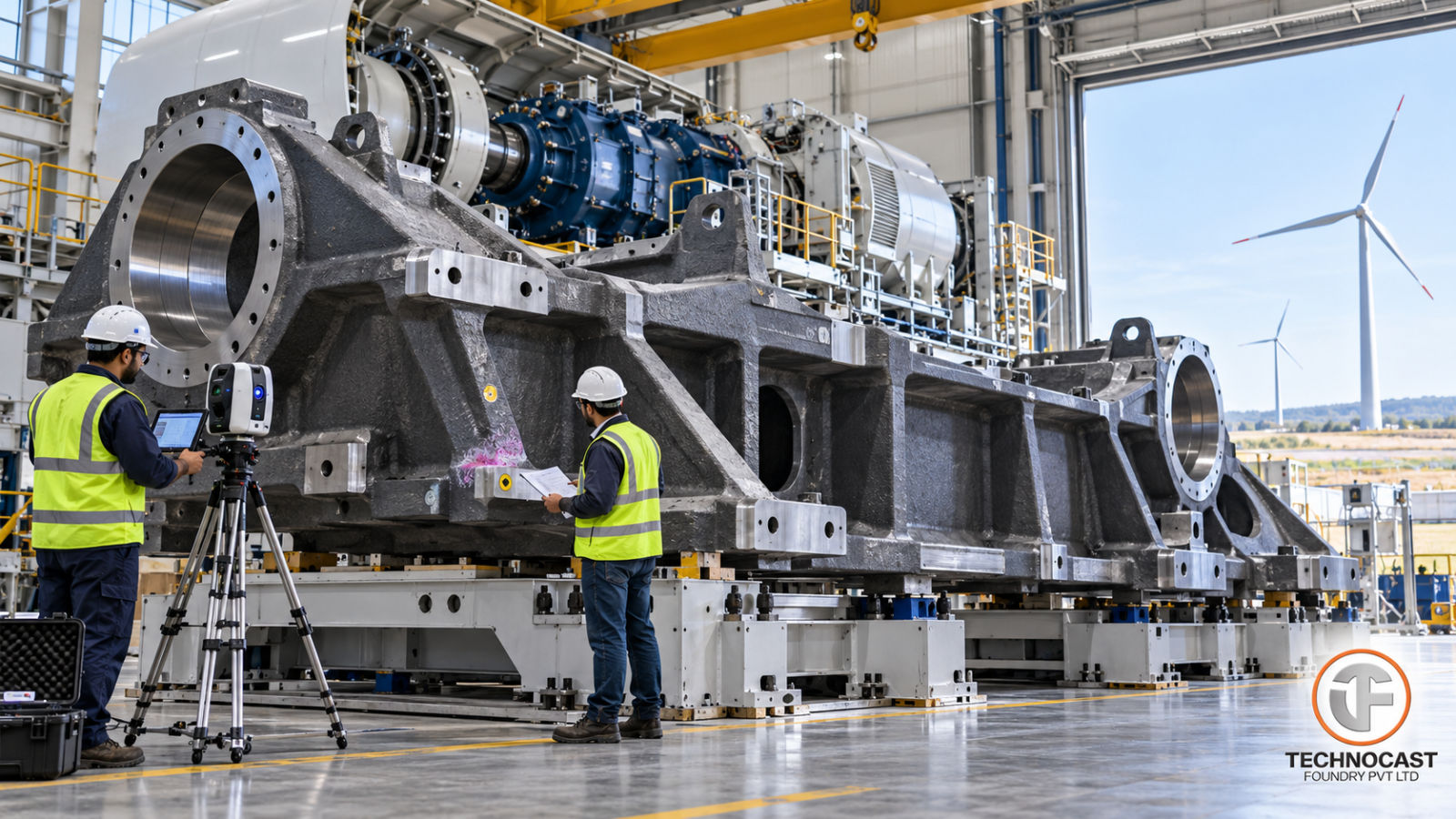
Wind-turbine castings do not fail because they look imperfect.
They fail when decades of torque, bending, vibration and cyclic loading expose weaknesses that were already present in the material or manufacturing process.
For a wind OEM, a main frame or nacelle structural casting may spend years carrying drivetrain loads while maintaining the alignment of bearings, shafts and mounting interfaces.
That places far greater importance on:
- Heavy-section metallurgy
- Graphite nodularity
- Solidification control
- Dimensional stability
- Machining accuracy
- Non-destructive testing
- Traceability
than on the simple question:
“Can the foundry pour a casting of this weight?”
For procurement and engineering teams evaluating a wind energy casting supplier in India, the more important question is:
Can the supplier repeatedly produce the required metallurgy, internal integrity and machined geometry at serial-production scale?
That is where wind casting sourcing becomes a process-capability decision rather than a kilogram-price comparison.
What Cast Components Are Used in Wind Turbines?
Wind turbines contain several large structural components that can be produced in ductile iron depending on turbine architecture and OEM design.
Typical casting families include:
- Main frames
- Bedplates
- Nacelle structural housings
- Bearing supports
- Torque arms
- Trunnions
- Structural brackets
- Hub-adjacent structural components
These components combine three manufacturing challenges:
Heavy sections
which create metallurgical and solidification challenges.
High machining content
because drivetrain alignment depends on precisely controlled interfaces.
Fatigue-sensitive service
where small defects can become significant over millions of load cycles.
The supplied research identifies main frames, nacelle structures, bearing supports, torque arms, trunnions and other load-transfer castings as key wind component families.
Main Frames and Bedplates
The main frame or bedplate forms a structural foundation within the turbine nacelle.
Depending on turbine design, it may support or locate:
- Gearbox structures
- Main bearings
- Generator-related interfaces
- Drivetrain supports
- Yaw-related structures
- Other nacelle equipment
The engineering challenge is not simply strength.
The casting must maintain geometry while transmitting significant static and cyclic loads.
Critical concerns can include:
- Bearing alignment
- Flatness
- Bore location
- Mounting-face relationships
- Fatigue
- Thick-section soundness
- Residual stress
A casting that moves dimensionally after machining can create a drivetrain alignment problem even if its material certificate is acceptable.
Nacelle Housings and Bearing Supports
Bearing-support castings require particular attention to dimensional stability.
Bearing seats and mounting datums form part of an alignment chain.
Variation in those features can influence:
- Bearing load distribution
- Shaft alignment
- Vibration
- Gearbox interaction
- Long-term drivetrain reliability
For this reason, machining and dimensional verification should be considered during casting development rather than added after the casting design has already been frozen.
Torque Arms, Trunnions and Structural Brackets
These components often experience repeated cyclic loading.
The highest-risk areas can include:
- Fillets
- Boss transitions
- Lug regions
- Machined interfaces
- Thick-to-thin section transitions
A small internal discontinuity positioned in a low-stress region may have a very different engineering significance from the same discontinuity positioned in a high-cycle load path.
This is why wind casting inspection needs to be based on component criticality and load path, not simply a universal inspection rule.
Why Ductile Iron Is Used for Wind Castings
Ductile—or spheroidal graphite—iron offers a useful combination of:
- Castability
- Strength
- Elongation
- Damping
- Machinability
- Fatigue performance
The graphite exists mainly as spheroidal nodules rather than flakes.
This provides very different mechanical behaviour from conventional grey iron.
For wind structures, the supplied research focuses particularly on two EN 1563 material families:
EN-GJS-400-18
and
EN-GJS-500-7.
The correct choice depends on the component’s actual loading and toughness requirements.
EN-GJS-400-18
EN-GJS-400-18 is a relatively ductile spheroidal graphite iron grade.
The supplied source references approximately:
- 400 MPa minimum tensile strength
- 250 MPa yield strength
- 18% minimum elongation
for the applicable conditions described in the source.
The material typically has a predominantly ferritic structure.
This combination makes the grade relevant where:
- Ductility
- Toughness
- Impact margin
- Fatigue behaviour
are important.
Low-temperature requirements also need particular attention for wind-energy installations located in colder climates.
The exact impact requirement and test temperature should be specified according to the relevant material and OEM specification rather than assumed from the general grade designation alone.
EN-GJS-500-7
EN-GJS-500-7 shifts the balance further toward strength.
The supplied source references approximately:
- 500 MPa minimum tensile strength
- 320 MPa minimum yield strength
- 7% minimum elongation
with a ferritic-pearlitic matrix commonly associated with the grade.
This can make it relevant to higher-stress structural regions where more strength is required while retaining useful ductility and castability.
But higher tensile strength does not automatically mean a better wind casting.
The correct grade needs to consider:
- Fatigue
- Impact
- Section thickness
- Temperature
- Machinability
- Heat treatment
- Component geometry
Heavy-Section Metallurgy Changes the Discussion
One of the biggest mistakes in large casting sourcing is assuming that a material-property table tells the entire story.
A wind casting can contain substantial variation in section thickness.
Thin ribs and very heavy structural nodes do not cool at the same rate.
That influences:
- Graphite morphology
- Nodule count
- Ferrite/pearlite balance
- Carbide formation
- Mechanical properties
The question is therefore not simply:
“Is this EN-GJS-400-18?”
It is:
“Can this foundry achieve the required properties in the actual section thicknesses present in my casting?”
Nodularity Control
Ductile iron depends on graphite forming predominantly as nodules.
Poor nodularity can affect:
- Strength
- Elongation
- Fatigue behaviour
- Material consistency
A wind-casting control plan may therefore include reporting for:
- Nodularity
- Nodule count
- Matrix structure
- Carbides where relevant
- Mechanical properties
The supplied research cites 80% nodularity as one commonly referenced quality objective.
That number should not automatically be copied into every wind-casting drawing.
The actual acceptance requirement and measurement method should follow the OEM’s applicable specification and Quality Assurance Plan.
Melt Control
Achieving a ductile-iron grade consistently begins before pouring.
Important controls can include:
- Charge materials
- Chemistry
- Magnesium treatment
- Inoculation
- Pouring temperature
- Holding time
- Treatment fade
- Heat identification
An in-house spectrometer can provide chemistry verification.
For large wind components, however, chemistry results should form part of a larger metallurgical system that also confirms the resulting microstructure and mechanical properties.
Solidification Control in Large Wind Castings
Large structural castings create significant solidification challenges.
Heavy regions remain hot longer than thinner sections.
That can create:
- Hot spots
- Shrinkage risk
- Micro-porosity
- Metallurgical variation
- Residual stress
Foundry engineering therefore needs to evaluate:
- Gating
- Feeding
- Risering
- Section transitions
- Chills where applicable
- Core strategy
- Cooling behaviour
Casting simulation can be particularly valuable in this type of component because the cost of discovering a major feeding problem after tooling and trial production can be substantial.
Simulation does not replace actual process validation.
It helps engineering teams identify potential risk before physical trials begin.
Weight Capacity Is Only the First Question
Foundry brochures often highlight maximum casting weight.
That information matters—but only as an initial screening point.
The supplied Technocast research discusses a casting capability of approximately up to 1,500 kg for this type of sourcing program.
For an OEM, the next questions are more important:
Can the foundry achieve the required metallurgy at that weight?
Can it manage heavy-section feeding?
Can the casting remain stable through heat treatment?
Is sufficient machining allowance available?
Can the component be fixtured and machined accurately?
Can critical regions be inspected effectively?
Maximum pouring weight is not the same as demonstrated process capability.
Casting Tolerances and Machining Allowance
Large wind components should not be treated like fully machined parts while still in the mould.
Casting tolerances and final machining tolerances serve different purposes.
Standards such as ISO 8062-3 can provide a framework for discussing dimensional tolerances and machining allowances.
The supplied research cites CT8–CT10 as a typical planning range for some large ductile-iron sand castings.
This should be treated as design guidance rather than a universal Technocast capability.
The correct tolerance grade depends on:
- Casting process
- Size
- Geometry
- Tooling
- Supplier capability
- Specific feature
A better approach is to classify features.
As-Cast Geometry
Use realistic casting tolerances.
Machined Interfaces
Apply the final precision required for:
- Bearing seats
- Mounting faces
- Bores
- Locating datums
- Drivetrain interfaces
Machining Allowance
Provide enough stock to account for casting variation and subsequent processing without adding unnecessary material.
Datum Strategy Should Begin at Casting Development
For a large wind casting, datum planning cannot begin only when the component reaches the machine shop.
The foundry and machining teams should align on:
- Casting location features
- Rough-machining datums
- Final datums
- Fixture strategy
- Distortion expectation
- Inspection strategy
A poor datum strategy can turn an otherwise acceptable casting into a difficult and expensive machining program.
This is one of the reasons integrated foundry + CNC manufacturing can be valuable for large OEM components.
Residual Stress and Dimensional Stability
Large castings can contain residual stresses created by non-uniform cooling.
Those stresses may become visible only after material is removed during machining.
Possible symptoms include:
- Bore movement
- Loss of flatness
- Twisting
- Datum shift
Where the engineering route requires it, stress-relief or other heat-treatment operations may therefore be considered.
But heat treatment itself can also introduce dimensional movement.
The complete route should therefore be planned as:
Casting → Heat treatment where required → Rough machining → Stability verification → Finish machining → Final inspection
rather than treating each process separately.
NDT for Wind-Turbine Castings
Wind components are fatigue-sensitive, so inspection needs to target the defects that matter.
A strong Quality Assurance Plan may combine multiple methods.
The supplied research identifies visual testing, magnetic particle inspection, ultrasonic testing, CMM inspection and heat/lot traceability as important controls for large wind components.
Visual Testing
Visual inspection remains a fundamental first step.
It can identify:
- Surface discontinuities
- Improper finishing
- Obvious mould-related defects
- Damage
It can also prepare the component for additional inspection.
Magnetic Particle Inspection
MPI can be useful on suitable ferromagnetic castings for identifying surface and near-surface indications.
Potential focus regions can include:
- Structural fillets
- Lugs
- Machined transitions
- Highly stressed interfaces
The exact scope and acceptance criteria need to be defined in the OEM’s QAP.
Ultrasonic Testing
UT can help evaluate internal discontinuities in suitable thick sections.
For a large wind casting, simply writing:
“100% UT”
may not be sufficiently informative.
A better inspection specification can define:
- Critical zones
- Scan coverage
- Method
- Calibration
- Acceptance criteria
- Reporting/map requirements
Inspection effort can then be concentrated around engineering risk.
CMM and Dimensional Verification
Dimensional inspection becomes particularly important around drivetrain interfaces.
Typical requirements can include:
- Bore position
- Flatness
- Coaxiality
- Datum relationships
- Mounting-face geometry
- Positional tolerances
For very large components, the metrology strategy may involve CMM or other suitably validated large-component measurement methods depending on component size.
The objective is the same:
prove the functional geometry objectively.
Traceability
Traceability is particularly important for long-life energy components.
A finished casting should be linkable to relevant manufacturing information.
Depending on OEM requirements, that may include:
- Heat number
- Chemistry
- Mg treatment
- Inoculation
- Test coupon
- Mechanical properties
- Microstructure
- Heat treatment
- NDT reports
- Final dimensional inspection
If a field issue occurs years later, this production history becomes far more valuable than a generic certificate.
How Wind OEMs Should Qualify an Indian Foundry
Successful supplier qualification should prove repeatability, not simply produce one successful first article.
A useful process can include the following stages.
1. Confirm Material Capability
Ask:
- Which EN-GJS grades are routinely produced?
- What section thicknesses have been validated?
- How is nodularity measured?
- How is microstructure reported?
- What mechanical testing is performed?
2. Audit Melt Treatment
Review:
- Mg treatment
- Inoculation
- Chemistry
- Treatment timing
- Spectrometer records
- Reaction plans
Ask what happens when results move outside control limits.
3. Review Gating and Feeding Engineering
The supplier should be able to explain how the component will solidify.
Review:
- Hot spots
- Feeding
- Risers
- Section transitions
- Simulation where used
4. Review Heat Treatment
Where applicable, evaluate:
- Furnace capability
- Cycle control
- Calibration
- Batch identification
- Distortion management
5. Evaluate Machining Capability
For large wind structures, machining is often a major part of final component value.
Audit:
- Machine envelope
- Fixture strategy
- Datum planning
- Machining sequence
- In-process inspection
- Final dimensional verification
6. Review NDT
Confirm the relevant:
- UT
- MPI
- Visual testing
capabilities according to your QAP.
Ask about:
- Personnel qualification
- Calibration
- Coverage
- Reporting
- Acceptance criteria
7. Review Documentation
Depending on the OEM program, request documentation such as:
- Material certificates
- Dimensional reports
- Microstructure reports
- Nodularity reports
- NDT reports
- Control Plan
- PFMEA
- First Article Inspection
The source proposes a PPAP/FAI-style documentation approach even where conventional automotive PPAP is not formally required.
Why Source Wind Castings From India?
India has a large ferrous-casting manufacturing ecosystem.
The potential advantages for wind OEMs include:
- Foundry capacity
- Ductile-iron expertise
- Engineering talent
- CNC machining ecosystem
- Export experience
- Competitive conversion economics
But these advantages should be treated as supplier-discovery benefits, not automatic supplier approval.
An OEM should still qualify the individual plant.
The Coimbatore Manufacturing Ecosystem
Coimbatore and the wider Tamil Nadu industrial belt have a dense engineering manufacturing base.
For a casting buyer, proximity between:
- Tooling
- Foundry production
- Machining
- Inspection
- Finishing
- Engineering services
can help reduce unnecessary supply-chain interfaces.
The source specifically positions Coimbatore as a relevant cluster for foundry + machining coordination.
The real value, however, depends on how much of that process the selected supplier actually controls.
Evaluating Technocast Foundry for Wind Casting Programs
The supplied Technocast information identifies capabilities relevant to large ductile-iron programs, including:
- Ductile iron
- High-pressure moulding
- Heat treatment
- CNC machining
- CMM inspection
- Spectrometry
- Ultrasonic testing
- Export supply
The supplied material also refers to castings up to approximately 1,500 kg for relevant applications.
For a wind OEM, these capabilities should form the beginning of the qualification process—not the end.
For the actual casting, request evidence covering:
- Material grade
- Component weight
- Moulding route
- Heavy-section metallurgy
- Heat treatment
- Machining capacity
- NDT scope
- Dimensional inspection
- Traceability
For certifications or wind-specific approvals, request Technocast’s current official certification package rather than assuming availability from a general capability statement.
Wind Casting RFQ Checklist
When requesting a quotation for a wind casting, provide:
Component Drawing
Latest controlled revision.
3D Model
Where available.
Material Grade
For example:
- EN-GJS-400-18
- EN-GJS-500-7
or the exact OEM-specified grade.
Impact Requirements
Where applicable, define:
- Temperature
- Minimum impact performance
- Test method
Component Weight
Provide expected raw and finished weight.
Annual Volume
Include expected ramp-up and peak requirements.
Critical Sections
Identify areas where heavy-section properties or fatigue are important.
Machining Requirements
Clearly identify:
- Bores
- Bearing seats
- Mounting faces
- Datums
- Critical GD&T
Microstructure Requirements
Define any required:
- Nodularity
- Nodule count
- Ferrite/pearlite balance
according to the applicable specification.
NDT
Define:
- Method
- Area
- Coverage
- Acceptance criteria
Dimensional Inspection
Specify critical features requiring CMM or equivalent validated measurement.
Traceability
Define required heat/lot or serial-level records.
Conclusion
Large wind-turbine castings are long-life structural components.
Their reliability depends on far more than meeting nominal tensile strength.
A robust manufacturing route needs to control:
Melt chemistry
Graphite nodularity
Heavy-section microstructure
Solidification
Residual stress
Machining
NDT
Dimensional alignment
Traceability
For procurement teams, that changes the supplier-selection question.
Do not ask only:
“How many kilograms can you pour?”
Ask:
“Can you repeatedly prove that a large ductile-iron casting has the metallurgy, internal integrity and machined geometry required for decades of cyclic service?”
That is the standard a wind-energy casting supplier should be qualified against.
Request a Wind Casting Technical Review
For a new or re-sourced wind-energy component, send Technocast:
- Drawing
- Material grade
- Single-piece weight
- Annual volume
- Critical load/inspection requirements
- Machining requirements
- NDT requirements
- Documentation requirements
The component can then be reviewed for manufacturability, moulding route, tooling, metallurgy, machining and inspection before production tooling is released.
Frequently Asked Questions
Which ductile-iron grades are commonly considered for wind castings?
EN-GJS-400-18 and EN-GJS-500-7 are among the grades discussed for structural ductile-iron applications, depending on required strength, ductility, toughness, section thickness and temperature.
Why is nodularity important in wind-turbine castings?
Graphite morphology directly affects ductile-iron mechanical behaviour. Poor nodularity can reduce strength, elongation and fatigue performance.
Why are heavy wind castings difficult to manufacture?
Large components contain varying section thicknesses that cool differently. This creates challenges around solidification, shrinkage, microstructure, residual stress and dimensional stability.
Why is UT important for wind castings?
UT can help detect internal discontinuities in suitable heavy sections and fatigue-sensitive load paths.
Why is CMM inspection important?
Bearing seats, mounting faces, bores and drivetrain datums need controlled positional relationships. Accurate dimensional inspection helps protect the drivetrain alignment chain.
Is the highest-strength ductile iron always better?
No. Higher strength may come with lower elongation or different microstructural requirements. The material should be selected according to actual fatigue, impact, temperature and design requirements.
What information should a wind OEM send for an RFQ?
Provide the drawing, material grade, weight, annual volume, machining details, microstructure requirements, NDT requirements, dimensional inspection requirements and required documentation.
Related at Technocast: Wind energy castings · No Bake line for castings up to 1,500 kg
Read next: What to look for in an export-oriented foundry · Iron casting types and grades